Introduction: A Decade of Grief and a Demand for Justice
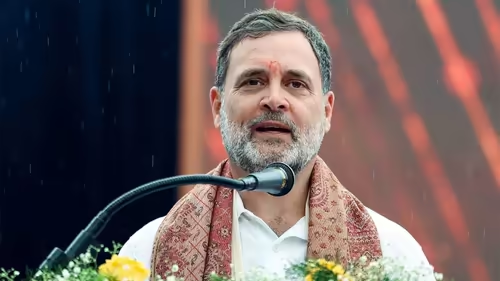
Ten years after the suicide of Hyderabad Central University scholar Rohith Vemula, his mother’s tears have not dried. His story—a poignant symbol of the deep-seated caste discrimination that persists in modern India—continues to haunt the nation’s conscience. On this somber anniversary, Congress leader Rahul Gandhi stood before a crowd and issued a powerful demand: India needs a dedicated anti-discrimination law .
This call isn’t just a policy suggestion; it’s a direct challenge to the current government and a rallying cry for marginalized communities. But in the charged atmosphere of Indian politics, every statement is scrutinized for its intent. Is this a genuine, long-overdue push for social justice, or a strategic maneuver to reclaim political ground? The answer matters deeply for millions of Indians who face daily prejudice.
Table of Contents
- The Rohith Vemula Tragedy: A Brief Recap
- Rahul Gandhi’s Proposal: What Would the Law Entail?
- The Legal Void: India Lacks a Comprehensive Framework
- Political Context: Is This a Policy or a Ploy?
- Global Precedents: What Can India Learn?
- Conclusion: The Path Forward for Social Justice
- Sources
The Rohith Vemula Tragedy: A Brief Recap
In January 2016, Rohith Vemula, a 26-year-old Dalit PhD student, took his own life at the University of Hyderabad. His suicide note, which read “My birth is my fatal accident,” became a national sensation, sparking massive protests across the country .
Vemula and four other students had been suspended from the university following a politically charged dispute with a right-wing student group. They were accused of assaulting a rival student, a charge they denied. The subsequent withdrawal of their hostel accommodations and monthly stipends left them in a state of social and financial isolation, which many believe was the final straw.
The case exposed the ugly reality of caste-based discrimination within India’s premier educational institutions, where meritocracy is often a myth for those from marginalized backgrounds.
Rahul Gandhi’s Proposal: What Would the Law Entail?
Rahul Gandhi’s call for an anti-discrimination law is a direct response to cases like Vemula’s. While he hasn’t released a detailed draft, the implication is clear: India needs a single, robust piece of legislation that explicitly prohibits discrimination on the grounds of caste, religion, gender, sexual orientation, and ethnicity in all spheres of public life—including education, employment, and housing.
Such a law would likely include provisions for:
- Clear Definitions: Establishing a legal definition of what constitutes discrimination and harassment.
- Strong Penalties: Imposing significant fines and potential jail time for individuals and institutions found guilty.
- Dedicated Enforcement Body: Creating an independent commission to investigate complaints and ensure compliance.
The Legal Void: India Lacks a Comprehensive Framework
While India has laws that address specific forms of discrimination—like the Scheduled Castes and Scheduled Tribes (Prevention of Atrocities) Act—the legal landscape is fragmented. There is no overarching law that protects all citizens from all forms of bias in their daily lives.
For instance, a person from a minority religion facing housing discrimination or a woman being denied a job due to her gender has limited legal recourse. The existing system is reactive and piecemeal, often failing to provide timely justice. An anti-discrimination law would fill this critical gap, creating a proactive shield for every citizen .
Political Context: Is This a Policy or a Ploy?
Cynics will point out that this announcement comes at a time when the Congress party is seeking to rebuild its base among Dalits, minorities, and other marginalized groups. By championing a cause so deeply tied to social justice, Rahul Gandhi is attempting to position himself and his party as the true defenders of India’s constitutional values against a backdrop of rising majoritarianism.
However, dismissing the proposal as purely political would be a mistake. The need for such a law has been advocated by civil society groups, legal experts, and human rights organizations for decades. The Sachar Committee report (2006) and the Ranganath Misra Commission report (2007) both recommended the creation of a comprehensive equality law, but these recommendations were never implemented .
Global Precedents: What Can India Learn?
India wouldn’t be starting from scratch. Many democracies have successful models:
- United Kingdom: The Equality Act 2010 consolidates over 100 pieces of legislation into one powerful law, protecting against discrimination based on nine “protected characteristics.”
- South Africa: The Promotion of Equality and Prevention of Unfair Discrimination Act, 2000, is a cornerstone of the post-apartheid legal framework, known for its broad scope and strong enforcement mechanisms.
These examples show that a well-crafted anti-discrimination law can be a powerful tool for building a more just and equitable society. For more on global human rights frameworks, see our analysis on [INTERNAL_LINK:global-human-rights-legislation].
Conclusion: The Path Forward for Social Justice
Rahul Gandhi’s call for an anti-discrimination law on the anniversary of Rohith Vemula’s death is both a memorial and a manifesto. Whether driven by pure idealism or political pragmatism, the core demand is valid and urgent. India’s democracy is incomplete as long as its citizens are not equally protected from prejudice and bias.
The real test will be whether this call translates into concrete action, cross-party dialogue, and ultimately, a law that can heal the deep wounds exposed by tragedies like Vemula’s. The nation’s conscience, and its future, depend on it.
Sources
- Times of India: Need law to fight discrimination, says Rahul on Vemula anniversary
- The Hindu: Rohith Vemula suicide case: A timeline
- Centre for Law and Policy Research: Reports on Equality and Non-Discrimination in India
- Ministry of Minority Affairs, India: Sachar Committee Report (2006)