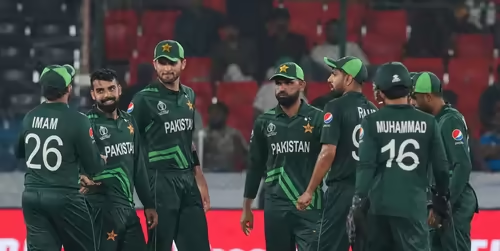
Cricket’s biggest political drama is heating up again—and this time, it’s centered on the T20 World Cup 2026. With the Pakistan Cricket Board (PCB) openly threatening to pull out of the tournament in protest over Bangladesh’s exclusion, tensions are running high. But former Indian captain Ajinkya Rahane isn’t buying it. In a scathing remark that’s gone viral, Rahane declared: “They don’t have guts.”
His blunt comment cuts to the heart of a brewing crisis that could shake the foundation of international cricket. The ICC has already issued a formal warning: if Pakistan refuses to participate, they face “severe disciplinary action”—a threat that could include suspension, fines, or even exclusion from future global events [[1]].
So what’s really going on? Is this a principled stand—or political posturing? And can Pakistan afford to walk away from the world’s most-watched T20 tournament?
Table of Contents
- Why Is Pakistan Threatening to Boycott the T20 World Cup 2026?
- ICC Issues Ultimatum: Severe Consequences Loom
- Ajinkya Rahane Doesn’t Buy It: “They Don’t Have Guts”
- The Real Stakes: For Pakistan, It’s Cricket and Politics
- What Happens If Pakistan Actually Pulls Out?
- Conclusion: A High-Stakes Game of Chicken
- Sources
Why Is Pakistan Threatening to Boycott the T20 World Cup 2026?
The controversy stems from the ICC’s decision to exclude Bangladesh from the upcoming T20 World Cup 2026 due to governance issues within the Bangladesh Cricket Board (BCB). While the move has drawn criticism, Pakistan has taken it upon itself to champion Bangladesh’s cause—despite having no formal obligation to do so.
According to reports, the PCB argues that excluding a Full Member nation like Bangladesh sets a dangerous precedent and undermines the spirit of international cricket [[1]]. However, many analysts see this as less about solidarity and more about regional politics and internal pressure within Pakistan.
Crucially, the final call doesn’t rest with the PCB alone. Under Pakistan’s current structure, any major international sporting decision requires approval from the federal government—a fact that turns this into a geopolitical chess match rather than a pure sporting one.
ICC Issues Ultimatum: Severe Consequences Loom
The International Cricket Council (ICC) has not remained silent. In a strongly worded statement, the global governing body warned that any team refusing to participate in an ICC event without valid justification would face “serious repercussions” under its regulations [[1]].
Historically, such actions have included:
- Heavy financial penalties
- Loss of voting rights in ICC meetings
- Suspension from international competitions
- Forfeiture of future hosting rights
For Pakistan—a nation already grappling with financial instability in its cricket board—the cost of a boycott could be catastrophic. Missing the T20 World Cup 2026 means losing crucial revenue from broadcasting rights, sponsorships, and fan engagement. More importantly, it risks isolating Pakistan from the global cricketing community at a time when unity is essential.
For context on ICC’s regulatory power, see the official ICC Regulations on member compliance.
Ajinkya Rahane Doesn’t Buy It: “They Don’t Have Guts”
Enter Ajinkya Rahane. Known for his calm demeanor on the field, the former Indian vice-captain didn’t hold back off it. Speaking at a recent event, Rahane dismissed Pakistan’s boycott threat as empty bravado.
“If they really had the courage, they’d play and prove their point on the field—not hide behind political statements,” Rahane said. “They don’t have guts.”
His words struck a chord with fans across India and beyond. Rahane’s critique isn’t just personal—it reflects a broader sentiment that using sport as a political bargaining chip harms the game itself. Cricket, after all, thrives on competition, not cancellation.
This isn’t the first time Rahane has spoken on India-Pakistan cricket dynamics. His leadership during the 2020–21 Border-Gavaskar Trophy in Australia remains legendary. Learn more about that historic series in our deep dive on [INTERNAL_LINK:india-australia-border-gavaskar-trophy-2020].
The Real Stakes: For Pakistan, It’s Cricket and Politics
Beneath the surface, Pakistan’s dilemma is deeply political. The government in Islamabad faces pressure from hardline factions to take a strong stance on regional issues. Supporting Bangladesh—especially against perceived Western or ICC overreach—plays well domestically.
Yet, the cricket-loving public in Pakistan tells a different story. Polls and social media trends show overwhelming support for participation in the T20 World Cup 2026. Fans are eager to see stars like Babar Azam and Shaheen Afridi compete on the global stage, not sidelined by bureaucratic disputes.
Moreover, a boycott would damage Pakistan’s chances of co-hosting future ICC events—a key goal for the PCB as it seeks to rebuild its international image and infrastructure.
What Happens If Pakistan Actually Pulls Out?
If Pakistan follows through, the ripple effects would be immediate:
- Group Stage Chaos: Pakistan is in a high-profile group; their absence would force the ICC to redraw fixtures or promote a reserve team, disrupting the tournament’s integrity.
- India-Pakistan Clash Cancelled: The most-watched match in cricket history could be lost—depriving broadcasters of billions in ad revenue and fans of a cultural moment.
- Player Morale Hits: Pakistani players, many of whom see the World Cup as a career pinnacle, would be devastated.
- Global Isolation: Other nations may view Pakistan as unreliable, affecting bilateral series and tour planning.
In short, the costs far outweigh any symbolic gain.
Conclusion: A High-Stakes Game of Chicken
Pakistan’s boycott threat over the T20 World Cup 2026 feels more like a bluff than a real plan. With the ICC drawing a red line and voices like Ajinkya Rahane calling out the lack of conviction, the pressure is mounting. Ultimately, cricket belongs to the fans—and the players. Politics may flare up, but the game must go on.
As the February 2026 deadline approaches, all eyes will be on Islamabad. Will they fold—or follow through? One thing’s certain: the world won’t forget who blinked first.
Sources
- [[1]] Times of India. (2026, January 29). ‘They don’t have guts’: Ajinkya Rahane mocks Pak over T20 World Cup boycott threat. https://timesofindia.indiatimes.com/…
- ICC Official Regulations. (2025). Member Compliance and Sanctions Framework. https://www.icc-cricket.com/…