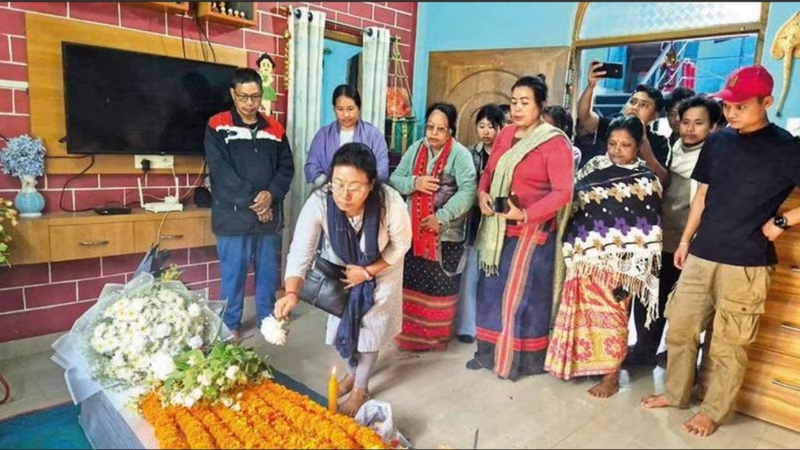
They were just walking home. Two brothers from Tripura, students in Dehradun, trying to build their futures like millions of other young Indians. Then came the slurs—the crude, dehumanizing words that questioned their belonging in their own country. In that moment, 24-year-old Ankur Debbarma did something profoundly simple yet defiantly patriotic: he stood his ground and said, “I’m Indian.”
Those were his last words.
Minutes later, he was stabbed to death in a brutal racial attack in India that has once again laid bare the deep-seated prejudice faced by people from India’s Northeast. His killing isn’t just a crime—it’s a national wound that’s reopened old scars and sparked furious demands for systemic change.
Table of Contents
- The Tragedy in Dehradun
- Racial Attack in India: A Pattern of Prejudice
- Outrage and Protests Across the Northeast
- Why India Needs a National Anti-Racism Law
- What the Government and Citizens Must Do
- Conclusion: His Words Echo in Our Conscience
- Sources
The Tragedy in Dehradun
On the night of December 26, 2025, Ankur Debbarma and his younger brother were returning to their hostel in Dehradun when a group of men began hurling racial slurs at them—mocking their appearance, questioning their nationality, and using derogatory terms commonly directed at people from Northeast India .
Instead of walking away, Ankur confronted them. “I’m Indian,” he asserted—a statement of identity, dignity, and rightful belonging. That act of courage was met with violence. One of the assailants pulled out a knife and stabbed Ankur multiple times. He was rushed to the hospital but succumbed to his injuries .
Police have since arrested three suspects, and a murder case has been registered. But for many, this isn’t just about punishing the perpetrators—it’s about confronting the culture of impunity and ignorance that allows such racial attacks in India to keep happening.
Racial Attack in India: A Pattern of Prejudice
Ankur’s death is not an isolated incident. For decades, students, professionals, and tourists from the Northeast have faced discrimination, harassment, and violence in major Indian cities like Delhi, Bengaluru, and Mumbai . Their Mongoloid features often lead to them being misidentified as foreigners—Chinese, Korean, or even “non-Indian”—despite being citizens with deep roots in the country’s history.
A 2014 report by the Ministry of Home Affairs, following the murder of another Northeast student, Nido Tania, acknowledged the “widespread” nature of racial prejudice and recommended a national law to combat hate crimes . Yet, over a decade later, no such law exists.
This systemic neglect has created a climate where perpetrators believe they can act with impunity. And victims, fearing further stigmatization or bureaucratic apathy, often don’t even report incidents.
Outrage and Protests Across the Northeast
News of Ankur’s death triggered immediate and intense reactions. In Tripura, Assam, Manipur, and Nagaland, students and civil society groups took to the streets. Slogans like “We are Indian, accept us” and “Stop racial violence” echoed through university campuses .
The All Northeast Students’ Association (ANSA) and the North East Students’ Organisation (NESO) have issued strong statements, demanding:
- The immediate enactment of a national law against racial hate crimes.
- Special fast-track courts for cases involving violence against Northeast Indians.
- Mandatory anti-racism sensitization programs in schools, colleges, and police academies.
- Official recognition of February 25 as “Anti-Racial Discrimination Day” in memory of Nido Tania .
These demands are not new—but they carry renewed urgency in the wake of yet another life lost to bigotry.
Why India Needs a National Anti-Racism Law
Currently, racial hate crimes in India are prosecuted under general sections of the Indian Penal Code (IPC), such as 302 (murder) or 323 (assault). But these provisions don’t acknowledge the motivation behind the crime—racism.
A specific law would:
- Recognize racial hatred as an aggravating factor, leading to stricter penalties.
- Create a legal framework for data collection on hate incidents, enabling better policy responses.
- Send a clear message that India will not tolerate discrimination based on ethnicity or appearance.
Countries like the UK and South Africa have comprehensive anti-racism legislation. India, as the world’s largest democracy and a nation of immense diversity, must follow suit. As the United Nations has long urged, legal frameworks are essential tools in the fight against systemic racism.
What the Government and Citizens Must Do
Beyond legislation, real change requires societal transformation. Here’s what’s needed:
- Education Reform: Integrate Northeast history, culture, and contributions into national school curricula to foster understanding from a young age.
- Media Responsibility: Stop stereotyping Northeast communities in films and news. [INTERNAL_LINK:northeast-india-representation-media]
- Police Training: Sensitize law enforcement to recognize, respond to, and prevent racially motivated crimes.
- Community Solidarity: Citizens must speak up when they witness discrimination—bystander silence fuels hate.
Conclusion: His Words Echo in Our Conscience
“I’m Indian.” Three words that should never need to be defended with one’s life. Ankur Debbarma’s final stand was a mirror held up to the nation—a challenge to live up to the ideal of “unity in diversity” that adorns our textbooks but too often fails in our streets.
The racial attack in India that took his life is a call to action. Justice for Ankur means more than convictions—it means ensuring no other student has to prove their Indianness to survive. It’s time for India to protect all its children, equally and without condition.
Sources
- Times of India. (2025). “‘I’m Indian’: Tripura student’s last words before he was killed in a racial attack.” https://timesofindia.indiatimes.com/…
- The Hindu. (2025). “Protests erupt in Northeast after student’s murder in Dehradun.”
- Amnesty International India. (2020). “Lives on the Edge: Racism and Violence Against People from the Northeast.”
- Ministry of Home Affairs, Government of India. (2014). “Bezbaruah Committee Report on Attacks on People from the Northeast.”
- North East Students’ Organisation (NESO). Official statements on social media, December 2025.