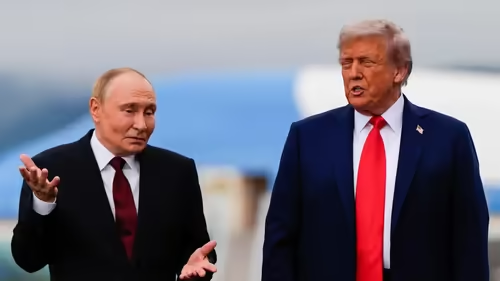
At first glance, it sounds like a polite brush-off. When asked about former U.S. President Donald Trump’s renewed interest in acquiring Greenland, Russian President Vladimir Putin offered a simple, almost indifferent reply: “It’s none of our business.” But in the high-stakes world of international diplomacy, especially when it comes to the Arctic, silence—and disinterest—can be its own form of strategy .
The Putin on Greenland comment, made during a recent press interaction, comes as Trump again floats the idea of the U.S. purchasing or otherwise gaining control over the Danish autonomous territory—a notion he first proposed in 2019, which was swiftly rejected by Copenhagen . While Moscow officially distances itself from the matter, analysts see a deeper game at play: Russia is watching, waiting, and potentially benefiting from the growing rift between Washington and its NATO allies over Arctic dominance .
Table of Contents
- The Context: Trump’s Greenland Obsession
- Putin on Greenland: The Diplomatic Shrug with a Strategic Edge
- Why Greenland Matters: The Arctic Prize
- Cracks in NATO? US-Denmark Tensions Rise
- Russia’s Silent Playbook in the Arctic
- Conclusion: “Not Our Business”—Or Is It?
- Sources
The Context: Trump’s Greenland Obsession
Donald Trump’s fascination with Greenland isn’t new. In 2019, he reportedly told aides he wanted to buy the island, calling it a “large real estate deal” . The proposal was met with ridicule and firm rejection from Denmark, whose Prime Minister called it “absurd.” Now, as he campaigns for a potential 2028 return to the White House, Trump is reviving the idea, framing it as a national security imperative .
His argument hinges on Greenland’s strategic location: it sits between North America and Europe, houses a critical U.S. airbase at Thule, and is rich in rare earth minerals essential for modern technology and defense systems . But his blunt approach has strained relations with Denmark, a key NATO ally, and raised eyebrows across Europe.
Putin on Greenland: The Diplomatic Shrug with a Strategic Edge
Putin’s “none of our business” remark appears to be a masterclass in strategic ambiguity. By publicly disengaging, Russia avoids direct confrontation with either the U.S. or Denmark. Yet, this neutrality serves a dual purpose:
- It allows Moscow to position itself as a non-aggressor while the West bickers internally.
- It subtly encourages discord within NATO, which aligns with Russia’s long-standing goal of weakening Western unity .
Experts note that while Russia isn’t seeking to acquire Greenland, it is deeply invested in Arctic influence. With over half of the Arctic coastline belonging to Russia, the Kremlin has spent years militarizing its northern regions, reopening Soviet-era bases and deploying advanced missile systems . In this light, any distraction that diverts U.S. attention or sows division among its allies is a win for Moscow.
Why Greenland Matters: The Arctic Prize
Greenland is far more than ice and tundra. Its strategic value is immense:
- Geopolitical Positioning: It offers unparalleled surveillance and missile defense capabilities over the North Pole—a key route for intercontinental ballistic missiles.
- Natural Resources: The island holds vast reserves of rare earth elements, uranium, and oil—resources that are becoming increasingly critical in the global tech and energy race .
- Climate Change Access: As Arctic ice melts, new shipping lanes and resource extraction opportunities are opening up, making control of the region a 21st-century priority .
For more on how climate change is reshaping global power dynamics, see our analysis on [INTERNAL_LINK:arctic-ice-melt-geopolitics].
Cracks in NATO? US-Denmark Tensions Rise
Trump’s comments have not only embarrassed Denmark but also exposed underlying tensions within NATO. While the alliance is united in principle, differing views on Arctic sovereignty and U.S. unilateralism are creating friction. Denmark, which handles Greenland’s foreign and defense policy, feels its sovereignty is being undermined .
This situation gives Russia an opportunity to exploit perceived U.S. arrogance. By contrast, Moscow can present itself as a respectful neighbor—even as it expands its own Arctic footprint through scientific missions and military exercises that skirt the edges of international norms .
Russia’s Silent Playbook in the Arctic
Russia’s Arctic strategy is well-documented. Since 2008, it has submitted claims to extend its continental shelf deep into the Arctic Ocean, including areas near Greenland. While these claims are under review by the UN Commission on the Limits of the Continental Shelf, Russia continues to assert its presence through infrastructure and military buildup .
Putin’s public disinterest in Greenland may be genuine—or it may be a smokescreen. Either way, it keeps the West guessing while Russia consolidates its position elsewhere in the region. For authoritative insights on Arctic governance, the Arctic Council, an intergovernmental forum, provides valuable data on regional cooperation and challenges.
Conclusion: “Not Our Business”—Or Is It?
Putin’s “none of our business” line on Greenland is a textbook example of diplomatic minimalism masking maximum strategic intent. While Russia may not want to own the island, it certainly benefits from the chaos surrounding it. As the U.S. and Europe navigate this delicate dispute, Moscow watches from the sidelines—not as a bystander, but as a player quietly advancing its own game on the world’s newest and coldest chessboard. In the Arctic, every word—and every silence—carries weight.
Sources
- Times of India: An unlikely partner: Russia says Trump’s Greenland trope ‘none of our business’ — what it means
- Reuters: Trump renews call for U.S. to buy Greenland
- Arctic Council: Official Website of the Arctic Council
- Council on Foreign Relations: Russia’s Arctic Ambitions