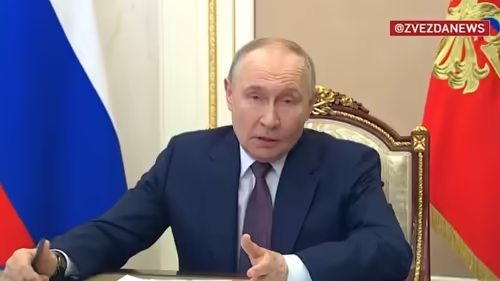
In a geopolitical twist that’s equal parts audacious and opportunistic, Russian President Vladimir Putin has floated a stunning proposal: use up to $1 billion from Russia’s frozen assets in the United States to fund Donald Trump’s so-called “Board of Peace” initiative for Gaza—and tie it to Ukraine’s future reconstruction. The move, framed as a goodwill gesture, is widely seen as a calculated attempt to court favor with the former U.S. president and potentially ease crippling Western sanctions .
But what’s really behind this offer? Is it a genuine step toward peace, or a shrewd diplomatic gambit designed to fracture Western unity ahead of a possible Trump return to the White House? Let’s unpack the layers of this high-stakes proposal.
Table of Contents
- Putin’s Proposal in Detail
- The Frozen Assets Backstory
- Trump’s “Board of Peace”: What Is It?
- Geopolitical Motivations Behind the Offer
- Can Putin Legally Access These Assets?
- Global Reactions and Implications
- Conclusion
- Sources
Putin’s Proposal in Detail
According to reports from the Kremlin, Putin has formally offered to allocate funds from the roughly $300 billion in Russian central bank assets currently frozen by Western nations following the 2022 invasion of Ukraine . Specifically, he proposed:
- A **$1 billion contribution** from these frozen assets to support Donald Trump’s Gaza reconstruction and peace initiative.
- Additional funds from the same pool to be used for **Ukraine’s post-conflict rebuilding**—but only after a peace treaty is signed.
- Direct talks with Trump’s envoys to advance this plan, signaling a clear outreach to the former U.S. president’s camp .
This dual-track approach—linking Gaza and Ukraine—appears designed to appeal to Trump’s transactional worldview while positioning Russia as a constructive global player.
The Frozen Assets Backstory
Following Russia’s full-scale invasion of Ukraine in February 2022, the U.S., EU, UK, and other allies froze approximately $300 billion of the Russian Central Bank’s foreign reserves held in Western financial institutions . These assets remain legally owned by Russia but are inaccessible due to sanctions.
Recent U.S. legislation has explored using interest from these assets to support Ukraine, but seizing the principal remains legally contentious under international law . Putin’s offer cleverly sidesteps this by framing the release as a voluntary Russian contribution—though critics argue it’s a narrative sleight of hand.
Trump’s “Board of Peace”: What Is It?
Donald Trump has repeatedly claimed he could “solve” the Israel-Gaza conflict “in 24 hours” and has mentioned forming a “Board of Peace” comprising global leaders and business figures to oversee reconstruction . While details remain vague, the initiative appears to focus on massive infrastructure investment in Gaza post-ceasefire.
By tying his frozen-assets offer to this plan, Putin is not only validating Trump’s self-styled diplomatic brand but also creating a potential backchannel that bypasses the current Biden administration—a move that could pay dividends if Trump wins the 2024 election.
Putin frozen assets offer: Geopolitical Motivations Behind the Offer
Experts see multiple strategic objectives in Putin’s proposal:
- Sanctions Relief: By portraying Russia as a cooperative partner in global reconstruction, Putin hopes to build political momentum for easing sanctions.
- Divide the West: Offering funds through Trump—not the current U.S. government—aims to exploit political divisions within America and between allies.
- Legitimacy Play: Positioning Russia as a peacemaker helps rehabilitate its image on the world stage, countering its pariah status over Ukraine.
- Future-Proofing: If Trump returns to power, this early engagement could secure a more favorable U.S. stance on Ukraine and sanctions .
Can Putin Legally Access These Assets?
Technically, no. The frozen assets are held in trust by custodians like the Federal Reserve and Euroclear. Russia cannot unilaterally “donate” them. Any transfer would require U.S. and EU legal approval—which is unlikely under current administrations due to concerns about setting a precedent or rewarding aggression .
However, the proposal’s real value may be symbolic. It shifts the narrative: instead of being the aggressor holding Ukraine hostage, Russia becomes the generous donor offering solutions for Gaza and Kyiv alike.
Global Reactions and Implications
Unsurprisingly, the proposal has been met with deep skepticism. Ukrainian officials called it “cynical,” noting that Russia is still actively destroying Ukrainian cities . The Biden administration has not commented directly but maintains that frozen assets should support Ukraine’s defense and recovery—not serve as bargaining chips for geopolitical favors.
Meanwhile, Trump’s team has reportedly welcomed the outreach, though no formal response has been issued. The episode underscores how the 2024 U.S. election is already shaping global diplomacy, with foreign powers hedging their bets on America’s next leader.
Conclusion
Putin’s $1 billion Gaza offer is less about charity and more about chess. By linking frozen Russian assets to Trump’s peace vision and Ukraine’s future, the Kremlin is attempting a masterstroke of narrative control and strategic positioning. Whether this bold Putin frozen assets offer gains traction depends on two wild cards: the outcome of the U.S. election and the willingness of Western legal systems to entertain such a politically charged transaction. For now, it stands as a stark reminder that in global politics, even frozen money can be weaponized—or offered as a peace token. Stay updated on this evolving story with our coverage of [INTERNAL_LINK:us-russia-diplomatic-relations-2026].
Sources
- Times of India: Putin responds to Trump’s ‘Board of Peace’ invite — what’s the $1bn frozen-asset offer?
- Reuters: Russia has about $300 billion frozen abroad, central bank says
- U.S. Department of the Treasury: Sanctions on Russian Central Bank
- Council on Foreign Relations: Can Western Nations Use Russia’s Frozen Assets for Ukraine?
- The Guardian: Trump claims he could solve Israel-Hamas war ‘in 24 hours’
- Brookings Institution: Putin’s Strategic Patience with Trump