Introduction: A Nation Watches as Justice Takes a New Turn
The Pune Porsche case, a name that has become synonymous with privilege, tragedy, and a potential miscarriage of justice, has taken a dramatic new turn. On February 2, 2026, the Supreme Court of India granted regular bail to three individuals who were at the heart of a shocking conspiracy to tamper with evidence following the fatal May 2024 crash. This decision doesn’t just free three men; it forces us to confront uncomfortable questions about accountability, the power of influence, and the very integrity of our legal system.
Table of Contents
- The Tragic Night: What Happened on May 19, 2024?
- The Core of the Controversy: The Juvenile Blood Swap Allegation
- Who Are the Three Accused Granted Bail?
- The Supreme Court’s Reasoning for Granting Bail
- Public Outcry and Legal Community Reaction
- Broader Implications for Juvenile Justice and Road Safety
- Conclusion: A Long Road to Justice Ahead
- Sources
The Tragic Night: What Happened on May 19, 2024?
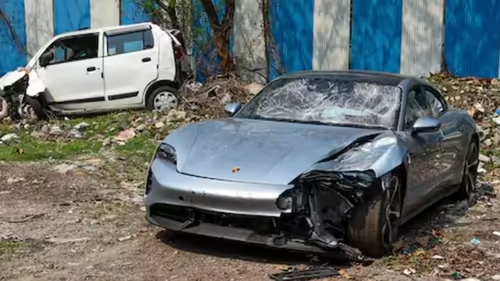
The incident that sparked this national controversy occurred in the early hours of May 19, 2024, in Pune. A speeding, unregistered Porsche Taycan allegedly driven by a 17-year-old minor lost control and plowed into a two-wheeler. The victims were two young IT professionals, Aneesh Awadhiya and Ashwini Koshta, both just 24 years old and hailing from Madhya Pradesh [[9]]. Their lives were cut short in an instant, leaving families and a community in mourning [[10]]. The sheer brutality of the crash, coupled with the luxury car involved and the driver’s age, immediately ignited public fury and media frenzy.
The Core of the Controversy: The Juvenile Blood Swap Allegation
The initial shock of the accident was soon compounded by a far more sinister allegation. It was alleged that in a desperate attempt to shield the minor driver from harsher punishment—potentially for driving under the influence—a coordinated effort was made to swap his blood samples with those of another juvenile passenger in the car [[6]]. This act of alleged evidence tampering became the central pillar of the case against several adults, transforming a tragic accident into a complex web of conspiracy.
Who Are the Three Accused Granted Bail?
The Supreme Court’s recent order specifically granted bail to three individuals who were accused of being instrumental in this alleged blood sample tampering scheme:
- Ashish Satish Mittal
- Aditya Avinash Sood
- Amar Santhosh Gaikwad
These three men had been languishing in judicial custody for approximately 18 months while the investigation and legal proceedings unfolded [[16]]. Their release on bail marks a significant development in the case.
The Supreme Court’s Reasoning for Granting Bail
The bench, in its order, noted the prolonged period of incarceration—18 months—for the accused, which is a substantial duration without a trial having commenced [[16]]. While the court did not exonerate them, it appears to have weighed the principle of personal liberty against the need for their continued detention at this stage of the proceedings. The court also made a pointed observation about the role of parents, suggesting a broader societal failure in cases involving minors and high-powered vehicles [[19]]. This commentary adds a layer of social critique to the legal decision.
Public Outcry and Legal Community Reaction
The news of the bail has predictably sparked mixed reactions. For the families of Aneesh and Ashwini, it may feel like another setback in their long quest for justice. Social media is ablaze with concerns that wealth and influence are once again bending the scales of justice. However, within legal circles, some argue that the bail is a procedural necessity given the extended pre-trial detention, and that it does not equate to a verdict of innocence. The real test will be the upcoming trial, where the prosecution must prove the charges of conspiracy and evidence tampering beyond a reasonable doubt.
Broader Implications for Juvenile Justice and Road Safety
The Pune Porsche case transcends the specifics of this one incident. It serves as a stark reminder of several systemic issues:
- Juvenile Accountability: How do we balance the rehabilitative focus of the Juvenile Justice Act with the need for accountability in cases of extreme negligence or recklessness that result in death?
- Parental Responsibility: The Supreme Court’s remarks highlight a critical gap. Parents who provide powerful, expensive vehicles to underage children without proper supervision must be held accountable.
- Road Safety Enforcement: The fact that the Porsche was unregistered points to a failure in vehicle regulation and enforcement mechanisms [[22]].
This case could potentially set a precedent for how similar incidents are handled in the future, pushing for stricter interpretations of the law when a minor’s actions lead to catastrophic consequences.
Conclusion: A Long Road to Justice Ahead
While the granting of bail to the three accused in the Pune Porsche case is a significant legal milestone, it is by no means the end of the story. The core allegations of blood sample tampering remain, and the trial will be a crucial battleground for truth and justice. For the families of the victims, the fight continues. For society, this case remains a powerful call to action to address the dangerous intersection of privilege, negligence, and a legal system that must work tirelessly to be seen as fair and impartial by all. The road to true justice is long, but every step, including this controversial bail order, is part of the journey.
Sources
- Times of India: Pune Porsche case: SC grants regular bail to 3 accused
- LiveLaw: Pune Porsche Case : Supreme Court Grants Bail To Three Accused Of Swapping Blood Samples
- Indian Express: SC grants bail to 3 accused in Pune Porsche crash case
- Wikipedia: 2024 Pune Porsche car crash
- NDTV: Pune Porsche Crash Accused Get Bail, Supreme Court Flags 18-Month Detention, ‘Parenting Failure’