Introduction: When Rural Roads Became Global Arenas
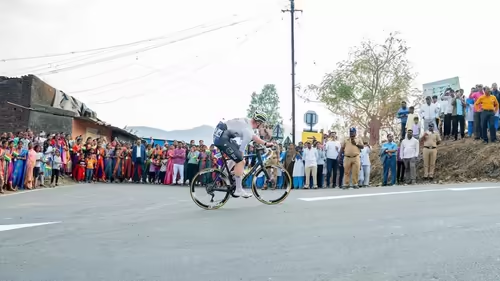
On a crisp January morning in 2026, something extraordinary happened on the dusty roads between Saswad and Baramati. Farmers paused their work. Schoolchildren skipped class. Shopkeepers rolled up their shutters—not for a festival, but for a bicycle race. The Pune Grand Tour, India’s first major international UCI-sanctioned cycling event, had arrived—and the people of Maharashtra didn’t just watch. They embraced it with open arms, loud cheers, and an infectious curiosity that left visiting teams stunned .
For decades, India’s sporting identity has been synonymous with cricket. But the scenes from this inaugural tour suggest a seismic shift. Could cycling be the next frontier? More importantly, can this momentum be sustained?
Table of Contents
- The Pune Grand Tour: A Spectacle of People Power
- Why International Riders Were Stunned
- From Saswad to Baramati: A Route of Warmth
- The Untapped Potential of Cycling in India
- Challenges Ahead: Infrastructure and Investment
- Conclusion: More Than a Race, a Cultural Moment
- Sources
The Pune Grand Tour: A Spectacle of People Power
The numbers alone tell a story. Organizers expected modest turnout—perhaps a few hundred enthusiasts along the route. Instead, they got thousands. Entire villages turned out, waving flags, offering water, and even forming human tunnels of encouragement. Social media exploded with videos of elderly women clapping beside sugarcane fields and kids running alongside riders shouting “Go! Go!”
This wasn’t orchestrated fandom. It was organic, spontaneous, and deeply human. As one local organizer put it, “We didn’t advertise much. The word spread like fire because people wanted to see something new.”
Why International Riders Were Stunned
For professional cyclists used to racing through European towns where fans are passionate but predictable, the Pune experience was surreal. “In Belgium or Italy, you know what to expect,” said a Dutch rider. “But here? The energy was raw, unfiltered, and overwhelming—in the best way.”
Many teams reported being offered homemade snacks, invited into homes for tea, and greeted with garlands at rest stops. Such hospitality isn’t part of standard UCI race protocols—but it became the defining feature of the Pune Grand Tour.
From Saswad to Baramati: A Route of Warmth
The 120-kilometer route wound through rural Maharashtra—a region not known for international sports events. Yet, every kilometer marker became a celebration zone:
- Saswad: Locals decorated bicycles with marigolds and placed them along the start line.
- Jejuri: Devotees of Lord Khandoba waved saffron flags, blending faith with sport.
- Baramati: The finish line saw a sea of blue and white—fans wearing replica team jerseys bought from pop-up stalls.
This grassroots mobilization showed that when given access to world-class events, Indian audiences don’t just consume—they participate.
The Untapped Potential of Cycling in India
Cycling already has deep roots in India—as a mode of transport, not a sport. But the Pune Grand Tour revealed a latent appetite for competitive cycling. According to the Ministry of Youth Affairs and Sports, over 60% of Indian households own a bicycle . Imagine converting even a fraction of that into spectator or participant interest.
Moreover, cycling aligns perfectly with national goals: fitness, sustainability, and affordable sport. With rising urban congestion and pollution, promoting cycling as both recreation and competition could yield dual benefits.
Challenges Ahead: Infrastructure and Investment
Enthusiasm alone won’t sustain a cycling revolution. Real growth requires:
- Dedicated cycling tracks in cities to nurture talent and ensure safety.
- Grassroots academies modeled after European development programs.
- Private sponsorship—currently dominated by cricket—to fund domestic leagues.
- Media coverage that goes beyond token highlights to build narratives around riders.
Without these, the Pune Grand Tour risks becoming a beautiful one-off rather than a movement.
Conclusion: More Than a Race, a Cultural Moment
The Pune Grand Tour wasn’t just about who crossed the finish line first. It was a mirror held up to India’s evolving relationship with global sport. It proved that when given the chance, Indians will rally behind any spectacle that feels authentic, inclusive, and inspiring.
Now, the baton—or rather, the pedal—is passed to policymakers, sponsors, and federations. Will they invest in this momentum? Or will the cheers from Saswad fade into memory? One thing is certain: the crowd has shown up. The question is, will the system follow?
Sources
- Times of India: Pune Grand Tour | ‘Never seen such a big crowd’: How India and Indians embrace cycling
- Union Cycliste Internationale (UCI): Official UCI Asia Tour Calendar
- Ministry of Youth Affairs and Sports, India: National Sports Development Reports
- [INTERNAL_LINK:india-sports-diversification-beyond-cricket]
- [INTERNAL_LINK:cycling-infrastructure-projects-in-india-2026]