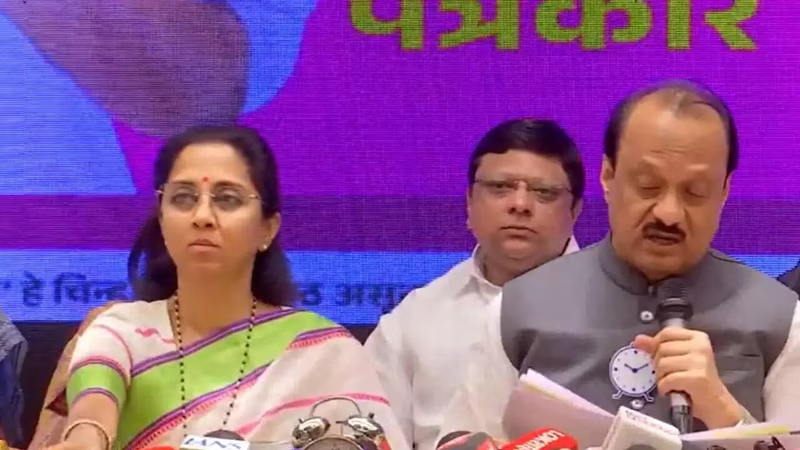
In a political spectacle that blurred factional lines and raised eyebrows across Maharashtra, **Ajit Pawar** and **Supriya Sule**—representing rival wings of the Nationalist Congress Party (NCP)—stood shoulder-to-shoulder in Pune to release a **joint manifesto** ahead of the fiercely contested **Pune civic polls**. The event, held just days before candidate nominations closed, sent a clear message: despite their internal rift, both camps are betting on a shared legacy to win over disillusioned voters .
But here’s the twist: while they’re campaigning on the same promises, they’re not running on the same ticket. Ajit Pawar’s NCP (Democratic) has fielded **37 independent candidates**, while Supriya Sule’s NCP (Sharadchandra Pawar) has announced its slate for **seven Mumbai wards**—and is actively contesting in Pune as well . So what does this mean for Pune’s electorate? And can a unified manifesto paper over a fractured party?
Table of Contents
- The Joint Manifesto: Key Promises
- Pune Civic Polls: Strategic Alliance or Photo Op?
- Candidate Lists and Factional Rivalry
- Voter Sentiment on the Ground in Pune
- Historical Context: NCP’s Influence in Pune
- Conclusion: Will Unity Win Votes?
The Joint Manifesto: Key Promises
The newly unveiled NCP manifesto—endorsed by both Ajit Pawar and Supriya Sule—centers on urban livability, public health, and infrastructure. At its core is a bold pledge: **“pothole-free roads within six months”** of assuming office in the Pune Municipal Corporation (PMC). This promise directly addresses one of the city’s most persistent grievances, especially during monsoon season.
Other headline commitments include:
- Upgraded primary health centers** with 24/7 emergency services and free diagnostics for senior citizens.
- A **green corridor initiative** to plant 500,000 trees and create new urban parks in underserved neighborhoods.
- **Smart waste management** systems with door-to-door collection and segregation at source.
- **Affordable housing** for low-income families through public-private partnerships.
- Digitization of all civic services to reduce corruption and processing time.
Notably, the manifesto avoids divisive rhetoric and focuses squarely on governance—a calculated shift from identity-based politics to performance-based appeals .
Pune Civic Polls: Strategic Alliance or Photo Op?
The image of Ajit Pawar and Supriya Sule smiling together was undeniably powerful. Yet political analysts remain skeptical. “This is less about reconciliation and more about brand preservation,” says Dr. Meera Desai, a political scientist at Savitribai Phule Pune University. “Both factions know that ‘NCP’ still carries emotional weight in western Maharashtra. They’re leveraging that nostalgia while quietly competing for the same voter base.”
Indeed, the timing is strategic. With the **Pune civic polls** scheduled for late January 2026 and vote counting set for the following day , the joint launch aims to dominate headlines during the critical final week of campaigning. But without a unified candidate list, the risk of vote-splitting is real—potentially benefiting rivals like the BJP and Shiv Sena (Shinde faction).
Candidate Lists and Factional Rivalry
Despite the shared platform, the ground reality tells a different story:
- Ajit Pawar’s NCP (D)** has nominated **37 candidates** across key PMC wards, including several former corporators known for their grassroots networks.
- Supriya Sule’s NCP (SCP)**, while focusing heavily on Mumbai (with 7 candidates declared there), is also contesting select high-profile wards in Pune—often against Ajit’s nominees.
This parallel candidature raises questions about the manifesto’s enforceability. If either faction wins, who gets credit? And if they lose, who takes the blame? For now, both sides are avoiding direct confrontation, framing their competition as “healthy democratic participation.”
Voter Sentiment on the Ground in Pune
On the streets of Kothrud and Hadapsar—two politically sensitive zones—residents express mixed feelings. “We liked Sharad Pawar’s leadership,” says Ramesh Inamdar, a retired teacher. “But now his family is fighting among themselves. How can they fix our roads when they can’t even agree on a common candidate?”
Others are more pragmatic. “If the manifesto delivers pothole-free roads and better hospitals, I don’t care which NCP wins,” says Priya Deshmukh, a small business owner. This sentiment reflects a growing trend: urban voters prioritizing **service delivery over party loyalty**—a shift that could reshape Maharashtra’s political landscape .
Historical Context: NCP’s Influence in Pune
Pune has long been an NCP stronghold, thanks to Sharad Pawar’s deep roots in the region and the party’s focus on cooperative institutions and urban development. From 2002 to 2017, the NCP either led the PMC or was a pivotal coalition partner. However, recent years have seen its influence wane due to internal splits and aggressive campaigns by the BJP-Shiv Sena alliance.
The **2026 Pune civic polls** represent a make-or-break moment. A strong showing could signal a revival; a poor result might cement the party’s decline in its traditional bastion. For more on Maharashtra’s evolving urban politics, see our analysis on [INTERNAL_LINK:maharashtra-local-elections-trends].
Conclusion: Will Unity Win Votes?
The joint NCP manifesto for the **Pune civic polls** is a masterclass in political messaging—offering concrete, voter-centric solutions while evoking the legacy of a once-dominant party. But without organizational unity, even the best promises may fall flat. As counting day approaches, all eyes will be on whether emotional appeals can overcome electoral fragmentation. One thing is certain: Pune’s voters are watching closely—and they’re ready to hold every candidate accountable.