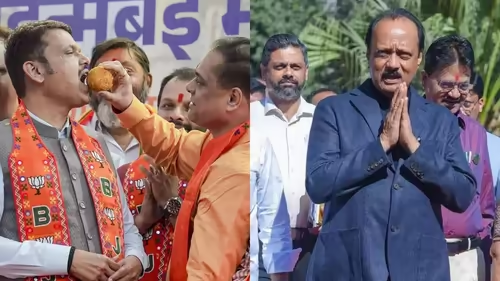
For decades, Pune and Pimpri-Chinchwad were considered the unshakable citadels of the Nationalist Congress Party (NCP)—the very heartland where the Pawar family’s political legacy was forged. But the 2026 civic elections have rewritten that narrative in bold, unmistakable terms. The BJP didn’t just win; it delivered a landslide victory in both municipal corporations, shattering the myth of NCP invincibility and exposing the fragility of even a reunited front led by Ajit and Sharad Pawar .
Table of Contents
- BJP’s Historic Win in Pune and Pimpri-Chinchwad
- Why the NCP Alliance Failed Despite Unity
- Congress Meltdown and Third-Front Irrelevance
- BJP’s Urban Strategy Decoded
- What This Means for the 2029 Maharashtra Assembly Elections
- Key Takeaways for Opposition Parties
- Conclusion: The End of an Era in Pune Politics?
- Sources
BJP’s Historic Win in Pune and Pimpri-Chinchwad
The numbers speak louder than slogans. In Pune Municipal Corporation (PMC), the BJP crossed the 90-seat mark—far beyond the 75 needed for a simple majority and a significant jump from its 2022 tally. In Pimpri-Chinchwad Municipal Corporation (PCMC), the party repeated the feat, consolidating its control over western Maharashtra’s most economically vital urban centers .
This isn’t just a win—it’s a systemic takeover. From ward-level volunteers to digital campaigning, the BJP’s machine operated with surgical precision, turning even traditional NCP bastions into saffron strongholds.
Why the NCP Alliance Failed Despite Unity
For the first time since their bitter 2023 split, Ajit Pawar’s NCP (Democratic) and Sharad Pawar’s NCP (Sharadchandra Pawar) presented a united front. Yet, this alliance proved to be more symbolic than strategic. Several critical flaws doomed their campaign:
- Lack of cohesive messaging: Voters received mixed signals—was this about development, legacy, or anti-BJP sentiment?
- Weak local leadership: Many candidates lacked grassroots connect or name recognition beyond the Pawar surname.
- Over-reliance on nostalgia: Appeals to “Pawar rule” rang hollow in cities demanding modern infrastructure, waste management, and traffic solutions.
- Delayed coordination: Seat-sharing talks concluded late, leaving little time for joint rallies or unified booth management.
As one political analyst noted, “Unity without organization is just noise.” The Pune civic polls proved that point decisively.
Congress Meltdown and Third-Front Irrelevance
While all eyes were on the NCP-BJP battle, the Congress suffered a near-total collapse. Once a key MVA partner, the party won fewer than 10 seats across both corporations—a damning indictment of its fading relevance in urban Maharashtra. Smaller outfits like the Shiv Sena (UBT) and AIMIM also failed to gain traction, confirming that Maharashtra’s urban electorate now operates on a two-party axis: BJP vs. everyone else.
BJP’s Urban Strategy Decoded
The BJP’s success wasn’t accidental. It was the result of a multi-year urban transformation strategy:
- Hyper-local governance: Empowering corporators with funds for micro-projects (streetlights, footpaths, drainage).
- Digital outreach: WhatsApp groups, Instagram reels, and AI-driven voter targeting in every ward.
- Youth mobilization: BJYM and Yuva Morcha recruited thousands of college students as booth agents.
- Infrastructure branding: Every new flyover, metro station, and water project prominently featured the BJP logo.
This ground-up approach turned civic issues into electoral assets—a lesson other parties are only now beginning to grasp.
What This Means for the 2029 Maharashtra Assembly Elections
The Pune civic polls are a bellwether for the state assembly elections three years away. If the BJP can dominate in the NCP’s ancestral home, no seat is safe. For the opposition, the path forward requires more than alliances—it demands reinvention. Can the NCP rebuild its urban cadre? Can Congress find a voice beyond protest politics? The answers will shape Maharashtra’s next decade.
For deeper insights into Maharashtra’s political realignment, see our analysis on [INTERNAL_LINK:maharashtra-2029-election-roadmap].
Key Takeaways for Opposition Parties
- Personality-driven politics no longer works in urban India.
- Voters prioritize service delivery over legacy or loyalty.
- Electoral unity must be backed by organizational unity.
- Digital literacy and youth engagement are non-negotiable.
Conclusion: The End of an Era in Pune Politics?
The 2026 Pune civic polls mark more than a BJP victory—they signal the end of dynastic dominance in Maharashtra’s urban core. The Pawars, once untouchable, now face their most existential challenge. Meanwhile, the BJP has proven it can not only win but govern, build, and brand at scale. As Pune and Pimpri-Chinchwad turn saffron, the message to every opposition party is clear: adapt or fade into irrelevance.
Sources
- Times of India: Decoding Pune and Pimpri Chinchwad civic polls: Landslide win for BJP, combined NCPs no match
- Election Commission of India: Official Civic Election Results Portal
- PRS Legislative Research: Analysis of Urban Governance in Maharashtra