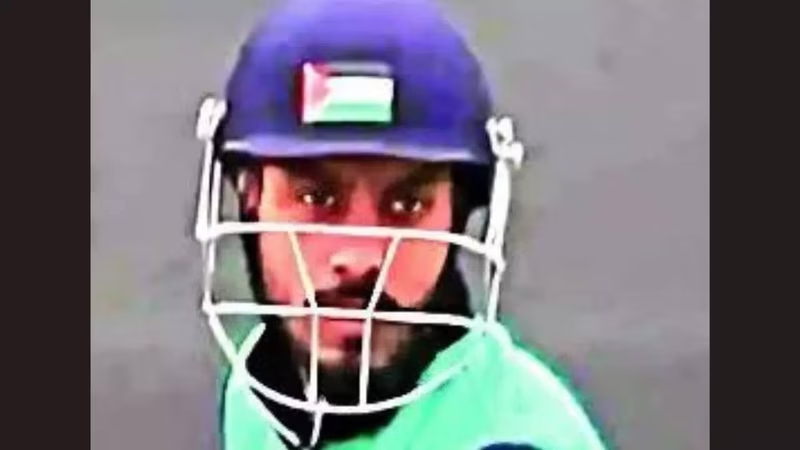
In the high-stakes world of Indian cricket, where every boundary and wicket is celebrated, a simple sticker has ignited a national firestorm. A young Pulwama cricketer—whose name has not been officially released—has found himself at the heart of a complex debate over freedom of expression, nationalism, and geopolitical solidarity after he wore a batting helmet adorned with a Palestinian flag during a recent tournament in Jammu.
What might have seemed like a quiet gesture of global empathy quickly escalated into a formal police investigation, political outrage, and a sharp divide in public opinion. Was it a harmless act of humanitarian concern? Or, as some officials allege, a veiled political statement with dangerous undertones in one of India’s most sensitive regions? This is the full story behind the helmet, the flag, and the fallout.
Table of Contents
- The Incident: What Happened at the Jammu Tournament?
- Pulwama Cricketer: The Symbolism and the Backlash
- Official Response: JKCA and Police Actions
- Public Reaction: Polarized Opinions Across India
- Freedom of Expression vs. National Security in Sports
- Conclusion: More Than Just a Sticker
- Sources
The Incident: What Happened at the Jammu Tournament?
The controversy unfolded during a private cricket tournament held in Jammu, a city in the Union Territory of Jammu and Kashmir. The event, though not officially sanctioned by the Jammu & Kashmir Cricket Association (JKCA), drew local talent—including a young player from Pulwama, a district in southern Kashmir that has been at the epicenter of decades-long conflict .
During his innings, the cricketer wore a standard protective helmet. But affixed to its side was a small, unmistakable sticker: the black, white, green, and red tricolor of the Palestinian flag. The image was quickly captured by onlookers and shared widely on social media, where it went viral within hours .
For many viewers, the gesture was seen as a show of solidarity with Palestinians amid ongoing conflict in Gaza. For others—particularly in a region as geopolitically volatile as J&K—the act was interpreted as politically charged and potentially inflammatory.
Pulwama Cricketer: The Symbolism and the Backlash
The Pulwama cricketer’s choice of symbol is layered with meaning. Pulwama itself became globally synonymous with terrorism after the 2019 suicide attack that killed 40 Indian paramilitary personnel—a tragedy that led to heightened security and scrutiny in the region .
In that context, any public display perceived as “anti-India” or sympathetic to causes deemed adversarial can trigger strong institutional responses. Critics argue that displaying the Palestinian flag in this setting—especially by someone from Pulwama—could be misconstrued as aligning with separatist or anti-national sentiments, given how certain militant groups have historically used the Palestinian cause as rhetorical cover.
However, defenders of the player point out a glaring double standard. “Indian cricketers have worn ribbons for Ukraine, raised rainbow flags for LGBTQ+ rights, and posted about Black Lives Matter,” noted one commentator on X (formerly Twitter). “Why is Palestinian solidarity suddenly ‘sedition’?” .
Official Response: JKCA and Police Actions
The Jammu & Kashmir Cricket Association (JKCA) moved swiftly to distance itself from the incident. In an official statement, the body clarified that the tournament was a “private, non-affiliated event” and that the association “does not endorse or condone any political statements by participants” . This disclaimer effectively left the player exposed to legal scrutiny without institutional backing.
More significantly, local police launched a formal investigation into the matter. Authorities are now probing the “intent” behind the sticker, examining whether it constitutes a violation of laws related to promoting enmity or undermining national integrity . While no charges have been filed as of January 3, 2026, the probe itself has cast a chilling shadow over the player’s future in the sport.
[INTERNAL_LINK:freedom-of-expression-in-indian-sports] The case raises urgent questions about how India regulates political and social expression in athletics—a space that is increasingly global and conscience-driven.
Public Reaction: Polarized Opinions Across India
Public discourse has split sharply along ideological lines:
- Hardline nationalists condemned the act as “unpatriotic” and “provocative,” demanding strict action.
- Human rights advocates and left-leaning voices defended it as peaceful solidarity, warning against conflating humanitarian concern with political subversion.
- Cricket fans expressed concern that sports are becoming a battleground for political policing, potentially stifling young talent from conflict-affected regions.
Notably, several former cricketers remained silent, reflecting the sensitivity of wading into such a charged issue. Meanwhile, international observers have begun citing the incident as an example of shrinking civic space in India—a claim the government strongly rejects.
Freedom of Expression vs. National Security in Sports
This incident sits at the intersection of two critical principles: the right to express humanitarian solidarity and the state’s duty to maintain public order in sensitive zones. The UN Special Rapporteur on Freedom of Expression has consistently affirmed that peaceful symbolic acts—like wearing a flag sticker—fall under protected speech, provided they don’t incite violence .
Yet, in Jammu and Kashmir, where security concerns are paramount, authorities often adopt a zero-tolerance approach to ambiguous symbols. The real question isn’t just about a sticker—it’s about whether a young athlete from a conflict zone can express global empathy without being branded a security threat.
Conclusion: More Than Just a Sticker
The Pulwama cricketer may have intended a simple gesture of human solidarity, but in today’s hyper-polarized climate, even the smallest symbols carry enormous weight. His helmet has become a mirror—reflecting deep divides over nationalism, freedom, and who gets to express compassion in public.
As the police probe continues, one thing is clear: this is no longer just about cricket. It’s about the space India creates for its youth—especially those from historically troubled regions—to engage with global issues without fear of retribution. The outcome of this case could set a precedent for how sports, symbolism, and citizenship intersect in modern India.
Sources
- Times of India: “Pulwama cricketer wears helmet with Palestinian flag sticker; cops start probe” (January 3, 2026)
- Local Jammu police confirm investigation into the incident.
- BBC News: “Pulwama attack: The 2019 suicide bombing that changed India-Pakistan ties”
- Social media discourse on X and Instagram regarding selective outrage.
- Office of the United Nations High Commissioner for Human Rights (OHCHR): Guidelines on Freedom of Expression.