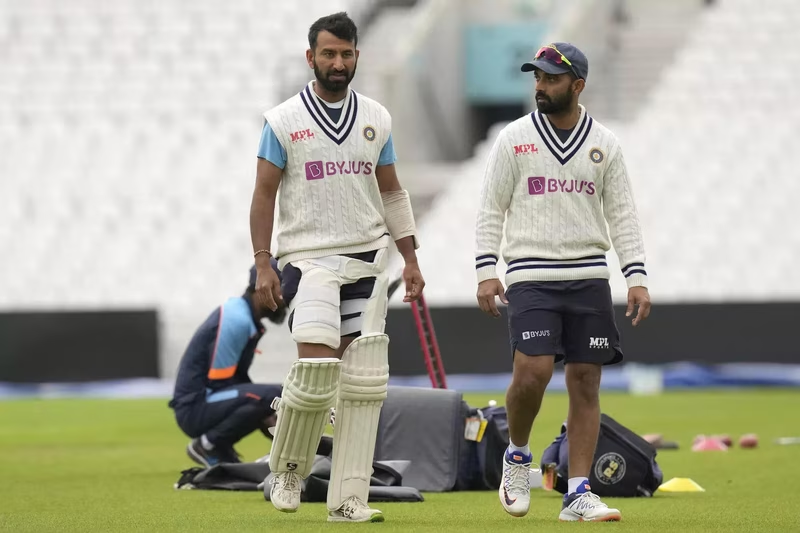
Test cricket is in trouble—and it’s not the pitches that are failing. According to former India star Robin Uthappa, the real crisis lies in the mindset of today’s batters: impatient, flashy, and utterly unprepared for the slow-burn battle that defines the longest format. Speaking out after the recent MCG Test meltdown, Uthappa didn’t mince words: “Play like Pujara and Rahane,” he urged. “That’s how you survive—and win—in real Test cricket.”
His message cuts to the heart of a growing divide in the cricketing world. As T20 leagues dominate calendars and cash flows, the art of occupation—of leaving balls, rotating strike, and valuing your wicket above all—has been sidelined. But Uthappa argues that on pitches like the MCG’s, which he insists are “seam-friendly but not unplayable,” the Pujara and Rahane batting style isn’t just nostalgic—it’s essential. And without a course correction, Test cricket risks becoming a sideshow in its own sport.
Table of Contents
- The MCG Meltdown and Uthappa’s Take
- Pujara and Rahane Batting Style: The Blueprint for Resilence
- Why Modern Batters Are Failing in Test Cricket
- Joe Root and the Global Crisis of Technique
- Redefining Success: Why 250 Can Still Win a Test
- Is There Hope for Test Cricket’s Future?
- Conclusion: Back to Basics—or Bust
- Sources
The MCG Meltdown and Uthappa’s Take
The recent Boxing Day Test at the Melbourne Cricket Ground saw top-order collapses that left fans bewildered. Balls were flying, edges were flying, and wickets tumbled in clusters. Critics blamed the pitch, calling it “dangerous” and “unplayable.” But Uthappa pushed back: “It was a good seam-friendly track—challenging, yes, but not unfair. The problem wasn’t the pitch. It was the preparation,” he told reporters .
He pointed out that disciplined batsmen—those who respect the red ball’s movement and prioritize survival in the first hour—can still score runs on such surfaces. The issue, he insists, is that too many modern players approach Test cricket with a T20 trigger finger: looking to score off every ball, playing away from their body, and falling to soft dismissals.
Pujara and Rahane Batting Style: The Blueprint for Resilience
When Uthappa says “play like Pujara and Rahane,” he’s not just name-dropping legends—he’s invoking a philosophy. Both batters built their Test careers on three core principles:
- Leave more, play less: Pujara’s signature trait was letting 60% of deliveries go by—a discipline almost extinct today.
- Value your wicket: Rahane treated his wicket as a non-renewable resource, often batting for hours without hitting a boundary.
- Build partnerships, not highlights: Their focus was on wearing down bowlers and laying foundations, not social media clips.
Together, they formed the bedrock of India’s golden overseas era (2018–2022), scoring crucial runs in Australia, England, and South Africa—conditions far tougher than the MCG. Their approach wasn’t glamorous, but it was brutally effective. And that, says Uthappa, is what’s missing now.
Why Modern Batters Are Failing in Test Cricket
The T20 explosion has reshaped batting DNA. Young players grow up idolizing six-hitters, not survivors. Academies prioritize “scoring intent” over “defensive technique.” The result? A generation of batters who struggle to:
- Play with a straight bat under their eyes (leading to outside edges).
- Leave the ball outside off stump (resulting in false shots).
- Handle long spells of pressure without panicking.
“We’ve conflated entertainment with excellence,” Uthappa lamented. “But Test cricket isn’t a Netflix series—it’s a novel. You have to read every page, not just the cliffhangers.”
Joe Root and the Global Crisis of Technique
Uthappa didn’t single out one team. He expressed deep concern for England legend Joe Root, whose recent struggles symbolize a broader issue. Once the epitome of classical technique, Root has been dismissed playing across the line or chasing wide balls—classic T20 errors in a Test arena .
Root’s case shows that even elite players aren’t immune to format bleed. When your domestic season is 80% white-ball cricket, muscle memory shifts. And without dedicated red-ball practice, even the best can lose their edge against the new ball in seaming conditions.
Redefining Success: Why 250 Can Still Win a Test
One of Uthappa’s most provocative points? “250 is still a competitive Test total—if you bowl and field well.” In an era obsessed with 400+, this seems radical. But history backs him up. On seaming tracks like Lord’s, Headingley, or even the MCG, ESPNCricinfo data shows that sub-250 totals have won countless Tests when paired with disciplined bowling.
The obsession with big scores, he argues, pressures batters into reckless shots. Instead, teams should focus on collective responsibility: 50 from each of five batters beats one 150 and four ducks. It’s not sexy—but it wins matches.
Is There Hope for Test Cricket’s Future?
Uthappa believes change is possible—but it requires structural reform:
- More dedicated red-ball domestic competitions.
- Coaching that rewards patience over power.
- Fans and media celebrating “boring” innings that anchor victories.
Initiatives like the World Test Championship help, but the cultural shift must start at the grassroots. [INTERNAL_LINK:why-test-cricket-needs-a-revival]
Conclusion: Back to Basics—or Bust
The plea to embrace the Pujara and Rahane batting style isn’t about nostalgia—it’s about survival. Test cricket’s unique charm lies in its tension, its patience, its test of character over time. If the sport keeps chasing T20’s shadow, it risks losing its soul. As Uthappa’s warning makes clear: without discipline, even the fairest pitch will feel unplayable.
Sources
[1] Times of India: “‘Play like Pujara and Rahane’: Ex-India batter’s old-school advice amid Test batting chaos” (https://timesofindia.indiatimes.com/sports/cricket/ashes/play-like-pujara-and-rahane-ex-india-batters-old-school-advice-amid-test-batting-chaos/articleshow/126289619.cms)
ESPNCricinfo – Test Match Archive and Pitch Analysis: https://www.espncricinfo.com/