Spaceflight is unforgiving. A single anomaly can turn a meticulously planned mission into a costly setback. That’s exactly what happened during India’s recent PSLV rocket failure—a rare stumble for the otherwise reliable Polar Satellite Launch Vehicle. Yet, in the midst of disappointment, a glimmer of triumph emerged: one satellite, against all odds, activated in orbit and beamed back precious data for nearly three minutes before falling silent.
This bittersweet outcome—part failure, part scientific victory—has sparked intense analysis within the Indian Space Research Organisation (ISRO) and the global aerospace community. It underscores a profound truth: even in disaster, knowledge can be salvaged. And sometimes, three minutes of data are worth more than weeks of silence.
Table of Contents
- What Happened During the PSLV Rocket Failure?
- The Lone Survivor: How a Single Satellite Defied Odds
- Why Those 3 Minutes of Data Matter
- Technical Analysis: What Went Wrong with PSLV-C60?
- ISRO’s Response: Transparency and Resilience
- Historical Context: PSLV Reliability and Past Anomalies
- What This Means for India’s Future Missions
- Conclusion: Failure as a Stepping Stone
- Sources
What Happened During the PSLV Rocket Failure?
The PSLV-C60 mission, launched from Sriharikota on January 14, 2026, was designed to deploy multiple satellites into precise low-Earth orbits. However, during the fourth and final stage of ascent, a critical anomaly occurred—likely related to propulsion or guidance systems—preventing the vehicle from reaching its intended velocity and altitude .
As a result, most payloads failed to separate properly or were stranded in a useless suborbital trajectory, destined to burn up in the atmosphere. Initial reports from ISRO confirmed a “partial failure,” marking only the second major PSLV setback in over three decades of service.
The Lone Survivor: How a Single Satellite Defied Odds
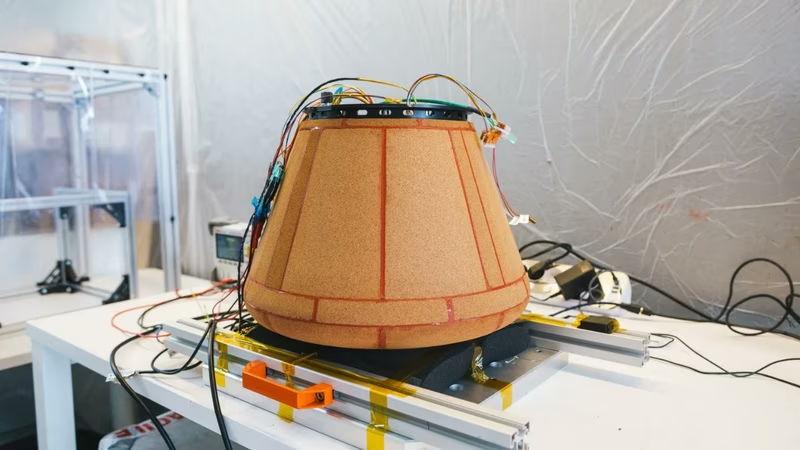
Amid the gloom, one payload—a small experimental satellite developed by an Indian academic consortium—managed to power on autonomously after separation. For approximately **three minutes**, it successfully established a downlink with ground stations, transmitting telemetry and preliminary sensor readings before its signal faded permanently.
Experts believe this satellite may have been mounted on an earlier separation ring or had a more robust activation protocol, allowing it to function briefly despite the compromised orbit. Its ability to “wake up” and communicate—even for a short window—demonstrates the value of redundant design and autonomous systems in high-risk missions.
Why Those 3 Minutes of Data Matter
In space science, every second counts. The data received during those three minutes could provide invaluable clues:
- Anomaly Diagnostics: Telemetry might reveal the exact moment and nature of the PSLV’s failure.
- Survivability Testing: How did the satellite endure extreme stresses during the malfunction?
- Orbital Decay Models: Even brief orbital data helps refine predictions for future missions.
As Dr. K. Sivan, former ISRO chairman, once noted: “A failed mission that returns data is not a total loss—it’s a lesson in disguise.” This philosophy appears to be guiding ISRO’s current post-mortem.
Technical Analysis: What Went Wrong with PSLV-C60?
While ISRO has not released full details, early speculation points to a possible issue in the liquid-fueled fourth stage (PS4), which uses twin engines for fine orbital insertion. A fuel leak, valve malfunction, or software glitch in the navigation system could have caused premature shutdown.
Notably, this was a “DL” (Dual Launch) variant of the PSLV, carrying a complex multi-satellite stack. The added complexity may have introduced unforeseen integration challenges—a reminder that even veteran rockets face new risks with evolving mission profiles.
ISRO’s Response: Transparency and Resilience
In keeping with its recent commitment to openness, ISRO quickly acknowledged the anomaly without deflection. Chairman S. Somanath stated, “We will investigate thoroughly and return stronger.” This candid approach has earned praise from international partners, including NASA and ESA, who view such transparency as essential for collaborative space exploration.
For more on global space agency protocols, see the safety guidelines published by the United Nations Office for Outer Space Affairs (UNOOSA) .
Historical Context: PSLV Reliability and Past Anomalies
The PSLV has long been ISRO’s workhorse, with 57 successful launches out of 60 attempts since 1993. Its only prior full failures occurred in 1993 (maiden flight) and 1997. This latest incident—while serious—is an outlier in an otherwise stellar record that includes landmark missions like Chandrayaan-1 and Mars Orbiter Mission.
This resilience is why experts remain confident. As one senior engineer noted, “One anomaly doesn’t erase decades of excellence. It sharpens our focus.”
What This Means for India’s Future Missions
The PSLV-C60 setback may delay upcoming launches, including commercial payloads and the NISAR earth observation satellite (a joint NASA-ISRO project). However, it also presents an opportunity:
- Enhanced Redundancy: Future satellites may include more autonomous check-in protocols.
- Stage-by-Stage Review: Deeper scrutiny of PS4 systems before next flight.
- Public Trust: Honest communication strengthens long-term credibility.
Learn more about India’s ambitious roadmap in our feature on [INTERNAL_LINK:isro-upcoming-missions-2026-2030].
Conclusion: Failure as a Stepping Stone
The PSLV rocket failure is a sobering reminder that space exploration remains a high-stakes endeavor. Yet, the fact that one satellite fought through the chaos to deliver data—even for just three minutes—transforms a narrative of loss into one of perseverance. In the grand arc of India’s space journey, this mission may ultimately be remembered not for its flaw, but for the resilience it revealed in both machine and mission team.
Sources
- Times of India: 1 satellite survives PSLV rocket failure, transmits data from space for 3 mins
- United Nations Office for Outer Space Affairs (UNOOSA): International Space Safety Frameworks
- ISRO Official Website: Mission Archives & Statements
- [INTERNAL_LINK:history-of-pslv-launches]
- [INTERNAL_LINK:how-satellites-communicate-with-earth]