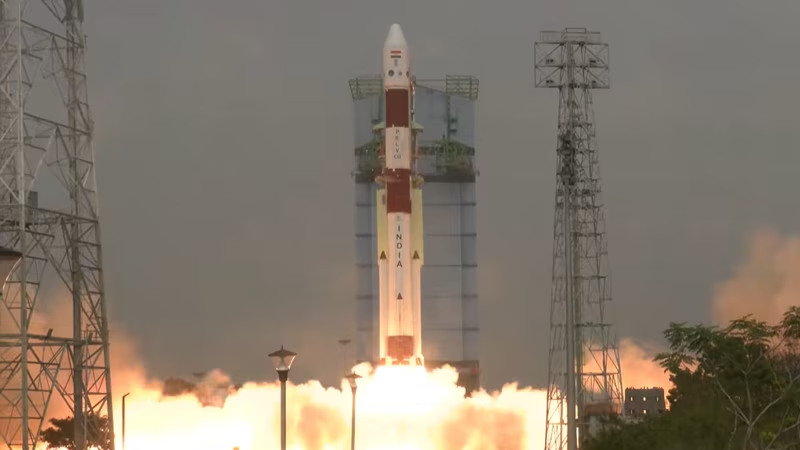
It was supposed to be a triumphant start to India’s space year—a reliable Polar Satellite Launch Vehicle (PSLV) lifting off from Sriharikota with a suite of 16 satellites, headlined by the advanced hyperspectral imaging satellite EOS-N1. But just minutes after a picture-perfect liftoff on January 12, 2026, ISRO announced a sobering reality: the PSLV-C62 failure had claimed the entire payload .
The agency confirmed a “disturbance” or “deviation” during the third stage (PS3) of the flight—echoing a hauntingly similar failure that grounded the PSLV-C61 mission just eight months earlier in May 2025 . With all satellites lost, including a crucial Earth observation asset developed for strategic and environmental monitoring , questions are mounting about quality control, design vulnerabilities, and the future of India’s most trusted launch vehicle.
Table of Contents
- What Happened During the PSLV-C62 Launch?
- The PSLV-C62 Failure: A Third-Stage Crisis
- Lost Payloads: The Strategic Cost of Failure
- Historical Context: ISRO’s Rare but Recurring Setbacks
- What Next for ISRO and the PSLV Program?
- Conclusion: Resilience in the Face of Adversity
- Sources
What Happened During the PSLV-C62 Launch?
The PSLV-C62 lifted off at 10:17 AM IST from the Satish Dhawan Space Centre in Sriharikota as scheduled . The initial phases—the solid-fueled first stage and liquid-fueled second stage—performed nominally, with live telemetry showing stable parameters . However, trouble began near the end of the third stage burn.
ISRO officials later stated that a “disturbance” was observed during the PS3 phase, leading to a loss of control and ultimately mission failure . While the exact nature of the anomaly is still under investigation, early data points to a critical propulsion issue within the solid-fueled motor of the third stage.
The PSLV-C62 Failure: A Third-Stage Crisis
The PSLV-C62 failure bears an unsettling resemblance to the PSLV-C61 mishap in May 2025. In that incident, ISRO attributed the loss to a “fall in the chamber pressure of the motor case” during the third stage—a flaw that prevented the rocket from reaching orbital velocity .
Possible root causes being examined include:
- Nozzle control malfunction: A failure in the thrust vector control system could cause instability.
- Casing rupture or insulation breach: Compromised structural integrity in the solid motor could lead to rapid pressure loss .
- Propellant grain defect: An inconsistency in the solid fuel could cause uneven burning and pressure drop.
Given the recurrence, experts are questioning whether ISRO has fully addressed the systemic issues from the previous failure—or if supply chain and manufacturing oversight gaps persist .
Lost Payloads: The Strategic Cost of Failure
The PSLV-C62 wasn’t just another commercial launch. Its primary payload, the EOS-N1 (Anvesha) satellite, was a state-of-the-art hyperspectral imager designed for defense surveillance, agricultural monitoring, and environmental assessment . Developed in collaboration with DRDO, its loss represents a significant setback for India’s strategic space capabilities .
In addition to EOS-N1, the mission carried 15 other satellites from international and domestic customers, all now lost. This not only damages ISRO’s reputation for reliability—a key selling point for its commercial arm, NewSpace India Limited (NSIL)—but also delays critical scientific and commercial projects worldwide .
Historical Context: ISRO’s Rare but Recurring Setbacks
While the PSLV boasts an impressive success record—earning the nickname “Workhorse of ISRO”—it is not immune to failure. Before 2025, its last full mission failure was in 1993. The back-to-back third-stage anomalies in C61 and C62 mark a concerning new chapter .
This pattern suggests a potential vulnerability in the current configuration of the PS3 stage, which uses a solid propellant (HTPB-based) and a flex-bearing gimbaled nozzle for steering. If a common component or manufacturing batch is at fault, ISRO may need to ground the fleet temporarily for thorough audits—a move that would impact India’s ambitious 2026 launch manifest .
What Next for ISRO and the PSLV Program?
ISRO Chairman S. Somanath has promised a transparent and rigorous failure analysis. A Failure Analysis Committee (FAC) is already reviewing telemetry, hardware remnants (if recovered), and production logs .
Potential next steps include:
- A temporary suspension of PSLV launches until the root cause is confirmed.
- Enhanced non-destructive testing (NDT) protocols for all solid motor segments.
- Accelerated transition to more advanced vehicles like the Small Satellite Launch Vehicle (SSLV) or the human-rated LVM3 for critical missions.
For now, India’s space community—and its global partners—are watching closely. Trust, once eroded, takes years to rebuild. You can learn more about India’s broader space strategy in our guide to [INTERNAL_LINK:india-space-program].
Conclusion: Resilience in the Face of Adversity
Spaceflight is inherently risky. Even the most experienced agencies—NASA, ESA, SpaceX—have faced catastrophic failures. What matters is how they respond. The PSLV-C62 failure is a major blow, but it also presents ISRO with an opportunity to reinforce its engineering rigor, improve transparency, and emerge stronger. India’s space dreams are far from over—but they will require even greater precision and vigilance moving forward.
Sources
- Times of India: “India’s first space mission of 2026: Isro’s PSLV-C62…”
- ISRO Official Announcement on PSLV-C62 Launch Schedule
- NewSpace India Limited (NSIL) Mission Brochure
- Live Updates: “Disturbance at PS3 phase causes…”
- NDTV Explains: “Why ISRO’s EOS-9 Satellite Launch Failed”
- ISRO Post-Mission Briefing on PSLV-C61 Failure
- “Back on the launch pad: ISRO’s fresh attempt after PSLV-…”
- NASA’s Lessons Learned from Launch Failures (External Authority) https://www.nasa.gov/