Table of Contents
- Why Project-75I Matters More Than Ever
- The Anatomy of Project-75I: Key Features and Goals
- China’s Undersea Expansion and the Indian Ocean Stakes
- Pakistan Navy: The Secondary (But Real) Threat
- ‘Make in India’ Meets Military Tech
- Strategic Impact on Indo-Pacific Security
- Conclusion
- Sources
Why Project-75I Matters More Than Ever
In an era where control of the seas often dictates regional dominance, India’s Project-75I has emerged as a cornerstone of its national security strategy. Originally conceived over a decade ago, this submarine acquisition program has gained renewed urgency—not because of budget approvals, but because of the rapidly shifting maritime landscape in Asia.
With China aggressively expanding its naval footprint into the Indian Ocean and Pakistan modernizing its own undersea fleet with Chinese help, India can no longer afford a gap in its underwater deterrence. Project-75I is New Delhi’s answer—a bold, high-stakes bet on indigenous capability, cutting-edge technology, and strategic autonomy .
The Anatomy of Project-75I: Key Features and Goals
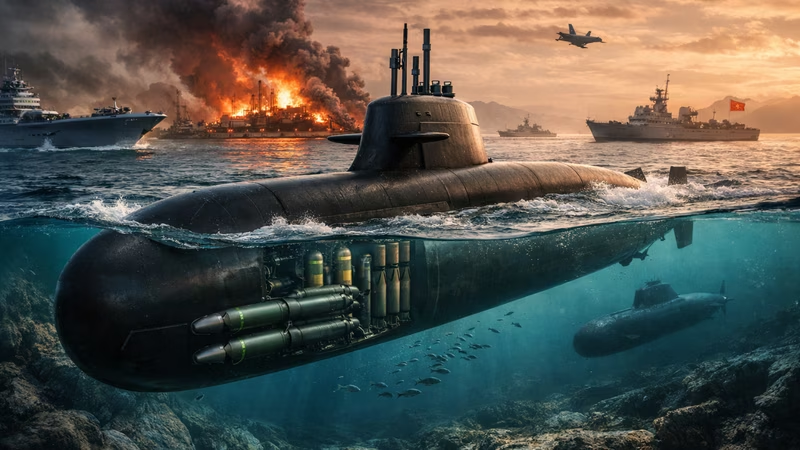
At its core, Project-75I aims to deliver six advanced diesel-electric attack submarines to the Indian Navy. But it’s not just about numbers—it’s about quality, stealth, and self-reliance.
The selected platform, the German-origin **Type-214NG**, is among the world’s most sophisticated non-nuclear submarines. Its key advantages include:
- Air-Independent Propulsion (AIP): Allows the sub to stay submerged for up to 18 days without surfacing—critical for evading detection.
- Advanced sonar and combat systems: Enables precision targeting and superior situational awareness.
- Vertical launch system compatibility: Potential to fire land-attack cruise missiles, adding strategic depth.
- Indigenous construction: All six submarines will be built in India—at Mazagon Dock Shipbuilders (Mumbai) and Goa Shipyard—with significant technology transfer from the original equipment manufacturer.
This isn’t just a buy-it deal; it’s a build-it, master-it mission under the ‘Make in India’ defense initiative .
China’s Undersea Expansion and the Indian Ocean Stakes
China’s People’s Liberation Army Navy (PLAN) now operates over 60 submarines, including nuclear-powered attack and ballistic missile variants. More alarmingly, Chinese subs have been making regular forays into the Indian Ocean—often docking at ports like Gwadar (Pakistan) and Hambantota (Sri Lanka), both part of Beijing’s Belt and Road Initiative .
These deployments aren’t just symbolic. They enable intelligence gathering, potential disruption of sea lanes, and rapid power projection—all within striking distance of India’s western and southern coasts. In this context, Project-75I is India’s countermove: a stealthy, agile, and locally maintained undersea shield designed to monitor, deter, and if necessary, neutralize hostile assets .
Pakistan Navy: The Secondary (But Real) Threat
While China is the primary strategic concern, Pakistan remains a persistent tactical challenge. The Pakistan Navy recently inducted eight Hangor-class submarines—based on China’s Type-039 design—built with direct Chinese assistance. These vessels, though less advanced than the Type-214NG, significantly boost Islamabad’s anti-access capabilities in the Arabian Sea.
Given that over 80% of India’s seaborne trade passes through this region, any threat to maritime security directly impacts the economy. Project-75I ensures the Indian Navy maintains qualitative superiority, preventing Pakistan from achieving even temporary undersea dominance during a crisis .
‘Make in India’ Meets Military Tech
Perhaps the most transformative aspect of Project-75I is its emphasis on domestic production. Unlike previous deals that involved full imports, this program mandates that major subsystems—including sonar, weapons, and AIP—are either developed in India or co-produced with foreign partners.
This approach does three things:
- Reduces long-term dependency on foreign suppliers for maintenance and spares.
- Builds a sovereign defense industrial base capable of future innovation.
- Creates high-skilled jobs in shipbuilding, electronics, and materials science.
For a nation that still imports nearly 60% of its defense hardware, this shift is revolutionary .
Strategic Impact on Indo-Pacific Security
Beyond bilateral rivalries, Project-75I strengthens India’s role as a “net security provider” in the Indo-Pacific—a concept championed by Quad partners (US, Japan, Australia, India). A robust, modern submarine fleet allows India to contribute more effectively to regional stability, freedom of navigation, and humanitarian operations.
It also sends a clear message to adversaries: India is investing not just in defense, but in deterrence by denial. If hostile submarines can’t operate freely in the Indian Ocean, their strategic value plummets.
Conclusion
Project-75I is far more than a naval procurement program. It’s a strategic declaration of intent. By combining world-class German engineering with Indian manufacturing prowess, New Delhi is building a silent but formidable force that will shape maritime dynamics for decades. In the high-stakes chess game against China’s expansionism and Pakistan’s asymmetric tactics, these six submarines may well become India’s most valuable pieces on the board.