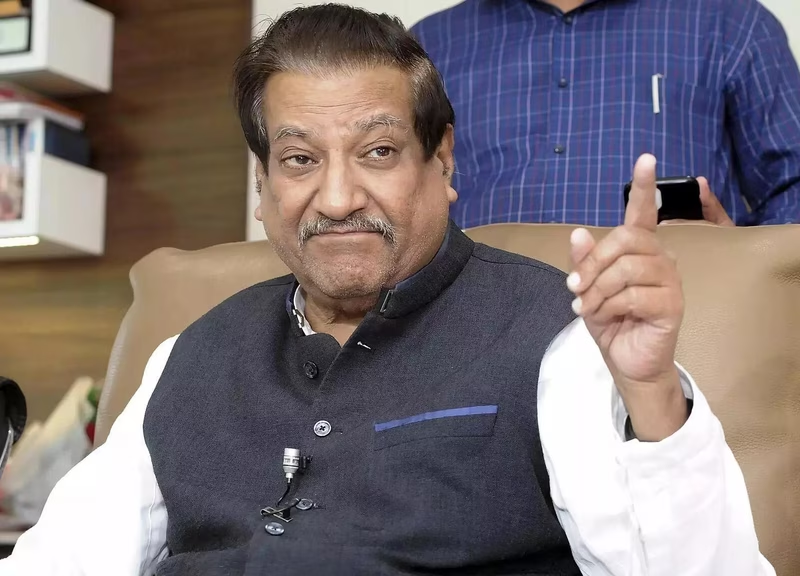
In a stunning and widely criticized statement, former Maharashtra Chief Minister Prithviraj Chavan has drawn a bizarre parallel between the US-led geopolitical maneuvering in Venezuela and India’s own foreign policy stance—going so far as to ask aloud: “Will Trump kidnap our PM?” The remark, made during a public address amid escalating trade tensions between New Delhi and Washington, has sparked national debate over diplomatic decorum, economic sovereignty, and the limits of political rhetoric.
Chavan’s comments came in the context of two major international flashpoints: the reported CIA-backed operation in Venezuela and the recent imposition of a 50% tariff by the United States on select Indian exports . While criticizing the Indian government’s silence on Venezuela, Chavan suggested that New Delhi’s reluctance to speak out stems from a “fear of the US”—a fear so profound, he implied, that it might even invite extreme actions from a former US president known for his unpredictable style.
Table of Contents
- The Controversial Remark in Context
- Prithviraj Chavan Trump and the Venezuela Connection
- The Real Issue: US Tariffs and India’s Export Crisis
- Political Reactions and Public Backlash
- What India Can Do: Alternative Markets and Strategic Autonomy
- Conclusion
- Sources
The Controversial Remark in Context
Speaking at a public forum in Pune, Chavan questioned the Indian government’s muted response to the alleged US role in Venezuela’s political turmoil. “While the world discusses covert operations and regime change,” he said, “India remains silent. Are we so afraid of America that we can’t even express concern? Will Trump kidnap our PM next?”
The hyperbolic question was clearly rhetorical—but its framing has been condemned by opposition and ruling party members alike as reckless and damaging to national dignity. While Chavan later clarified he was highlighting “asymmetry in global power dynamics,” the soundbite has gone viral, overshadowing his intended critique of India’s trade vulnerability.
Prithviraj Chavan Trump and the Venezuela Connection
Chavan’s remarks tie together two seemingly unrelated events:
- The Venezuela Crisis: Reports from multiple Western outlets have alleged that US intelligence agencies, including the CIA, were involved in a failed 2025 operation to oust Venezuelan President Nicolás Maduro—a claim the US has neither confirmed nor denied .
- India’s Strategic Silence: Unlike countries like Russia, China, and even some European nations, India has refrained from commenting on Venezuela’s internal affairs, a stance Chavan calls “subservient.”
By invoking Donald Trump—a figure synonymous with aggressive foreign policy and personal diplomacy—Chavan sought to dramatize what he sees as India’s loss of strategic autonomy. But experts argue that conflating Venezuela with India’s bilateral relationship with the US is both inaccurate and inflammatory.
The Real Issue: US Tariffs and India’s Export Crisis
Beneath the sensational headline lies a serious economic concern. The US has recently imposed a 50% tariff on a range of Indian goods, including textiles, pharmaceuticals, and engineering products, citing “unfair trade practices” and intellectual property concerns .
This move could cost India an estimated $8–10 billion in annual exports, hitting small and medium enterprises (SMEs) the hardest. Chavan’s core argument—that India must diversify its export markets to reduce dependence on the US—is actually shared by many economists and trade experts.
“Relying on a single major market is risky,” says Dr. Meera Joshi, a trade policy analyst at the Indian Council for Research on International Economic Relations (ICRIER). “But the solution is not provocative rhetoric—it’s building stronger trade ties with the EU, Africa, and ASEAN.”
Political Reactions and Public Backlash
Chavan’s “kidnap” comment drew swift condemnation:
- Bharatiya Janata Party (BJP): Called the remark “childish” and “an insult to the office of the Prime Minister.”
- Congress leadership: Distanced itself, with a senior spokesperson stating, “While we respect Mr. Chavan’s views, this language is unbecoming of a former CM.”
- Public sentiment: Social media erupted with memes and criticism, with many accusing Chavan of seeking headlines rather than offering constructive policy alternatives.
Interestingly, some foreign policy scholars noted that while the phrasing was inappropriate, the underlying anxiety—about US hegemony and India’s constrained diplomatic space—is a legitimate topic for democratic debate .
What India Can Do: Alternative Markets and Strategic Autonomy
Instead of inflammatory questions, experts suggest practical steps for India to navigate this complex landscape:
- Accelerate FTA talks with the EU and UK to open new export corridors.
- Boost trade with Global South nations through India’s G20 legacy initiatives.
- Strengthen domestic manufacturing under the ‘Make in India’ 2.0 framework to reduce import dependency.
- Engage in quiet diplomacy on sensitive issues like Venezuela, avoiding public grandstanding that could backfire.
[INTERNAL_LINK:india-us-trade-relations-2026] For an in-depth look at how the 50% US tariff impacts Indian industries, see our detailed report.
Conclusion
Prithviraj Chavan’s “Will Trump kidnap our PM?” remark may have been a rhetorical misfire, but it has inadvertently spotlighted a critical strategic dilemma: how can India assert its sovereignty while remaining economically intertwined with a superpower that increasingly uses tariffs as a political weapon? The answer lies not in sensationalism, but in smart statecraft, economic diversification, and a foreign policy that balances principle with pragmatism. In the end, national security and dignity are best defended with strategy—not soundbites.
Sources
- Times of India: ‘Will Trump kidnap our PM?’ Prithviraj Chavan’s bizarre remark amid Venezuela crisis
- The Hindu: US Imposes 50% Tariff on Select Indian Exports
- Reuters: Alleged US Role in Venezuela Operation Draws Global Scrutiny
- Ministry of External Affairs, India: Official Statements on International Affairs
- [INTERNAL_LINK:india-foreign-policy-under-modi] India’s Foreign Policy: Balancing Act in a Multipolar World