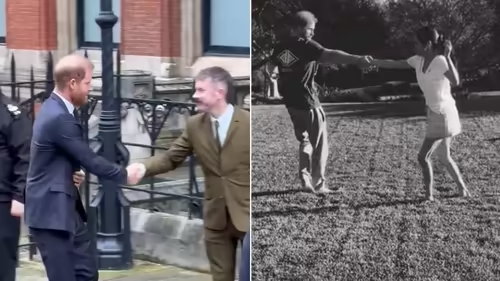
He walked into a London courtroom for a high-stakes legal battle—but what dominated headlines wasn’t his testimony or his case. It was his hair. Prince Harry’s latest public appearance has sent social media into a tailspin, with users joking, “Did he leave his hair in Montecito?” The stark contrast between his current look and a recent throwback photo posted by Meghan Markle has turned his Prince Harry hairline into an unexpected global talking point .
While the Duke of Sussex battles legal issues over UK press intrusion, the internet is fixated on something far more personal: the visible signs of aging and thinning that many men experience—but few are scrutinized for as intensely as a royal.
Table of Contents
- The Montecito vs. London Contrast
- Social Media Reactions to Prince Harry Hairline
- The Science Behind Male Pattern Baldness
- Why Are We So Obsessed With Royal Hair?
- How Harry’s Image Has Evolved Since Leaving the UK
- Conclusion: Beyond the Hairline
- Sources
The Montecito vs. London Contrast
The controversy began when Meghan Markle shared a nostalgic Instagram post from their life in Montecito—a sun-drenched image of Harry with a full, tousled head of hair, looking relaxed and youthful . Fast forward to January 2026, and the same man appears in a London courtroom with a visibly receded hairline and thinner crown, his forehead more prominent under the harsh courtroom lights.
The juxtaposition was jarring. Fans and critics alike couldn’t help but notice the difference. While aging is natural, the speed and visibility of the change—amplified by royal photography standards and relentless media coverage—turned a private biological process into a public spectacle.
Social Media Reactions to Prince Harry Hairline
Twitter, Instagram, and TikTok exploded with memes and commentary. One popular tweet read: “Harry left his hair, his accent, and his peace in California.” Another user quipped, “Montecito gave him glow-ups. London gave him stress and a receding hairline.”
While some comments were lighthearted, others sparked deeper conversations about double standards:
- Gender Bias: Female royals like Kate Middleton are praised for “aging gracefully,” while men like Harry face ridicule for normal hair loss.
- Stress Factor: Many pointed out that Harry’s legal battles, media scrutiny, and relocation stress could accelerate hair thinning—a medically recognized phenomenon.
- Privacy Invasion: Critics argued that focusing on his appearance during a serious legal proceeding is a form of body-shaming and distracts from the actual issues at hand.
The Science Behind Male Pattern Baldness
For those wondering if this is just “bad lighting” or something more, the answer lies in genetics and hormones. According to the American Academy of Dermatology, male pattern baldness (androgenetic alopecia) affects about 50% of men by age 50—and can start as early as the 20s .
Prince Harry’s maternal grandfather, Mark Shand, also experienced significant hair loss, suggesting a strong genetic component. Add to that chronic stress—a known trigger for telogen effluvium (temporary hair shedding)—and the picture becomes clearer. His lifestyle shift from sunny California to the pressures of London courtrooms may have simply accelerated a natural process.
Why Are We So Obsessed With Royal Hair?
Royals are held to impossible aesthetic standards. Their hair isn’t just hair—it’s a symbol of vitality, youth, and regal composure. From Prince William’s carefully coiffed locks to Queen Elizabeth’s iconic updos, royal hair has always been part of the brand.
But in the age of social media, every strand is magnified. Harry’s transformation from a “ginger heartthrob” to a stressed father of two makes him more human—but the public isn’t always ready to accept that humanity. The obsession with his Prince Harry hairline reflects our broader cultural fixation on celebrity perfection and the discomfort we feel when icons show vulnerability.
How Harry’s Image Has Evolved Since Leaving the UK
Since stepping back as senior royals in 2020, Harry and Meghan have cultivated a more “authentic” image—less stiff, more emotional, often barefoot in Montecito. But returning to the UK for legal fights forces Harry back into the rigid, scrutinized world he tried to escape.
The contrast isn’t just sartorial—it’s existential. In Montecito, he’s a husband, dad, and wellness advocate. In London, he’s a litigant, a former prince, and a target. His changing appearance mirrors this internal tension. As one royal commentator noted, “His hair might be thinning, but his resolve seems stronger than ever.”
Conclusion: Beyond the Hairline
Yes, Prince Harry’s hairline has receded. But reducing his current chapter to a meme misses the bigger story: a man fighting for privacy, grappling with legacy, and navigating fatherhood under a global microscope. The real takeaway isn’t how much hair he’s lost—it’s how much he’s willing to risk to protect his family’s future.
While the internet debates follicles, Harry’s legal team is preparing for a landmark privacy trial that could reshape UK media laws. That’s the headline worth remembering. For more on the Sussexes’ legal battles, check out our [INTERNAL_LINK:royal-legal-cases] coverage.
Sources
- Times of India: ‘Did he leave his hair in Montecito?’: Prince Harry mocked over courtroom look
- American Academy of Dermatology: Male pattern baldness: Overview
- BBC News: Prince Harry’s High Court case explained
- The Guardian: Harry’s legal fight against UK tabloids