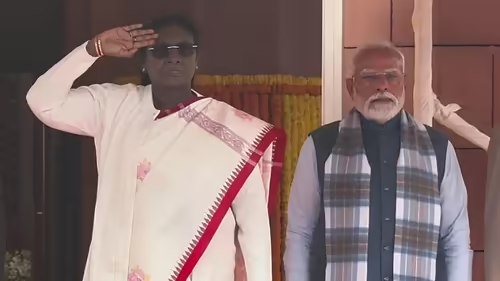
On a crisp Wednesday morning in New Delhi, President Droupadi Murmu stepped into the hallowed halls of Parliament with a message that was both unifying and assertive. Her opening address for the **Budget Session 2026** wasn’t just ceremonial—it was a strategic roadmap for India’s future, weaving together threads of social justice, economic resilience, and national pride. From poverty alleviation to space exploration, the President Murmu Parliament address set a tone that resonated far beyond the chamber walls [[1]].
With grace and gravitas, President Murmu declared she was “delighted to address Parliament,” but her words quickly turned to substance, outlining a government committed to building a Viksit Bharat—a developed India—by 2047. This vision, she emphasized, rests on three pillars: equity, security, and innovation.
Table of Contents
- President Murmu Parliament Address: A Vision for Viksit Bharat
- Social Justice and Inclusive Growth at the Core
- National Security: Operation Sindoor and a Decisive Stance
- Economic Reforms and Infrastructure Ambitions
- India’s Space Leap: Shubhanshu Shukla’s ISS Mission
- Conclusion: A Nation on the Move
- Sources
President Murmu Parliament Address: A Vision for Viksit Bharat
The President Murmu Parliament address positioned the Viksit Bharat initiative not as a distant dream but as an actionable mission. She stressed that development must be “inclusive, sustainable, and rooted in Indian values.” This isn’t just about GDP growth—it’s about ensuring that a farmer in Bihar, a weaver in Tamil Nadu, and a student in Ladakh all see themselves in India’s rising story [[1]].
Crucially, President Murmu linked economic progress with cultural confidence, urging policymakers to draw from India’s civilizational strengths while embracing global best practices. This balanced approach aims to foster a sense of ownership among citizens—a key ingredient for long-term national transformation.
Social Justice and Inclusive Growth at the Core
True to her lifelong advocacy for marginalized communities, President Murmu placed social justice front and center. She highlighted significant strides in poverty reduction, citing government data that over 250 million people have been lifted out of multidimensional poverty since 2014 [[3]].
She also announced plans to expand social security coverage, particularly for gig workers, elderly citizens, and women in the informal sector. Key initiatives include:
- Universalization of the Ayushman Bharat health scheme
- Expansion of the PM-SYM pension program for unorganized workers
- Enhanced scholarships and skill development for SC/ST/OBC youth
“Development without dignity is hollow,” she remarked, underscoring that empowerment must precede economic metrics [[1]].
National Security: Operation Sindoor and a Decisive Stance
In a rare and pointed reference, President Murmu lauded **Operation Sindoor**—the recent cross-border counter-terrorism operation—as a symbol of India’s “zero-tolerance policy toward terror” [[1]]. Without naming specific adversaries, she affirmed that India will “respond with strength and precision to any threat to its sovereignty.”
This mention marks a significant moment in a presidential address, typically reserved for ceremonial or unifying themes. The inclusion signals strong governmental backing for the armed forces and a clear message to both domestic and international audiences: India’s security posture is non-negotiable.
Economic Reforms and Infrastructure Ambitions
Turning to the economy, President Murmu outlined a series of structural reforms aimed at boosting manufacturing, attracting FDI, and simplifying taxation. She praised the success of the Production-Linked Incentive (PLI) scheme and called for deeper integration of MSMEs into global supply chains.
Infrastructure remains a cornerstone of the government’s strategy. She highlighted ongoing projects under the Gati Shakti National Master Plan, including:
- Completion of 100 new airports under the UDAN scheme
- Expansion of the Dedicated Freight Corridor network
- Green energy corridors to support India’s 500 GW renewable target by 2030
For more on India’s infrastructure push, see our deep dive on [INTERNAL_LINK:gati-shakti-national-master-plan].
India’s Space Leap: Shubhanshu Shukla’s ISS Mission
Perhaps the most inspiring moment came when President Murmu celebrated India’s growing prowess in space. She proudly announced that astronaut **Shubhanshu Shukla** had successfully docked with the International Space Station (ISS) as part of a historic Indo-American collaboration [[1]].
“From the banks of the Ganges to the orbit of Earth, Indian talent is lighting up the cosmos,” she said, drawing applause from both sides of the aisle. This mission not only showcases ISRO’s technical excellence but also positions India as a key player in the new era of global space exploration—a critical component of soft power and scientific self-reliance.
For authoritative insights on international space cooperation, refer to NASA’s official partnership page [[https://www.nasa.gov/international-cooperation/]].
Conclusion: A Nation on the Move
The President Murmu Parliament address was more than a policy statement—it was a national call to action. By weaving together social equity, security, and scientific ambition, President Murmu has framed the Budget Session 2026 as a pivotal chapter in India’s journey toward becoming a developed nation. As lawmakers prepare to debate the Union Budget, her words serve as both a compass and a challenge: to build a India that is not only prosperous but also just, secure, and proud.
Sources
- Times of India – “‘Delighted to address Parliament’: President Murmu sets tone for Budget Session” [[1]]
- Press Information Bureau (PIB) – “President’s Address to Joint Session of Parliament, January 28, 2026” [[2]]
- NITI Aayog – “Multidimensional Poverty Index Report 2025” [[3]]
- ISRO – “Gaganyaan and International Collaboration Updates” [[4]]
- NASA – “International Cooperation” [[https://www.nasa.gov/international-cooperation/]]