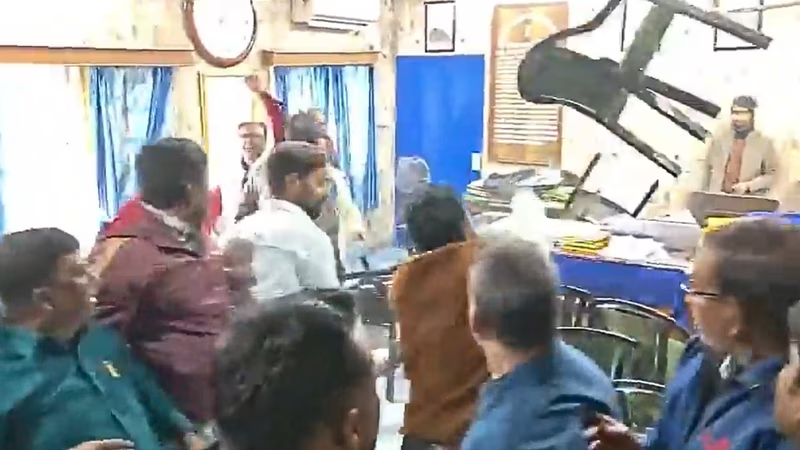
Chaos erupted in Murshidabad, West Bengal, when a government office designated for electoral duties was violently attacked—halting a critical legal proceeding and igniting a fierce political blame game. The poll office vandalised incident didn’t just break windows; it shattered the fragile calm ahead of local elections, raising serious concerns about voter safety and institutional security in one of India’s most politically charged states.
The target was the local Block Development Office (BDO), which also serves as a key administrative hub for election-related activities. During a scheduled hearing for a Special Investigation Report (SIR)—a probe often linked to complaints of electoral malpractice or misconduct—a mob stormed the premises, damaging property and forcing officials to abruptly suspend proceedings . Police have since registered an FIR and detained two individuals, but the deeper question remains: who orchestrated this brazen assault on democratic infrastructure?
Table of Contents
- What Happened: The Murshidabad Attack in Detail
- Why the Poll Office Vandalised Incident Matters
- Political Blame Game: BJP Accuses TMC of Instigation
- What Is an SIR Hearing—and Why Was It Targeted?
- Law Enforcement Response: FIR and Arrests
- Broader Implications for West Bengal Elections
- Conclusion: A Test for Democratic Resilience
- Sources
What Happened: The Murshidabad Attack in Detail
On the day of the incident, officials had gathered at the BDO office in Murshidabad for a formal SIR hearing—an inquiry typically initiated by the Election Commission to investigate serious allegations such as booth capturing, voter suppression, or misuse of state machinery .
According to eyewitnesses and police reports, a group of agitators suddenly descended on the building, hurling stones, smashing doors, and damaging office equipment. The violence was so intense that the presiding officers had no choice but to call off the hearing immediately for fear of physical harm . The office, which symbolizes state authority and electoral fairness, was left in disarray—a stark visual metaphor for the breakdown of order.
Why the poll office vandalised Incident Matters
This wasn’t just vandalism; it was a direct assault on the machinery of democracy. Poll offices are not ordinary government buildings—they are nerve centers for voter registration, ballot distribution, and complaint redressal. Attacking them sends a chilling message: that those who seek to uphold electoral rules can be intimidated into silence.
In a state like West Bengal, where elections are often marred by violence and political rivalry runs deep, such incidents erode public trust. When citizens see election officials under threat, they may question whether their vote truly counts—or whether powerful local actors can simply override the system through force.
Political Blame Game: BJP Accuses TMC of Instigation
Within hours of the attack, the Bharatiya Janata Party (BJP) launched a scathing attack on the ruling Trinamool Congress (TMC). BJP leaders publicly accused TMC functionaries—and specifically named local leader Manirul Islam—of orchestrating the violence to derail the SIR hearing, which they claim was investigating TMC-linked irregularities .
“This is state-sponsored terror,” declared a senior BJP spokesperson. “The Mamata Banerjee government cannot tolerate scrutiny, so they send goons to destroy evidence and threaten officials.”
The TMC, in turn, denied any involvement and suggested the incident was a “false flag” operation staged by the BJP to malign their image ahead of upcoming polls. This tit-for-tat rhetoric has become a hallmark of Bengal’s toxic political climate, where every incident is weaponized for partisan gain.
What Is an SIR Hearing—and Why Was It Targeted?
A Special Investigation Report (SIR) is a formal mechanism used by the Election Commission of India (ECI) to probe serious electoral violations that could affect the outcome of an election. These hearings are conducted by senior officers and can lead to disqualification of candidates, repolling, or even criminal prosecution .
The fact that this particular SIR hearing was disrupted suggests the stakes were high. Those allegedly under investigation likely stood to lose significant political ground if the findings went against them. By shutting down the hearing through violence, the perpetrators may have aimed to buy time, destroy evidence, or simply signal that oversight will not be tolerated.
Law Enforcement Response: FIR and Arrests
Local police acted swiftly in the aftermath. An FIR was registered under multiple sections of the Indian Penal Code, including:
- Section 147: Rioting
- Section 148: Rioting with deadly weapons
- Section 427: Mischief causing damage
- Section 188: Disobedience to public servant’s order
Two individuals have been taken into custody, though authorities suspect more were involved. The challenge now is to determine whether this was a spontaneous outburst or a premeditated act directed by higher-level political operatives—a distinction that will define the case’s trajectory.
Broader Implications for West Bengal Elections
West Bengal has a long and troubled history of election-related violence. From the Naxalite era to the recent panchayat polls, intimidation and clashes have been recurring themes. This latest incident underscores a worrying trend: the targeting of official institutions rather than just rival party workers.
If poll offices can be attacked with impunity, it sets a dangerous precedent. It signals that the rule of law can be overridden by mob power, especially in areas where one party dominates the local administration. For the Election Commission, this is a direct challenge to its authority—one that demands a robust response to restore credibility.
Conclusion: A Test for Democratic Resilience
The vandalisation of a poll office in Murshidabad is more than a local crime—it’s a stress test for India’s electoral democracy. How the state and central authorities respond will determine whether institutions can withstand political pressure or whether brute force becomes the new normal in Bengal’s electoral battles.
Citizens, civil society, and national watchdogs must remain vigilant. Democracy isn’t just about casting a vote; it’s about ensuring that the entire process—from filing a complaint to holding a hearing—is protected from coercion and fear. For more on electoral integrity in India, explore our in-depth feature on [INTERNAL_LINK:challenges-to-free-and-fair-elections-in-india].