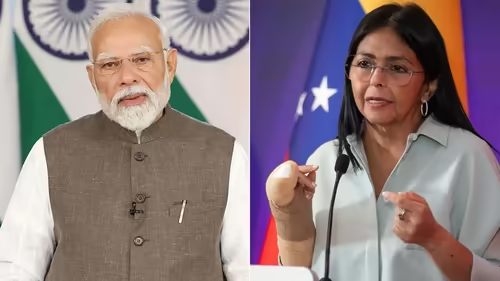
In a world where geopolitical chess moves happen at lightning speed, a phone call can speak volumes. On January 30, 2026, Prime Minister Narendra Modi picked up the phone and dialed Caracas, speaking with Venezuela’s newly appointed acting President, Delcy Rodríguez [[1]]. The official statement was brief and diplomatic: both leaders agreed to deepen bilateral ties. But in the shadow of Venezuela’s recent, dramatic political upheaval, this simple conversation begs a far more complex question: What is India really after?
Table of Contents
- Venezuela’s New Reality: Who is Delcy Rodríguez?
- The PM Modi Venezuela Call: Decoded
- India and Venezuela: A History of Limited Engagement
- Strategic Interests or Diplomatic Formality?
- Conclusion: A Calculated Gesture
- Sources
Venezuela’s New Reality: Who is Delcy Rodríguez?
Before we can understand the significance of the PM Modi Venezuela call, we must grasp the extraordinary context from which it emerged. Just weeks before, on January 5, 2026, Delcy Rodríguez was sworn in as acting president following the stunning capture and extraction of long-time leader Nicolás Maduro by U.S. special forces [[22]]. This event sent shockwaves through the international community.
Rodríguez, previously Venezuela’s vice president, now leads a nation in profound crisis. Her government is grappling with internal political infighting, a humanitarian emergency, and the immense challenge of stabilizing a country whose primary asset—oil—is now under significant U.S. influence [[24]]. Her recognition by Venezuela’s armed forces on January 28th was a crucial step in consolidating her fragile authority [[25]]. In this precarious moment, a call from a major global leader like PM Modi is not just a courtesy; it’s a vital signal of international legitimacy.
The PM Modi Venezuela Call: Decoded
The official readout from the Prime Minister’s Office was characteristically concise. It stated that the two leaders had a “warm and friendly” conversation and “agreed to deepen our bilateral partnership in all areas of mutual interest” [[1]]. While the specifics of their discussion remain private, we can infer the likely agenda based on historical ties and current realities.
The conversation almost certainly touched on:
- Political Stability: India, a champion of non-interference, would express its hope for a peaceful and stable transition in Venezuela, aligning with its broader foreign policy principles.
- Economic Potential: Despite current low trade volumes, Venezuela remains a resource-rich nation. India may have signaled its interest in future opportunities, particularly in energy and pharmaceuticals, once stability returns.
- Multilateral Coordination: Both nations often find common ground in forums like the UN. They likely discussed coordination on global issues of shared concern.
India and Venezuela: A History of Limited Engagement
It’s important to temper expectations. The relationship between India and Venezuela has historically been warm but limited in substance. Bilateral trade, which peaked at over $7.3 billion in FY19, has plummeted to just $1.6 billion in FY25 [[9]]. India’s imports from Venezuela, primarily crude oil, have seen an 81.3% drop year-on-year, totaling only $364.5 million in FY25 [[11]].
This decline is directly linked to the U.S. sanctions regime and the broader instability in Venezuela. India, while maintaining its diplomatic channels, has pragmatically diversified its oil imports away from the troubled nation. Therefore, any talk of a massive, immediate economic partnership is unrealistic. The current engagement is more about laying a foundation for the future than reaping immediate rewards.
Strategic Interests or Diplomatic Formality?
So, was this call a masterstroke of strategy or simply a necessary diplomatic box to be ticked? The truth likely lies somewhere in between.
The Case for Strategy: By reaching out early to the new acting president, India positions itself as a friend of Venezuela during its most vulnerable hour. This builds goodwill that could pay dividends later. It also subtly signals to other global powers, including the U.S., that India maintains an independent foreign policy and is not afraid to engage with complex situations. For India’s growing ambitions in Latin America, this is a crucial step in building a reputation as a reliable and consistent partner [INTERNAL_LINK:india-latin-america-policy].
The Case for Formality: On the other hand, given the minimal current economic stakes, the call could be seen as a standard protocol. When a new head of state emerges, world leaders are expected to make contact. It’s a way of acknowledging the new reality without making a major strategic commitment. India’s interests in Venezuela are currently negligible, so the call may be more about optics than a deep, actionable plan [[14]].
Conclusion: A Calculated Gesture
The PM Modi Venezuela phone call is best understood as a calculated, forward-looking diplomatic gesture. It is not a signal of an imminent, transformative partnership, but rather a smart investment in a potential future one. In a world where alliances are constantly shifting, India is wisely keeping its options open. By engaging with Delcy Rodríguez now, PM Modi ensures that when Venezuela eventually finds its footing, India will be remembered as a nation that offered a hand of friendship during its darkest days. It’s a move that costs little but could yield significant diplomatic capital down the line.
Sources
- [[1]] LiveMint: “PM Modi speaks to Venezuela’s acting President Rodriguez”
- [[9]] Wright Research: “US Takes Over Venezuela Oil: Impact Globally and on India”
- [[11]] The Hindu Business: “U.S.-Venezuelan conflict not to impact India’s trade: GTRI”
- [[14]] Ommcom News: “India’s Economic Interests In Venezuela Minimal”
- [[22]] ConstitutionNet: “Venezuela: Is a democratic transition possible?”
- [[24]] The New Humanitarian: “What next for the humanitarian crisis and response in Venezuela”
- [[25]] Xinhua News: “Venezuela’s armed forces recognize acting president”