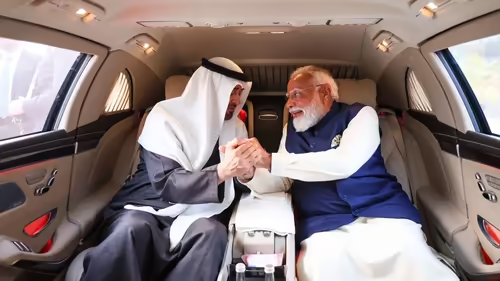
When Prime Minister Narendra Modi greeted UAE President Sheikh Mohamed bin Zayed Al Nahyan (MBZ) at New Delhi’s airport with a warm “Welcome, brother,” and then shared a car ride with him into the capital, it wasn’t just protocol—it was a potent political statement . This rare gesture of personal camaraderie between two of Asia’s most influential leaders underscores a dramatic deepening of the India-UAE strategic partnership, now entering a new era of collaboration on everything from defense and energy to food security and global governance.
Their brief but high-impact meeting—part of President MBZ’s whirlwind two-hour stopover in India—is far more than a photo op. It’s the latest milestone in a relationship that has transformed from transactional trade ties into a comprehensive geopolitical alliance. With China’s influence expanding in the Gulf and global supply chains being redrawn, this PM Modi UAE President MBZ meeting couldn’t be more timely.
Table of Contents
- A Brotherly Gesture: Symbolism Behind the Shared Car Ride
- The Strategic Agenda: Key Topics on the Table
- From Trade to Tech: The India-UAE Economic Revolution
- Defense and Security: Deepening Military Ties
- Regional Diplomacy: Aligning on Middle East and Beyond
- Why This Partnership Matters for India’s Global Ambitions
- Conclusion: A Model for South Asia-Gulf Cooperation
- Sources
A Brotherly Gesture: Symbolism Behind the Shared Car Ride
In diplomatic circles, who rides with whom—and how—carries immense weight. PM Modi personally receiving President MBZ at the tarmac and sharing a vehicle is a departure from standard protocol, where visiting heads of state are usually escorted separately. This intimate gesture echoes their previous meetings in Abu Dhabi and New York, where both leaders have consistently emphasized mutual respect and shared vision .
It also reflects the personal rapport that has developed between the two leaders since MBZ became UAE President in 2022. Unlike many state visits driven purely by bureaucracy, this relationship is marked by direct, leader-to-leader trust—a critical asset in today’s volatile geopolitical climate.
The Strategic Agenda: Key Topics on the Table
Though the visit lasted only two hours, the agenda was packed. The core focus remains on advancing the India-UAE Comprehensive Strategic Partnership, launched in 2017 and upgraded multiple times since. Key discussion points included:
- Trade & Investment: Accelerating the implementation of the Comprehensive Economic Partnership Agreement (CEPA), which has already boosted bilateral trade to over $85 billion .
- Food & Energy Security: Expanding joint ventures in food parks, renewable energy, and critical mineral supply chains.
- Defense Collaboration: Progress on defense industrial co-production and intelligence sharing.
- Regional Stability: Coordinating positions on West Asia, including the Israel-Hamas conflict and Red Sea security.
From Trade to Tech: The India-UAE Economic Revolution
The economic pillar of this partnership is nothing short of revolutionary. Since CEPA came into force in 2022, Indian exports to the UAE have surged by over 60%, with sectors like gems, pharmaceuticals, and electronics leading the charge . But the ambition goes beyond goods.
Both nations are now investing heavily in digital infrastructure, AI startups, and green hydrogen. The UAE’s $75 billion commitment to India’s infrastructure and tech ecosystem—including major stakes in Reliance and Adani projects—shows this is a long-term bet on India’s growth story [INTERNAL_LINK:india-uae-investment-deals].
Defense and Security: Deepening Military Ties
Once limited to arms purchases, India-UAE defense cooperation is now multifaceted. Recent developments include:
- Joint military exercises in desert warfare and maritime domains.
- UAE’s interest in co-producing Indian defense platforms like the Tejas fighter jet.
- Intelligence sharing on counter-terrorism and maritime threats in the Arabian Sea.
This alignment is especially significant as both nations seek to counterbalance external pressures and ensure autonomy in their security decisions.
Regional Diplomacy: Aligning on Middle East and Beyond
On the global stage, India and the UAE are increasingly singing from the same hymn sheet. Both support a multipolar world order and have resisted being drawn into bloc politics. They’ve jointly advocated for reforming multilateral institutions like the UN and have played quiet but crucial roles in de-escalating regional tensions—from facilitating grain deals to backchannel diplomacy during crises .
With the Gulf becoming a new arena of great-power competition, this partnership offers India a stable anchor in West Asia and gives the UAE a reliable democratic partner in Asia.
Why This Partnership Matters for India’s Global Ambitions
For India, the UAE is more than a trade partner—it’s a strategic gateway. It provides access to Arab markets, investment capital, and diplomatic leverage in Islamic forums. As India eyes a permanent seat on the UN Security Council and seeks leadership in the Global South, strong Gulf ties are indispensable.
Conversely, the UAE sees India as a counterweight to volatility, a source of skilled labor, and a massive consumer market. In an era of fragmentation, this alliance is a rare example of win-win geopolitics.
Conclusion: A Model for South Asia-Gulf Cooperation
The PM Modi UAE President MBZ meeting may have been brief, but its implications are long-lasting. From shared car rides to shared strategic visions, this relationship exemplifies how personal diplomacy can catalyze institutional transformation. As global uncertainties mount, the India-UAE partnership stands as a beacon of pragmatic, mutually beneficial cooperation—one that other nations would do well to study.
Sources
- Times of India: “India-UAE ties: PM Modi receives Prez MBZ at airport on short 2-hr trip to India”
- Ministry of External Affairs, Government of India: Official MEA Website
- UAE Embassy in India – Bilateral Relations: UAE Embassy Portal
- Brookings Institution – “The India-UAE Partnership in a Multipolar World”: High-Authority Analysis