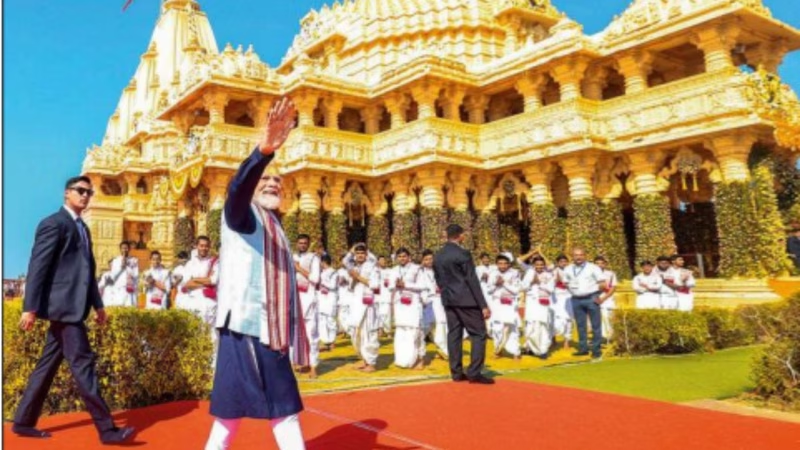
Standing against the majestic backdrop of the ancient Somnath temple in Gujarat, Prime Minister Narendra Modi delivered a speech that was as much a historical reflection as it was a sharp political warning. On Monday, January 12, 2026, during a public event marking a significant cultural milestone, PM Modi declared with firm resolve: “Appeasers and dividers are still active.”
This powerful statement, echoing through the very grounds that have witnessed centuries of resilience, was not just a rhetorical flourish. It was a direct call to action for the nation to guard its hard-won unity against forces—both overt and subtle—that seek to fragment its social fabric. In an era of heightened political and social discourse, Modi’s words carry immense weight and demand deep analysis.
Table of Contents
- The Historic Stage: Somnath as a Symbol
- Decoding PM Modi’s Key Message
- Who Are the ‘Appeasers and Dividers’?
- The Broader Political Context of the Speech
- Public and Expert Reactions
- Conclusion: A Call for Vigilant Unity
- Sources
The Historic Stage: Somnath as a Symbol
The choice of Somnath for this address was deeply symbolic. The temple, which has been destroyed and rebuilt multiple times throughout history, stands as an enduring emblem of India’s civilizational resilience and its ability to rise from adversity . By speaking here, PM Modi was drawing a parallel between the physical reconstruction of the temple and the ongoing effort to fortify the nation’s social and cultural unity.
His presence at this sacred site, a project championed by Sardar Vallabhbhai Patel—the architect of modern India’s integration—further underscored his message of national cohesion over division. It was a masterful use of historical narrative to frame a contemporary political argument.
Decoding PM Modi’s Key Message
At the heart of Modi’s speech was a clear dichotomy: on one side, the builders and unifiers of the nation; on the other, the “appeasers and dividers.” He argued that while India has made tremendous progress, these negative forces have not vanished. They have merely adapted their tactics .
He warned that these elements work by sowing seeds of doubt, exploiting regional or religious identities for narrow political gain, and attempting to weaken the collective spirit of the nation. His message was a plea for citizens to recognize these attempts and to consciously reject them in favor of a larger, shared national identity.
Who Are the ‘Appeasers and Dividers’?
While PM Modi did not name specific individuals or parties, his description points to a well-established political narrative. In this context:
- “Appeasers” typically refer to those accused of making political concessions or compromises based on vote-bank politics, often at the cost of long-term national interest or principle.
- “Dividers” are seen as actors who deliberately amplify differences—be they religious, linguistic, or caste-based—to create social fissures and maintain their own relevance or power.
This framing is a common theme in Modi’s political rhetoric, positioning his government as the force of decisive action and national integration against a backdrop of perceived historical indecisiveness and fragmentation [INTERNAL_LINK:modi-political-rhetoric-analysis].
The Broader Political Context of the Speech
This speech comes at a critical juncture in India’s political calendar. With several state elections on the horizon and a general election not too far off, the message serves to galvanize the ruling party’s core base while appealing to a wider electorate concerned about stability and national pride .
By invoking the legacy of Sardar Patel and the symbolism of Somnath, Modi is anchoring his government’s agenda in a powerful nationalist narrative. It’s a strategy designed to contrast his administration’s image of strong, unified leadership with what he portrays as the legacy of division left by previous regimes.
Public and Expert Reactions
The speech has predictably drawn a polarized response. Supporters hail it as a necessary and timely reminder of the threats to national unity, praising Modi for his forthright language. Social media platforms are abuzz with hashtags like #UnitedIndia and #SomnathMessage, reflecting this sentiment .
Conversely, critics argue that such rhetoric itself can be divisive, accusing the Prime Minister of using vague terms to target political opponents and stoke majoritarian sentiments. Political analysts from institutions like the Centre for Policy Research note that while the call for unity is noble, the method of defining ‘the other’ can sometimes deepen the very divides it seeks to heal .
Conclusion: A Call for Vigilant Unity
PM Modi’s address at Somnath was far more than a routine political stop. It was a carefully crafted ideological statement, using a potent historical symbol to deliver a contemporary warning. His assertion that “appeasers and dividers are still active” is a call for the nation to be perpetually vigilant.
Whether one agrees with his characterization or not, the speech undeniably sets the tone for the political discourse in the coming months. It challenges every citizen to reflect on their role in either strengthening or weakening the bonds that hold the diverse tapestry of India together. In the shadow of the rebuilt Somnath temple, the message was clear: unity is not a given; it must be actively protected.
Sources
- Times of India: Appeasers, dividers still active: PM Modi at Somnath
- Ministry of Culture, Government of India: History of the Somnath Temple
- Prime Minister’s Office (PMO) Archives: Sardar Patel and National Integration
- Centre for Policy Research: Political Discourse and National Identity in India