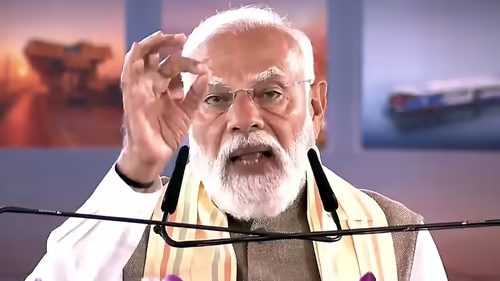
PM Modi’s ‘Mega Jungleraj’ Salvo: The Political Earthquake in Singur
On a Sunday that will be etched in West Bengal’s political memory, Prime Minister Narendra Modi stood in the historic grounds of Singur and delivered a thunderous message to the state: it’s time to end the ‘Mega Jungleraj’. This powerful term, resurrected with renewed ferocity, is the BJP’s central rallying cry against the 15-year reign of Chief Minister Mamata Banerjee and her Trinamool Congress (TMC) government .
The rally wasn’t just about rhetoric; it was a masterclass in political theatre, blending sharp criticism with a tangible promise of development. As the state gears up for the high-stakes 2026 assembly elections, this event in Hooghly district has dramatically shifted the narrative .
Table of Contents
- The ‘Mega Jungleraj’ Charge: What Does It Mean?
- Singur: A Symbolic Battleground
- Development on Display: Rs 830 Crore and New Trains
- The Blockade Allegation: Central Schemes in Limbo
- The Road to 2026: What This Means for Bengal
The ‘Mega Jungleraj’ Charge: What Does It Mean?
The term ‘Mega Jungleraj‘ is a deliberate escalation of an old political jibe. Historically, ‘Jungleraj’ (literally ‘rule of the jungle’) was used by the opposition to criticize the alleged lawlessness and partisan governance during the Left Front’s long tenure in Bengal. By prefixing it with ‘Mega’, PM Modi is arguing that the current TMC administration has not only failed to correct past wrongs but has amplified them into a grander, more systemic form of misrule .
This isn’t just name-calling. The charge is backed by a specific and potent accusation: that the TMC government is actively obstructing welfare schemes from the Central Government, thereby depriving millions of ordinary Bengalis of their rightful benefits.
Singur: A Symbolic Battleground
Choosing Singur for this pivotal speech was no accident. Nearly two decades ago, this very location was the epicenter of a massive political upheaval when Mamata Banerjee led a successful movement against the Tata Nano factory, a move that ultimately helped topple the Left Front government .
By returning to this symbolic ground, PM Modi is attempting a profound political reversal. He is framing the TMC not as the party of the people that ended one ‘Jungleraj’, but as the architect of a far worse one. It’s a direct challenge to Mamata Banerjee’s core political identity and legacy .
Development on Display: Rs 830 Crore and New Trains
To counter the narrative of a state in decline, PM Modi didn’t just offer words; he unveiled concrete action. During the rally on January 18, 2026, he inaugurated and laid the foundation stones for a host of infrastructure projects valued at over Rs 830 crore .
Perhaps the most visible symbol of this new push was the flagging off of three new Amrit Bharat Express trains. These new routes are designed to significantly boost West Bengal’s connectivity with other parts of India:
- Kolkata (Howrah) – Anand Vihar Terminal
- Kolkata (Sealdah) – Banaras
- Santragachi – Tambaram
This move directly ties national development to the Central Government’s efforts, implicitly contrasting it with the state government’s alleged inaction [[17], [21]].
The Blockade Allegation: Central Schemes in Limbo
The heart of PM Modi’s ‘Mega Jungleraj’ argument rests on the claim that the TMC government is a roadblock to progress. He specifically accused the state administration of preventing key central welfare programs from reaching the people of Bengal. According to the Centre, these include:
- Ayushman Bharat Health Scheme: A flagship program offering health insurance to the poor, which the Union government claims has been denied to millions in Bengal [[26], [31]].
- Free Electricity and Rooftop Solar Schemes: Initiatives aimed at reducing power bills and promoting green energy, allegedly obstructed by the state .
- Other Welfare Schemes: Union ministers have previously claimed that up to 80 central schemes have been blocked, affecting an estimated 4 crore residents .
This narrative positions the BJP as the true champion of the common man’s welfare, while painting the TMC as a self-serving entity more interested in political survival than public service.
The Road to 2026: What This Means for Bengal
With the 2026 West Bengal assembly elections on the horizon, this Singur rally is a clear declaration of the BJP’s main campaign theme: Parivartan (change). The party is betting that the electorate is fatigued by 15 years of TMC rule and is ready for an alternative that promises both good governance and direct access to central resources .
The strategy is multi-pronged: use the emotive ‘Mega Jungleraj’ label to delegitimize the incumbent, showcase the Central Government’s commitment through high-value projects, and provide a clear, simple reason for voters to switch sides. Whether this potent mix will be enough to unseat a still-popular Mamata Banerjee remains the biggest political question in India for the coming year.
Conclusion: A State at a Crossroads
PM Modi’s Singur speech has successfully reframed the political debate in West Bengal. The ‘Mega Jungleraj’ is no longer just a slogan; it’s a comprehensive critique of the TMC’s governance model, centered on the denial of welfare and a lack of development. By coupling this attack with the launch of significant infrastructure projects, the BJP has presented a stark choice to the people of Bengal: continue with the status quo or embrace a future of direct connection to a development-focused central government. The battle lines for 2026 have been drawn, and the fight for Bengal’s soul has truly begun.
Sources
- Times of India: Bengal ready to topple TMC’s mega-jungleraj: PM Modi rips into Mamata govt; watch
- ANI News: PM Modi to address Singur rally, flag off Rs 830-cr projects on Sunday
- Press Information Bureau: PM to flag off 7 Amrit Bharat trains, boosting rail connectivity of West Bengal
- The Hindu: PM Modi slams TMC for blocking central schemes