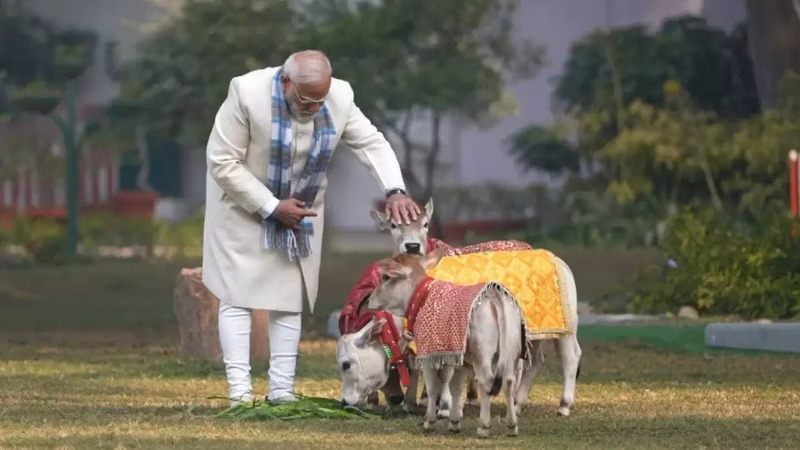
On the morning of January 15, 2026, a 39-second video from the Prime Minister’s residence offered a quiet yet powerful image: Prime Minister Narendra Modi, standing on the sun-dappled lawn of Lok Kalyan Marg, gently offering feed to a group of cows adorned with bright, decorative cloths. This simple act, performed to mark Makar Sankranti, is far more than just a festive gesture—it’s a rich tapestry woven with threads of ancient tradition, religious reverence, and modern political identity .
The timing is significant. Makar Sankranti, a major mid-winter harvest festival celebrated across India, marks the Sun’s celestial journey into the zodiac sign of Capricorn (Makar). It’s a day of thanksgiving for the bounty of the earth and a celebration of new beginnings. And at the heart of many of these celebrations is the cow, an animal held in the highest esteem in Hindu culture.
Table of Contents
- The Ritual of PM Modi Feeds Cows Makar Sankranti
- Why the Cow is Central to Makar Sankranti and Hindu Tradition
- The Political and Cultural Resonance of the Gesture
- How Makar Sankranti is Celebrated Across India
- Beyond the Video: What This Means for Public Perception
- Conclusion
- Sources
The Ritual of PM Modi Feeds Cows Makar Sankranti
The video, shared widely on social media, shows a serene scene. The Prime Minister, dressed in a simple kurta, is seen interacting with several cows that have been beautifully decorated with red and gold cloths—a common practice during festivals to honor the animals. He offers them a special mixture of jaggery, grains, and greens, a traditional offering known as ‘gau-daana’ or ‘godhuli.’
This specific ritual of feeding cows on Makar Sankranti is believed to bring good fortune, prosperity, and the blessings of Lord Vishnu, who is often associated with the preservation of life and nature. By performing this act at his official residence, PM Modi is not only participating in a personal religious observance but also publicly aligning himself with a core cultural value shared by millions of his constituents .
Why the Cow is Central to Makar Sankranti and Hindu Tradition
In Hinduism, the cow is revered as ‘Gau Mata’ or Mother Cow, symbolizing non-violence, motherhood, and the Earth’s bounty. She is considered a sacred giver of life, providing milk, dung (used as fuel and fertilizer), and urine (used in some traditional medicines). Her importance is deeply embedded in scriptures like the Vedas and Puranas.
During Makar Sankranti, the connection is amplified because the festival is fundamentally agrarian. It celebrates the harvest, and the cow has always been an indispensable partner in traditional Indian farming. Feeding her on this day is an act of gratitude for her role in sustaining rural life and the nation’s food security.
Key reasons for the cow’s significance include:
- Religious Symbolism: The cow is associated with several deities, including Krishna, who was a cowherd in his youth.
- Economic Importance: Historically, a family’s wealth was often measured by the number of cattle it owned.
- Environmental Harmony: The cow represents a sustainable, zero-waste model of living that is increasingly relevant today.
The Political and Cultural Resonance of the Gesture
While the act itself is rooted in faith, its public performance by a national leader inevitably carries political weight. In recent years, the cow has become a potent symbol in India’s socio-political discourse. For PM Modi and his party, championing the protection of the cow aligns with a broader narrative of cultural nationalism and the preservation of Hindu heritage.
This gesture can be seen as a form of soft power communication. It reinforces his image as a leader who is both a devout Hindu and a man of the people, connected to India’s rural heartland and its timeless traditions. It’s a message that resonates strongly with a large segment of the electorate, particularly in the lead-up to important state elections [INTERNAL_LINK:upcoming-indian-elections-2026].
How Makar Sankranti is Celebrated Across India
Makar Sankranti is one of the few Hindu festivals that follows a solar calendar, making its date fixed (January 14 or 15). Its celebrations, however, are wonderfully diverse across the country:
- Punjab & Haryana: Celebrated as Lohri the night before, with bonfires, folk songs, and dancing.
- Gujarat & Rajasthan: Known for its vibrant kite-flying competitions that fill the skies.
- Tamil Nadu: Observed as Pongal, a four-day harvest festival where a special dish of the same name is prepared.
- Assam: Celebrated as Magh Bihu, featuring community feasts and traditional games.
- Uttar Pradesh & Bihar: Marked by ritual baths in the Ganges and the consumption of sweets made from sesame and jaggery (til-gul).
Despite these regional variations, the underlying theme remains the same: gratitude for the harvest and hope for a prosperous year ahead.
Beyond the Video: What This Means for Public Perception
The release of this video is a masterclass in modern political communication. In an age of short attention spans, a 39-second clip can convey a complex set of values—piety, humility, cultural pride, and connection to the land—more effectively than a lengthy speech. It humanizes the leader while simultaneously anchoring him in a powerful cultural archetype.
For supporters, it’s a reaffirmation of his commitment to their values. For critics, it may be viewed as a calculated piece of political theater. Regardless of perspective, the image of PM Modi feeds cows Makar Sankranti is a potent visual that will linger in the public consciousness long after the festival has passed.
Conclusion
The simple act of feeding a cow on Makar Sankranti is a microcosm of India itself—a blend of the sacred and the secular, the ancient and the modern. PM Modi’s participation in this ritual at his residence is a reminder of the deep cultural currents that continue to shape the nation’s identity. Whether seen as a personal devotion or a public statement, the gesture underscores the enduring power of tradition in India’s public life and the careful ways in which its leaders navigate the intersection of faith, culture, and politics.
Sources
- Times of India: PM Modi’s moment from Makar Sankranti; feeds cows at his residence — watch
- Ministry of Culture, Government of India: Festivals of India – Makar Sankranti
- Britannica: Makar Sankranti | History, Significance, & Facts
- The Hindu: Significance of the cow in Hinduism