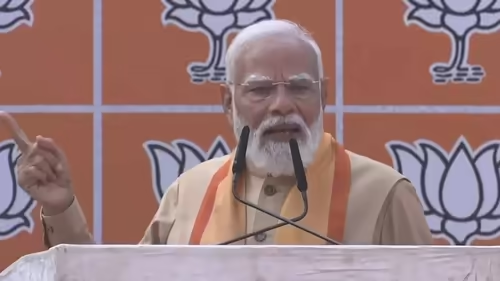
Prime Minister Narendra Modi has reignited a politically charged debate over national identity and border security with a blistering statement aimed at opposition parties allegedly shielding illegal immigrants. Speaking at a rally in West Bengal—a state heading into crucial assembly elections—Modi declared: “We must expose them to the public.”
Though he stopped short of naming any specific party, the context left little room for ambiguity. The remarks were widely interpreted as a direct assault on the ruling Trinamool Congress (TMC), led by Chief Minister Mamata Banerjee, which has long faced accusations from the BJP of soft-pedaling on illegal immigration from Bangladesh. With the electoral battle heating up, Modi’s words are not just policy commentary—they’re a strategic political salvo.
Table of Contents
- Modi’s Key Remarks on Illegal Immigrants
- The West Bengal Context and TMC Target
- Global Comparison: Wealthy Nations and Immigration
- What Are Illegal Immigrants in India?
- Political Fallout and Public Reaction
- Conclusion: A Deliberate Election Strategy
- Sources
Modi’s Key Remarks on Illegal Immigrants
Addressing a massive crowd in West Bengal, PM Modi drew sharp contrasts between national duty and political opportunism. “Some parties are covering up for illegal immigrants,” he said. “They are doing this for vote banks. But we cannot allow our nation’s integrity to be compromised for political gain.”
He then issued a direct call to action: “We must expose them to the public. Let the people decide who is betraying the nation and who is protecting it.”
The Prime Minister also sought to normalize India’s stance by pointing to global practices. “When the wealthiest and most powerful countries in the world crack down on illegal immigration, no one questions them,” he noted, referencing nations like the United States and members of the European Union that have tightened border controls in recent years .
The West Bengal Context and TMC Target
West Bengal shares a 4,096-kilometer border with Bangladesh—the longest land border India shares with any country. For decades, the issue of undocumented migration has been a flashpoint in state politics.
The BJP has consistently accused the TMC of granting “refuge” to illegal migrants in exchange for electoral support, particularly in districts like Nadia, Murshidabad, and North 24 Parganas. The TMC denies these claims, arguing that many labeled as “illegal” are actually long-settled Bengali-speaking minorities with legitimate roots in the region.
However, the National Register of Citizens (NRC) exercise in Assam—which identified nearly 2 million people as “foreigners”—has fueled fears in Bengal that a similar process could disenfranchise millions. Modi’s latest speech appears designed to reframe the narrative: not as a humanitarian issue, but as a matter of national sovereignty and security.
Global Comparison: Wealthy Nations and Immigration
Modi’s reference to Western nations is both strategic and factually grounded. According to data from the International Organization for Migration (IOM), countries like the U.S., UK, and Germany have significantly increased deportations and border enforcement in the past decade:
- The U.S. deported over 185,000 individuals in FY 2023 alone .
- The UK introduced the controversial Rwanda asylum plan to deter illegal crossings.
- Several EU nations have reinstated internal border checks under the Schengen Agreement.
By invoking these examples, Modi positions India’s potential crackdown not as xenophobia, but as alignment with global norms of sovereign control—a framing that resonates with nationalist voters.
What Are Illegal Immigrants in India?
Under Indian law, an illegal immigrant is defined as a foreigner who either enters the country without valid documents or overstays their visa. The primary legal instruments governing this are:
- The Foreigners Act, 1946: Empowers the government to detain and deport foreigners.
- Citizenship Act, 1955: Outlines pathways to citizenship and grounds for cancellation.
- Passport (Entry into India) Act, 1920: Regulates entry via documentation.
While estimates vary widely, independent studies suggest the number of undocumented migrants from Bangladesh could range from 5 to 20 million—though official figures remain classified. The lack of a nationwide NRC leaves the issue in a legal gray zone, which political parties exploit for mobilization.
Political Fallout and Public Reaction
The TMC swiftly dismissed Modi’s remarks as “divisive fear-mongering.” Senior leader Derek O’Brien tweeted: “Instead of creating jobs, they create ghosts. Instead of development, they peddle paranoia.”
Meanwhile, BJP leaders doubled down. State president Sukanta Majumdar stated, “The people of Bengal are tired of being taken for granted. They want clarity on who belongs and who doesn’t.”
Public opinion remains split along ideological lines. Urban youth express concern over communal polarization, while rural voters in border areas often voice genuine anxiety about demographic change and resource competition.
Conclusion: A Deliberate Election Strategy
PM Modi’s call to “expose” parties protecting illegal immigrants is far more than rhetoric—it’s a calculated electoral maneuver. By tying national security to voter identity, the BJP aims to consolidate its base, fracture opposition unity, and shift the campaign narrative away from local governance issues.
As West Bengal heads toward polls, this issue will likely dominate headlines, rallies, and kitchen-table debates. Whether it translates into votes remains to be seen—but one thing is certain: the battle for Bengal’s soul is now being fought on the contested terrain of citizenship itself. For deeper insights into India’s border policies, explore our [INTERNAL_LINK:india-border-security-analysis] series.
Sources
- Times of India: ‘Expose them to public’: PM Modi targets parties ‘protecting’ illegal immigrants
- Ministry of Home Affairs, Government of India: Foreigners Act & Citizenship Rules
- International Organization for Migration (IOM): World Migration Report 2024
- The Hindu: Modi’s immigration remarks spark fresh debate in Bengal