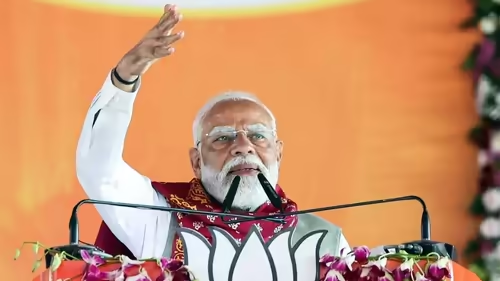
Thiruvananthapuram’s Putharikandam Maidan was packed. Flags waved, chants echoed, and energy crackled through the air as Prime Minister Narendra Modi took the stage—not just to campaign, but to make a prophecy. “The BJP’s rise in Kerala,” he declared, “will expand like it did in Gujarat.”
For many, this statement wasn’t just hopeful—it was audacious. After all, BJP in Kerala has long been a political footnote in a state dominated by the Left and Congress-led coalitions. Yet Modi’s words weren’t mere rhetoric; they were a strategic echo of history, drawing a direct line from Gujarat’s transformation in the 1980s to what the BJP hopes will be a southern renaissance.
Table of Contents
- Modi’s Gujarat Blueprint for Kerala
- Why Kerala Is the Toughest Challenge for BJP
- Signs of a Saffron Shift in Kerala Politics?
- The Strategy Behind the Rhetoric
- Conclusion: Can BJP Really Crack Kerala?
- Sources
Modi’s Gujarat Blueprint for Kerala
PM Modi didn’t pull the Gujarat comparison out of thin air. He referenced a pivotal moment in BJP history: 1987. Before that year, the party was virtually invisible in Gujarat, winning no significant ground and dismissed as a fringe player. But everything changed when the BJP captured the Ahmedabad Municipal Corporation—their first major urban foothold .
From that single city council victory, the party built a grassroots network, nurtured local leaders, and gradually expanded its influence until it became the dominant force in Gujarat—a stronghold that would later launch Modi onto the national stage.
Now, he’s suggesting Kerala could follow the same arc. “Just as we started with one city in Gujarat, our journey in Kerala is beginning with determination and faith,” Modi told the crowd . This isn’t just nostalgia—it’s a deliberate narrative framing the BJP’s current efforts in Kerala not as a losing battle, but as the early chapter of a long-term conquest.
Why Kerala Is the Toughest Challenge for BJP
Let’s be clear: replicating the Gujarat model in Kerala is arguably the BJP’s hardest political challenge in India. The state has never elected a BJP MLA to its assembly. In the 2021 elections, the party contested all 140 seats and won exactly zero. Even in the 2016 polls, its sole victory—O. Rajagopal in Nemom—was a historic anomaly, not a trend .
Several structural factors make Kerala resistant to saffron politics:
- Strong ideological polarization: The electorate is deeply divided between the CPI(M)-led LDF and Congress-led UDF, leaving little room for a third front.
- Secular social fabric: Kerala’s unique blend of religious pluralism, high literacy, and social reform movements creates skepticism toward identity-based politics.
- Organized civil society: From trade unions to student groups, opposition to BJP policies is deeply institutionalized.
- Limited Hindutva resonance: Unlike North India, communal narratives have historically failed to gain traction in mainstream Kerala discourse.
So when Modi speaks of expansion, he’s not just talking about votes—he’s attempting to reshape the very cultural and political DNA of the state.
Signs of a Saffron Shift in Kerala Politics?
Despite the odds, there are subtle indicators that the BJP’s persistence is yielding small gains. While electoral success remains elusive, the party has made inroads in specific demographics:
- NRI support: Malayali expatriates in the Gulf and beyond have shown increased financial and moral backing for BJP initiatives.
- Urban youth engagement: Through digital campaigns and campus outreach, the BJP is slowly building a base among younger, aspirational voters.
- Tribal and Ezhava communities: Targeted welfare schemes and leadership appointments aim to chip away at traditional LDF/UDF loyalties.
Moreover, the BJP’s vote share has crept upward—from 10.5% in 2011 to 13.4% in 2021—suggesting a slow but steady consolidation . It’s not a landslide, but it’s movement. And in politics, momentum often matters more than margins.
The Strategy Behind the Rhetoric
PM Modi’s “expand like Gujarat” line isn’t just motivational—it’s part of a larger national strategy. By positioning Kerala as the next frontier, the BJP accomplishes several things:
- Boosts cadre morale: Activists on the ground need hope. Comparing their struggle to Gujarat’s origin story gives them a sense of purpose.
- Signals long-term commitment: It tells voters the BJP isn’t just parachuting in for elections—it’s here to stay.
- Pressures rival alliances: If even 5–10% of voters shift, it could fracture the LDF-UDF duopoly, especially in close constituencies.
- Reinforces Modi’s nation-builder image: Framing himself as the architect of pan-Indian BJP unity strengthens his leadership narrative ahead of 2029.
This is psychological warfare as much as political strategy. And rallies like the one at Putharikandam Maidan are its primary battlegrounds.
Conclusion: Can BJP Really Crack Kerala?
The short answer? Not anytime soon. But the long game? That’s where Modi’s vision lives. The BJP in Kerala may never dominate like it does in Gujarat—but it doesn’t need to. Even becoming a credible third force could reshape coalition dynamics, influence policy debates, and erode the Left’s cultural hegemony over time.
Modi knows that political revolutions aren’t always loud. Sometimes, they start with a single municipal win… or a prophetic speech at a packed maidan. Whether Kerala becomes the BJP’s next Gujarat remains to be seen—but the party is clearly betting that history can repeat itself, even in the unlikeliest of places.
Sources
- Times of India: ‘To expand like Gujarat’: PM Modi’s big prediction on BJP’s rise in Kerala
- Election Commission of India: Official Kerala Assembly Election Results
- PRS Legislative Research: Analysis of Political Trends in South India