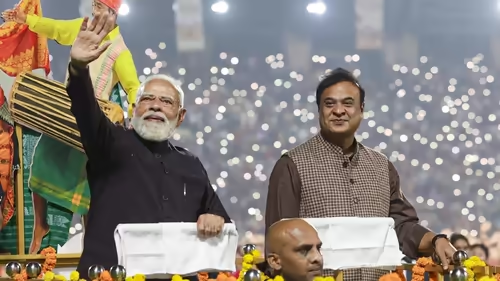
In a hard-hitting address that has reignited the national debate over governance in India’s northeast, Prime Minister Narendra Modi launched a scathing attack on the Congress party, accusing it of prioritizing “politics over peace” in Assam. Speaking at a public rally in the state, PM Modi alleged that the Congress had systematically neglected Assam for decades, using its complex socio-political challenges as a tool for vote-bank politics rather than genuine problem-solving .
This latest salvo comes at a critical juncture—just months before key assembly elections in several northeastern states—and underscores the BJP’s intensified focus on consolidating its narrative of development, security, and cultural pride in a region long plagued by insurgency, migration anxieties, and infrastructural gaps.
Table of Contents
- Modi’s Scathing Indictment of Congress
- The Allegations: Decades of Neglect?
- BJP’s Vision for Assam: Development and Dignity
- Congress Response and Counter-Narrative
- Why Assam Politics Matters Nationally
- Conclusion: A Battle for Assam’s Future
- Sources
Modi’s Scathing Indictment of Congress
Standing before a massive crowd in Guwahati, PM Modi delivered one of his most pointed critiques of the Congress in recent memory. “For 60 years, they ruled Assam—but what did they leave behind? Only problems, not solutions,” he declared. He accused the party of treating Assam not as a land of opportunity but as a “political laboratory” where identity issues were stoked to keep communities divided .
His central charge—“politics over peace”—struck a chord with many locals who have lived through cycles of unrest, from the Assam Agitation of the 1980s to more recent border tensions and ethnic conflicts. Modi argued that while the Congress talked about harmony, it failed to deliver the infrastructure, jobs, or security needed to sustain it.
The Allegations: Decades of Neglect?
The Prime Minister laid out a series of specific grievances:
- Infrastructure deficit: Despite being a gateway to the Northeast, Assam lacked world-class roads, railways, and airports under Congress rule.
- Security vacuum: Insurgency groups flourished due to weak counter-insurgency strategies and inconsistent peace talks.
- Economic stagnation: Youth unemployment remained high, with little industrial investment or skill development.
- Cultural erasure: Modi claimed the Congress ignored Assamese language, heritage, and indigenous rights in favor of short-term political alliances.
These claims, while politically charged, tap into real frustrations among sections of Assamese society. According to data from the Ministry of Statistics, Assam’s per capita income lagged behind the national average for much of the 2000s—a period dominated by Congress-led state governments .
Assam politics: BJP’s Vision for Development and Dignity
In contrast, PM Modi positioned the BJP as the party that has finally brought “dignity and development” to Assam. He highlighted several flagship initiatives:
- Silchar–Sabroom Highway: Part of the Kaladan Multi-Modal Transit Transport Project, enhancing connectivity to Southeast Asia.
- AIIMS Guwahati and new IITs: Major investments in health and education infrastructure.
- Peace accords: Successful signing of agreements with groups like the NDFB and ULFA (Pro-talk faction), reducing violence significantly.
- Swarna Jayanti Bighar Mulyankan Yojana: A state-level housing scheme supported by central funds.
He also emphasized the National Register of Citizens (NRC) and Citizenship Amendment Act (CAA)—controversial but central to the BJP’s promise of protecting “indigenous identity.” While critics argue these policies have deepened social fault lines, the BJP frames them as essential for long-term stability .
Congress Response and Counter-Narrative
The Congress has dismissed Modi’s remarks as “diversionary tactics” ahead of elections. Senior leader Rahul Gandhi, in a recent statement, countered that it was the BJP that had “weaponized identity” and failed to create jobs despite being in power at both the Centre and in Assam since 2016 .
Congress leaders also point to rising drug abuse, farmer distress, and delays in flood rehabilitation as evidence that BJP’s “development model” is more rhetoric than reality. They argue that true peace requires inclusive dialogue—not polarizing legislation.
Why Assam Politics Matters Nationally
Assam isn’t just another state—it’s the geopolitical and cultural heart of India’s Northeast. Its stability affects border security with Bangladesh and Bhutan, trade corridors under India’s Act East Policy, and the delicate balance of ethnic and linguistic identities across seven sister states.
Moreover, as noted by the Brookings Institution, successful governance in Assam can serve as a template for conflict resolution in other insurgency-affected regions . That’s why both national parties are investing so heavily in shaping the narrative around Assam politics.
Conclusion: A Battle for Assam’s Future
PM Modi’s “politics over peace” barb is more than campaign rhetoric—it’s a strategic framing of the Congress as a party of the past, incapable of delivering the security and prosperity modern Assam demands. Whether voters buy this narrative will likely determine not just Assam’s fate, but the broader trajectory of India’s democratic discourse in ethnically diverse regions. For deeper insights into regional political shifts, explore [INTERNAL_LINK:northeast-india-politics].
Sources
- Times of India: “‘Politics over peace’: PM Modi slams Congress for ‘neglecting’ Assam” – https://timesofindia.indiatimes.com/…/articleshow/126618702.cms
- Ministry of Statistics and Programme Implementation (MOSPI), Government of India – State-wise NSDP data.
- The Hindu: “Understanding the CAA and NRC debate in Assam” – https://www.thehindu.com
- Indian Express: “Congress hits back at Modi’s Assam remarks” – https://indianexpress.com
- Brookings Institution: “Governance Challenges in India’s Northeast” – https://www.brookings.edu