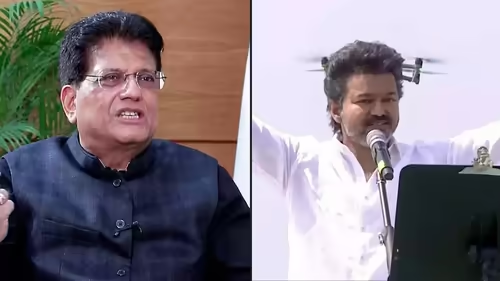
Introduction: The Clash of Titans in Tamil Nadu
The political temperature in Tamil Nadu is rising as the 2026 assembly elections draw near. In a bold statement that has sent ripples through the state’s political circles, Union Minister and BJP’s Tamil Nadu election-in-charge, Piyush Goyal, has played down the potential electoral impact of superstar actor Vijay. His dismissive remark, “many film stars come and go,” directly challenges the notion that a massive fan following can be seamlessly converted into votes.
But is this just political posturing from a confident incumbent alliance, or a genuine assessment of the ground reality? With Vijay having officially launched his political party, the Tamilaga Vettri Kazhagam (TVK), and preparing for a full-fledged campaign, the stage is set for a fascinating battle of old guard versus new hope.
Table of Contents
- Goyal’s Take: Why He Believes Film Stardom Isn’t Enough
- Vijay’s Political Entry: More Than Just a Fan Club?
- The Real Battle: AIADMK-NDA vs. DMK Alliance
- Historical Context: The Mixed Record of Film Stars in TN Politics
- Conclusion: What This Means for Tamil Nadu Elections 2026
- Sources
Goyal’s Take: Why He Believes Film Stardom Isn’t Enough
Piyush Goyal’s confidence stems from his belief in a strong anti-incumbency wave against the ruling DMK government. He has been vocal about what he calls the DMK’s “corruption and anti-Tamil culture,” positioning the AIADMK-led NDA alliance as the agent of change [[9]].
His core argument is simple: a passionate fan base does not automatically translate into a loyal voter base. “Film stars come and go, but people vote for their future, for development, and for good governance,” he asserted. This is a direct challenge to the long-standing tradition in Tamil Nadu where cinema and politics have been deeply intertwined.
Goyal’s focus is squarely on consolidating the NDA alliance, which includes the AIADMK and other regional partners like the PMK [[10]]. He has been actively involved in seat-sharing talks with AIADMK leader Edappadi K. Palaniswami, signaling a united front against the DMK [[1], [5]].
Vijay’s Political Entry: More Than Just a Fan Club?
Dismissing Vijay as just another film star would be a grave miscalculation. Unlike many before him, Vijay has taken concrete steps to build a political organization from the ground up. He officially launched the Tamilaga Vettri Kazhagam (TVK) in 2024 and has since announced his retirement from films to focus entirely on politics [[23], [24]].
His party is not merely riding on his charisma; it’s actively building a cadre and planning a grand statewide conference in February 2026 to kick off its election campaign [[21], [25]]. Vijay himself has framed the 2026 contest as a “democratic battle” against established political powers, appealing to a sense of civic duty among his supporters [[26]].
While his core support remains his massive, dedicated fan club, the TVK is making strategic efforts to reach out to urban, youth-heavy constituencies like Velachery, betting on a desire for fresh leadership [[22]]. This suggests a more nuanced and organized approach than just leveraging star power.
The Real Battle: AIADMK-NDA vs. DMK Alliance
At its heart, the Tamil Nadu elections 2026 will likely be a two-horse race between the incumbent DMK-led Secular Progressive Alliance and the opposition AIADMK-led NDA bloc. The entry of Vijay’s TVK adds a wildcard element that could potentially split votes, particularly in key constituencies.
The DMK, led by Chief Minister M.K. Stalin, is banking on its development record and has dismissed the NDA as a threat to the state’s progress [[16]]. Meanwhile, the AIADMK, under Palaniswami, is projecting the 2026 polls as the “last” for the DMK, capitalizing on any perceived governance failures [[14]].
Goyal’s comments about Vijay can also be seen as an attempt to solidify his own alliance. By downplaying a potential third front, he aims to present the NDA as the only viable alternative to the DMK, preventing a fragmentation of the anti-DMK vote.
Historical Context: The Mixed Record of Film Stars in TN Politics
Tamil Nadu has a rich history of actors transitioning into successful chief ministers, most notably M.G. Ramachandran (MGR) and J. Jayalalithaa. However, their success was built on more than just fame; they cultivated strong party machinery and connected with the masses on socio-economic issues.
More recent attempts have yielded mixed results. While Rajinikanth generated immense buzz before the 2021 elections, he ultimately chose not to contest, citing personal reasons. This precedent shows that while stardom can create a platform, converting it into a sustainable political movement is a far more complex challenge.
Vijay’s path will be closely watched to see if he can break this recent trend and establish a lasting political legacy, or if he will indeed be one of the “film stars” who, as Goyal suggests, simply “come and go.”
Conclusion: What This Means for Tamil Nadu Elections 2026
Piyush Goyal’s dismissal of Vijay’s political clout is a calculated move rooted in his confidence in the AIADMK-NDA alliance and the perceived anti-incumbency against the DMK. While his point about fan-following not guaranteeing votes is valid, it may underestimate the organizational efforts and unique appeal of Vijay’s nascent political project.
The true impact of Vijay’s TVK remains to be seen. It could act as a spoiler, siphoning votes from either major alliance, or it could galvanize a new generation of voters disillusioned with traditional politics. One thing is certain: the Tamil Nadu elections 2026 promise to be one of the most unpredictable and closely-watched contests in recent history, where the interplay between legacy, alliance arithmetic, and a new political experiment will decide the state’s future.