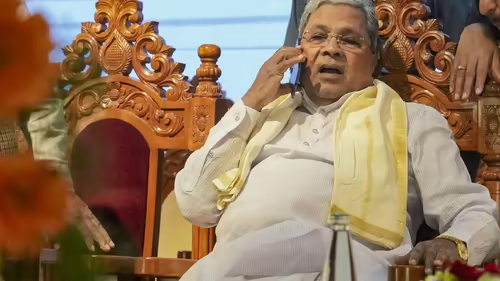
Chaos erupted in the Karnataka Legislative Assembly this week as the BJP hurled a bombshell allegation: the state’s Congress-led government, under Chief Minister Siddaramaiah, is running a “phone tapping govt” that spied on none other than the Governor himself. The explosive claim—made during a heated debate over the controversial MUDA scam—has sent shockwaves through the political establishment, raising serious questions about surveillance, privacy, and the abuse of state power.
Table of Contents
- The Allegation: What Did the BJP Claim?
- The Congress Response: Denial and Counter-Accusations
- Legal and Constitutional Implications of Phone Tapping
- Historical Context: Spying Scandals in Indian Politics
- What Happens Next? Political Fallout in Karnataka
- Conclusion: A Dangerous New Front in Indian Politics
- Sources
The Allegation: What Did the BJP Claim?
During a session marked by intense sloganeering and walkouts, senior BJP leader CT Ravi stood up in the assembly and directly accused the Siddaramaiah administration of orchestrating illegal surveillance on the official phone of Governor Thawar Chand Gehlot [[3]]. Ravi claimed to have credible information suggesting that the state intelligence apparatus was used to monitor the Governor’s communications, a move he described as an “unprecedented attack on constitutional authority” [[3]].
The timing of the accusation is critical. It comes amid a bitter standoff between the elected Congress government and the BJP-appointed Governor over several key bills, including those related to administrative reforms and minority welfare. The BJP alleges that the phone tapping was an attempt by the CM’s office to gain advance knowledge of the Governor’s decisions and potentially manipulate the political narrative.
The Congress Response: Denial and Counter-Accusations
The Congress party has categorically denied the allegations, calling them “baseless,” “politically motivated,” and a “desperate attempt” by the BJP to deflect attention from its own corruption scandals, particularly the MUDA land allotment case that has ensnared several former BJP ministers [[3]].
Chief Minister Siddaramaiah’s office issued a statement asserting that all surveillance activities in the state are conducted strictly within the legal framework and with proper authorization from the Home Department. They further accused the BJP of hypocrisy, pointing to numerous instances of alleged phone tapping during the previous BJP regime in Karnataka, including the infamous Prajwal Revanna CD scandal.
Legal and Constitutional Implications of Phone Tapping
Phone tapping in India is governed by Section 5(2) of the Indian Telegraph Act, 1885, and the Information Technology Act, 2000. Legally, such surveillance can only be authorized in specific circumstances: public emergency, public safety, or in the interest of sovereignty and integrity of India. Crucially, the order must come from the Union Home Secretary or the State Home Secretary and must be reviewed by a committee headed by the Cabinet Secretary at the central level or the Chief Secretary at the state level [[7]].
Illegally tapping the phone of a constitutional head like a Governor would be a severe breach of both law and protocol. The Governor, as the representative of the President, holds a unique position of neutrality. Spying on such an office would not just be a criminal offense but a direct assault on the federal structure of the Indian Constitution. The Supreme Court of India, in the landmark PUCL vs Union of India case, has laid down strict guidelines to prevent the misuse of surveillance powers, emphasizing the right to privacy as a fundamental right [[9]].
Historical Context: Spying Scandals in Indian Politics
This isn’t the first time phone tapping has become a political flashpoint in India. The nation has a long and troubled history with political espionage:
- The ISRO Spy Case (1994): Though later discredited, it highlighted the potential for intelligence agencies to be misused for political ends.
- The Pegasus Project (2021): Revelations that the spyware may have been used to target journalists, activists, and even ministers sparked a national uproar and multiple Supreme Court hearings.
- State-Level Scandals: From West Bengal to Tamil Nadu, various state governments have faced accusations of using surveillance to intimidate opponents.
The current phone tapping govt Karnataka controversy fits squarely into this troubling pattern, where the tools of national security are allegedly weaponized for partisan gain.
What Happens Next? Political Fallout in Karnataka
The immediate fallout will likely be more legislative gridlock. The BJP is expected to demand a judicial inquiry or a probe by a central agency like the CBI. The Congress, in control of the assembly, will likely block any such move, leading to a stalemate.
However, the bigger battle may be fought in the court of public opinion and, potentially, in the courts of law. If the BJP can provide even a shred of credible evidence, it could severely damage the Siddaramaiah government’s credibility. Conversely, if the allegations are dismissed as pure fiction, it could backfire on the BJP, painting them as reckless accusers. For a deeper look at the ongoing political tensions, see our analysis on [INTERNAL_LINK:karnataka-political-crisis-2026].
Conclusion: A Dangerous New Front in Indian Politics
Whether the “phone tapping govt” accusation is true or not, its very utterance marks a dangerous escalation in India’s political discourse. It injects a deep sense of mistrust into the relationship between the elected government and the constitutional head of state. In an era where digital privacy is already under siege, such allegations, if left uninvestigated, erode public faith in democratic institutions. The Karnataka Assembly has now become the latest battleground in a war over not just power, but the very rules of the game.
Sources
- Times of India: ‘Phone tapping govt’: BJP accuses Siddaramaiah-led Congress of spying on governor’s phone
- The Hindu: BJP accuses Congress govt of phone-tapping in Karnataka
- Supreme Court of India: PUCL vs Union of India (1996) – Right to Privacy Judgment
- PRS India: The Indian Telegraph Act, 1885 – Key Provisions