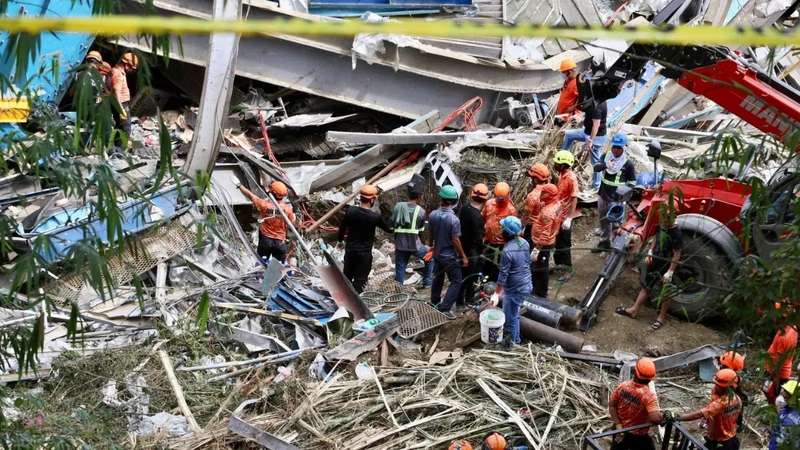
In a horrifying echo of past tragedies, a massive Philippines landfill collapse has struck Cebu City, claiming at least four lives and leaving 34 people feared buried under mountains of decomposing trash. The incident occurred on January 10, 2026, at an unregulated dumpsite in the city’s outskirts, where dozens of informal waste pickers—many of them daily wage earners—were scavenging for recyclables when the ground gave way .
Rescue crews, hampered by unstable terrain and the stench of methane, have been working nonstop to locate survivors. Heavy rainfall in recent days is suspected to have saturated the waste pile, triggering what locals are calling a ‘garbage avalanche’—a terrifying phenomenon that has haunted the Philippines for decades .
Table of Contents
- What Happened in the Cebu Landfill Collapse?
- The Philippines Landfill Collapse Crisis: A Recurring Nightmare
- Who Are the Victims? Informal Waste Pickers at Risk
- Why Did the Landfill Collapse? Cause and Contributing Factors
- Rescue Efforts and Government Response
- Lessons from History: Can Future Disasters Be Prevented?
- Conclusion: A Call for Safer Waste Systems
- Sources
What Happened in the Cebu Landfill Collapse?
Early Saturday morning, residents near the dumpsite in Cebu heard a thunderous roar—like a landslide, but worse. Within seconds, a section of the unstable waste mound collapsed, sending a wave of debris crashing into makeshift homes and trapping workers who were sorting through trash at dawn .
Emergency responders from the Philippine National Police and local disaster units arrived within the hour. Using excavators, sniffer dogs, and thermal imaging cameras, they’ve managed to recover four bodies so far. But with 34 still unaccounted for—including women and children living in adjacent shanties—the death toll is expected to rise .
“It’s like digging through quicksand,” said one rescue volunteer. “Every time we move a piece of metal or plastic, the whole pile shifts.”
The Philippines Landfill Collapse Crisis: A Recurring Nightmare
This isn’t the first time the Philippines has faced such a catastrophe. The most infamous example is the 2000 Payatas dumpsite collapse in Quezon City, which killed over 200 people after heavy rains triggered a similar garbage avalanche . That disaster led to the passage of the Ecological Solid Waste Management Act of 2000—but enforcement has been inconsistent, especially in rapidly urbanizing areas like Cebu.
Despite national laws banning open dumping, hundreds of unregulated sites still operate across the country, often on the margins of cities where land is cheap and oversight is minimal. These sites become de facto workplaces for thousands of informal waste pickers who rely on selling recyclables to survive .
Who Are the Victims? Informal Waste Pickers at Risk
The victims of the Philippines landfill collapse are not just statistics—they are among the most vulnerable members of society. Known locally as “mangangalakal” or waste pickers, they work without protective gear, contracts, or safety nets.
Many live in shantytowns built right next to dumpsites, exposing their families to toxic fumes, disease, and structural hazards. According to the World Bank, over 1.5 million Filipinos depend on informal waste collection for their livelihood—a system that persists due to gaps in municipal recycling programs .
“They go there every day because they have no choice,” said a community organizer in Cebu. “If they don’t pick, they don’t eat.”
Why Did the Landfill Collapse? Cause and Contributing Factors
Preliminary investigations point to a combination of factors:
- Heavy rainfall: Cebu experienced above-average precipitation in the week leading up to the collapse, saturating the waste pile and reducing its structural integrity.
- Poor site management: The dumpsite lacked proper engineering controls like leachate drainage or slope stabilization.
- Overloading: Continuous dumping without compaction or layering created unstable vertical walls of waste.
- Urban pressure: As Cebu’s population grows, waste generation outpaces disposal capacity, forcing cities to rely on unsafe interim sites.
Environmental experts warn that climate change is making such events more likely. Intense rainstorms—once rare—are now common during the Philippine wet season, turning poorly managed landfills into ticking time bombs .
Rescue Efforts and Government Response
The Cebu City government has declared a state of calamity, unlocking emergency funds for search operations and victim support. The Department of Social Welfare and Development (DSWD) is providing food packs and temporary shelter to displaced families.
Meanwhile, President Ferdinand Marcos Jr. has ordered a nationwide audit of all active and closed dumpsites, vowing to “prevent another Payatas.” Critics, however, argue that reactive measures aren’t enough—what’s needed is investment in integrated waste management, formalization of waste picker roles, and strict enforcement of environmental laws .
Lessons from History: Can Future Disasters Be Prevented?
Yes—but only with political will and community inclusion. Successful models exist:
- San Fernando, Pampanga: Transformed its dumpsite into a materials recovery facility (MRF) with trained waste workers earning fair wages.
- Mandaluyong City: Implemented door-to-door segregation and banned single-use plastics, drastically reducing landfill dependency.
- Global best practices: Cities like San Francisco achieve over 80% diversion from landfills through composting and reuse programs .
For Cebu and other Philippine cities, the path forward lies in treating waste not as a disposal problem, but as a resource—and its workers not as invisible laborers, but as essential environmental stewards.
Conclusion: A Call for Safer Waste Systems
The Philippines landfill collapse in Cebu is more than a tragic accident—it’s a symptom of deeper systemic failures in urban planning, environmental justice, and social protection. While rescue teams continue their grim work, the nation must ask: how many more lives must be lost before we build a waste system that’s safe, sustainable, and humane? The answer can’t wait for the next avalanche.
Sources
- Times of India. (2026). Garbage avalanche: Death toll rises in Philippines landfill collapse; 34 feared trapped. https://timesofindia.indiatimes.com/world/rest-of-world/garbage-avalanche-death-toll-rises-in-philippines-landfill-collapse-34-feared-trapped/articleshow/126451038.cms
- Reuters. (2026). Philippines rescuers search for survivors after landfill collapse in Cebu.
- Philippine Daily Inquirer. (2026). 4 dead, dozens missing in Cebu dumpsite collapse.
- Republic Act No. 9003. (2000). Ecological Solid Waste Management Act of the Philippines. https://emb.gov.ph/
- World Bank. (2023). What a Waste 2.0: Solid Waste Management in East Asia and Pacific. https://www.worldbank.org/en/topic/urbandevelopment/publication/what-a-waste-20
- United Nations Environment Programme (UNEP). (2025). Global Waste Management Outlook. https://www.unep.org/resources/global-waste-management-outlook