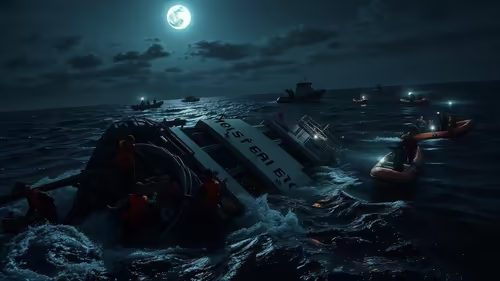
A sense of dread has settled over the southern Philippines after a passenger ferry, teeming with life, vanished beneath the waves in an area known for its complex waterways. The Philippines ferry disaster that unfolded on Monday, January 26, 2026, is not just a story of tragedy; it’s a stark, urgent question mark hanging over the nation’s maritime safety protocols.
The vessel, carrying an estimated 350 passengers and crew, sank in the early hours near the island village of Baluk-baluk in Basilan province . In a chilling twist that has baffled authorities and terrified the public, the sinking occurred in what officials described as “good weather”—a detail that immediately shifts the focus from an act of nature to a potential human or mechanical failure .
Table of Contents
- The Tragedy Unfolds: A Timeline of the Philippines Ferry Disaster
- Rescue and Recovery: A Race Against Time
- Why Did It Happen? The Search for Answers
- A History of Tragedy: Is the Philippines Doing Enough?
- Conclusion: Beyond the Headlines
- Sources
The Tragedy Unfolds: A Timeline of the Philippines Ferry Disaster
The ferry, whose name has not yet been widely reported in initial briefings, was on a routine inter-island journey—a lifeline for countless communities in the Philippine archipelago. Around midnight, everything changed. The ship sent out a distress signal before succumbing to the sea just one nautical mile from the shore of Baluk-baluk .
Initial reports were chaotic, with varying numbers of passengers and casualties. However, a clearer, more horrifying picture has since emerged. The vessel was carrying at least 350 souls. As of the latest official updates, at least 15 bodies have been recovered, and a significant number of people remain unaccounted for, with some sources reporting the missing count as high as 43 [[4], [5]]. This stark reality underscores the immense scale of the emergency.
Rescue and Recovery: A Race Against Time
In the immediate aftermath, a massive search and rescue (SAR) operation was launched. The Philippine Coast Guard and Navy swiftly deployed vessels and helicopters to scour the area . Their efforts were joined by local fishermen, whose intimate knowledge of the local waters proved invaluable in the critical first hours .
The operation has been a beacon of hope amidst the despair. Over 300 individuals have been rescued, a testament to the speed and coordination of the responders . Survivors were taken to safety, many suffering from exposure and shock. The fact that a coast guard officer was reportedly on board and managed to send a distress call was likely a crucial factor in the high number of rescues [[Original Summary]].
Here’s a quick snapshot of the current situation:
| Metric | Figure |
|---|---|
| Total Onboard | 350+ |
| Rescued | 300+ |
| Confirmed Dead | 15+ |
| Still Missing | 28-43 |
Why Did It Happen? The Search for Answers
This is the question haunting every Filipino and maritime safety expert. How could a ship sink so close to shore in good weather?
Authorities have confirmed that the weather was not a factor, which immediately points to other, more preventable causes. Historically, ferry disasters in the Philippines have been linked to a dangerous cocktail of issues:
- Overcrowding: Ferries are often packed beyond their legal capacity, especially during peak travel times.
- Poor Vessel Maintenance: Aging fleets and inadequate maintenance can lead to catastrophic mechanical failures.
- Regulatory Gaps: Enforcement of safety regulations can be inconsistent across the vast archipelago.
“The cause of the ferry sinking was not immediately clear and there will be an investigation,” officials stated, adding that the vessel had been cleared for departure before its final, fateful journey . This pending investigation is now under intense public scrutiny. Was this a simple, tragic accident, or a symptom of a much larger, systemic problem?
A History of Tragedy: Is the Philippines Doing Enough?
This latest Philippines ferry disaster is a grim echo of the past. The nation holds the tragic record for the world’s deadliest peacetime maritime disaster—the 1987 sinking of the MV Doña Paz, which claimed over 4,300 lives after a collision with an oil tanker .
For decades, safety advocates have warned that without a fundamental overhaul of the inter-island ferry system, history would repeat itself. Sea accidents remain common in the Philippines due to the very factors mentioned above: storms, badly maintained vessels, overcrowding, and spotty enforcement of safety rules .
While the government has made efforts to improve maritime safety, this incident raises serious doubts about their effectiveness. Are the current measures merely a band-aid on a deep, festering wound? This event must serve as a catalyst for real, enforceable change to prevent another MV Doña Paz-scale catastrophe. For more on the region’s ongoing challenges, see our analysis on [INTERNAL_LINK:philippine-infrastructure-challenges].
Conclusion: Beyond the Headlines
The sinking of this ferry is more than a news story; it’s a national crisis. Behind the statistics of the rescued, the dead, and the missing are families shattered and a community in mourning. The fact that it happened in calm seas makes it all the more terrifying, as it suggests that no voyage is truly safe if the underlying systems are flawed.
The immediate focus must remain on the search for the missing and supporting the survivors. But in the days and weeks ahead, the Philippines must confront the hard truths this disaster has exposed. A thorough, transparent investigation is not just needed—it’s demanded by the victims and the public. Anything less would be a betrayal of their memory and a guarantee that this will happen again.
Sources
- Times of India: Ferry carrying 350 passengers sinks off southern Philippines, at least 15 dead
- Xinhua News Agency: 15 dead after ferry sinks off Basilan province in S. Philippines
- Associated Press: Ferry with more than 350 people sinks in the southern Philippines
- Maritime Safety Committee, International Maritime Organization: Global Maritime Safety Standards