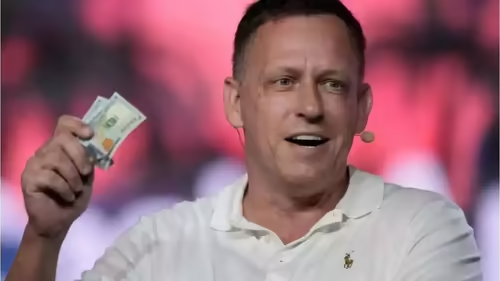
“You can never have a Google, Microsoft, or Amazon.”
That’s not a prediction—it’s a verdict. And it came straight from Peter Thiel, the PayPal co-founder, early Facebook investor, and one of Silicon Valley’s most provocative thinkers. In a recent commentary that’s sparked fierce debate across the Atlantic, Thiel didn’t just critique Europe’s tech scene—he declared it structurally incapable of producing world-dominating companies.
His reasoning? European entrepreneurs are too risk-averse, too eager to sell early, and too culturally conditioned to avoid the kind of bold, almost reckless ambition that built America’s tech titans. “In Europe, if you get a $100 million offer, you take it,” Thiel said. “In Silicon Valley, you turn down a $1 billion offer because you believe you’re building something worth $100 billion.”
He pointed to Mark Zuckerberg famously rejecting Yahoo’s $1 billion bid for Facebook in 2006 as the quintessential Silicon Valley mindset—a move almost unthinkable in today’s European startup culture [[1]].
Table of Contents
- What Peter Thiel Said About European Tech
- The Data Behind the Gap: US vs Europe in VC Funding
- Why European Founders Cash Out Early: Cultural and Systemic Barriers
- Silicon Valley Mindset: Embracing Failure as a Feature
- Can Europe Ever Build a Google? The Path Forward
- Expert Reactions to Thiel’s Critique
- Conclusion
- Sources
What Peter Thiel Said About European Tech
Thiel’s core argument hinges on a fundamental difference in entrepreneurial psychology. He contends that while Silicon Valley glorifies “going big or going home,” Europe prioritizes stability, incremental growth, and early exits. This isn’t just about money—it’s about vision.
“The fear of failure is paralyzing,” Thiel noted. “In the U.S., failure is a badge of honor. In Europe, it’s a stigma that follows you forever.” This cultural attitude, he argues, discourages founders from pursuing moonshot ideas that require years of unprofitable scaling—a necessity for building platforms like Amazon or Google [[1]].
The Data Behind the Gap: US vs Europe in VC Funding
Thiel’s claims aren’t just hot air—they’re backed by hard numbers. According to PitchBook’s 2025 Global Venture Capital Report:
- The U.S. raised **$185 billion** in VC funding in 2025.
- Europe raised just **$48 billion**—less than a quarter of the U.S. total [[2]].
- There are over **300 U.S.-based VC funds** with assets under management exceeding $1 billion.
- Europe has fewer than **40** such mega-funds [[3]].
This funding chasm means European startups often run out of runway before they can scale globally. Without access to late-stage capital, selling to a U.S. acquirer becomes the only viable exit—reinforcing Thiel’s point about premature cash-outs.
Why European Founders Cash Out Early: Cultural and Systemic Barriers
It’s not just mindset—structural factors play a huge role:
- Fragmented Markets: Europe isn’t a single market but 27+ countries with different languages, regulations, and consumer behaviors. Scaling across borders is exponentially harder than in the U.S.
- Risk-Averse Investors: European VCs tend to favor B2B SaaS and fintech with clear paths to profitability, not capital-intensive, long-gestation plays like AI infrastructure or space tech.
- Social Safety Nets: Ironically, strong welfare systems reduce the “burn-the-boats” urgency that drives many American founders. Why risk everything when failure won’t leave you destitute?
As one Berlin-based founder told TechCrunch: “We’re taught to be responsible, not revolutionary” [[4]].
Silicon Valley Mindset: Embracing Failure as a Feature
Contrast this with Silicon Valley’s origin story. PayPal itself was born from the ashes of Confinity and X.com—two failed startups that merged out of desperation. Thiel, Elon Musk, and Max Levchin didn’t see failure as an end; they saw it as data.
Zuckerberg’s rejection of Yahoo’s offer wasn’t arrogance—it was conviction. He believed social networking would become the internet’s central layer. That kind of belief requires not just vision, but a culture that rewards audacity over caution.
For more on how this mindset shapes innovation, see our deep dive on [INTERNAL_LINK:silicon-valley-vs-global-startup-hubs].
Can Europe Ever Build a Google? The Path Forward
Despite Thiel’s pessimism, there are signs of change:
- The EU’s **European Innovation Council (EIC)** now offers up to €15 million in non-dilutive funding for deep-tech ventures.
- Startups like **Spotify**, **Klarna**, and **Revolut** have shown that European-born companies *can* achieve global scale—though all faced near-collapse before breaking through.
- New generation founders (e.g., from France’s Station F or Estonia’s e-Residency program) are increasingly adopting Silicon Valley-style ambition [[5]].
But systemic change requires more than a few success stories. It demands a cultural shift—one that celebrates boldness, tolerates intelligent failure, and builds larger, more patient capital pools.
Expert Reactions to Thiel’s Critique
Not everyone agrees with Thiel. Reshma Sohoni, founding partner at Seedcamp, argues: “Europe isn’t trying to copy Silicon Valley. We’re building sustainable, profitable businesses—not vanity unicorns.”
Yet even critics admit there’s truth in his assessment. As the Financial Times noted, “Europe excels at scaling *after* product-market fit—but struggles to fund the chaotic journey *to* it” [[6]].
Conclusion
Peter Thiel’s message may sting, but it’s a necessary wake-up call. Europe doesn’t lack talent, education, or infrastructure. What it lacks is the collective courage to dream bigger, fail louder, and hold out for legacy over liquidity. Until that changes, Thiel’s prophecy—that Europe will never birth its own Google or Amazon—may remain tragically self-fulfilling.
Sources
- [[1]] Times of India: Peter Thiel to Europe: You can never have a Google, Microsoft, or Amazon
- [[2]] PitchBook NVCA Venture Monitor Q4 2025: Global VC Funding Trends
- [[3]] European Startup Monitor 2025: State of European Venture Capital
- [[4]] TechCrunch: Why European Founders Play It Safe
- [[5]] European Commission: European Innovation Council Official Site
- [[6]] Financial Times: Can Europe Close Its Tech Innovation Gap?