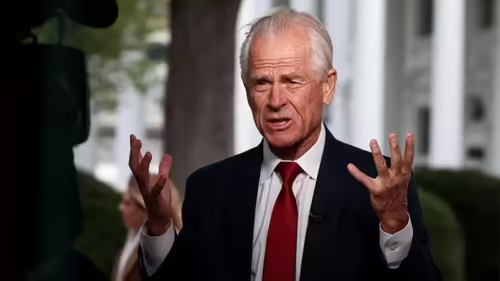
Peter Navarro Slams India Again: ‘Why Are Americans Paying for AI Used in India?’
In a fresh escalation of long-standing trade grievances, former White House trade adviser Peter Navarro has once again targeted India—this time zeroing in on artificial intelligence (AI). In a recent public statement, Navarro questioned why American consumers and taxpayers are effectively footing the bill for AI infrastructure and services that are heavily utilized by users in India. The comments come amid renewed scrutiny of U.S.-India economic ties and follow Navarro’s previous criticisms over Indian oil imports from Russia and tariff imbalances .
This latest salvo—framed around the explosive growth of AI—has sparked debate among economists, tech analysts, and foreign policy experts. Is Navarro raising a legitimate concern about digital trade equity, or is this another politically charged talking point ahead of the 2026 U.S. election cycle? Let’s unpack the facts behind the Peter Navarro India AI controversy.
Table of Contents
- Navarro’s Latest Claim: What Did He Actually Say?
- The U.S.-India AI Connection: How It Really Works
- Historical Context: Navarro’s Longstanding Grievances with India
- Expert Reactions: Is Navarro Right About AI Subsidies?
- Broader Implications for U.S.-India Trade Relations
- Conclusion: Beyond the Rhetoric
- Sources
Navarro’s Latest Claim: What Did He Actually Say?
Speaking at a policy forum in Washington, D.C., Navarro posed a provocative question: “Why are Americans paying for AI that’s being used by people in India?” He argued that major U.S.-based tech companies—like Google, Microsoft, and Amazon—host massive AI models and cloud infrastructure in the United States, funded by American capital, energy, and regulatory frameworks. Yet, he claimed, a significant portion of the user base benefiting from these services resides outside the U.S., particularly in India .
Navarro framed this as an unfair burden on American consumers and taxpayers, suggesting that India isn’t contributing its fair share to the global digital ecosystem despite being one of the largest consumers of AI-driven tools—from chatbots to enterprise software.
The U.S.-India AI Connection: How It Really Works
To understand Navarro’s claim, it’s essential to look at how global AI services operate:
- Cloud Infrastructure: U.S. tech giants operate data centers worldwide, including in India. While core AI training often happens in U.S. facilities, inference (the actual use of AI) increasingly occurs locally to reduce latency and comply with data laws.
- Pricing Models: Indian users typically pay for AI services in rupees, and those revenues flow back to U.S. parent companies. There’s no direct “subsidy” from American taxpayers—consumers globally pay market rates.
- Investment Flows: Many U.S. firms also invest heavily in India’s tech sector. Microsoft, for instance, has committed billions to expand its AI and cloud footprint in India .
In short, the relationship is symbiotic—not parasitic. Indian demand fuels U.S. tech revenue, while U.S. innovation enables India’s digital transformation.
Historical Context: Navarro’s Longstanding Grievances with India
This isn’t Navarro’s first jab at India. During the Trump administration, he was a vocal critic of what he saw as India’s “unfair” trade practices:
- In 2019, he supported the U.S. decision to revoke India’s Generalized System of Preferences (GSP) trade benefits, citing high tariffs on American goods .
- He repeatedly condemned India’s purchase of discounted Russian oil after the Ukraine invasion, calling it a betrayal of Western unity .
- He has long advocated for a more aggressive U.S. stance on intellectual property and digital service taxes affecting American firms.
His latest remarks on AI appear to be part of a broader narrative that positions India as a strategic competitor rather than a partner—a view not universally shared within U.S. foreign policy circles.
Expert Reactions: Is Navarro Right About AI Subsidies?
Most economists and tech policy analysts have pushed back against Navarro’s framing. “This confuses commercial transactions with public subsidies,” said Dr. Anjali Sharma, a senior fellow at the Center for Strategic and International Studies (CSIS). “When an Indian startup uses Azure or AWS, they’re paying for a service—just like any U.S. customer.”
Furthermore, the U.S. government does not directly fund private AI development for foreign consumption. While federal grants support basic AI research (e.g., through DARPA or NSF), the commercial deployment of large language models is entirely industry-driven .
Others argue that Navarro’s critique overlooks the immense value U.S. firms gain from India’s talent pool, market scale, and strategic alignment on issues like semiconductor supply chains and countering Chinese influence in tech .
Broader Implications for U.S.-India Trade Relations
The timing of Navarro’s comments is significant. With the U.S. and India negotiating a limited trade deal and deepening defense-tech cooperation, inflammatory rhetoric could complicate diplomatic efforts. Key areas of collaboration include:
- The iCET (U.S.-India Initiative on Critical and Emerging Technology)
- Joint ventures in semiconductor manufacturing
- AI safety and governance frameworks
Ironically, both nations are working to reduce dependence on China in the tech sector—a goal that requires trust, not accusations of freeloading. Navarro’s remarks may resonate with protectionist factions in the U.S., but they risk alienating a crucial democratic ally in the Indo-Pacific.
For more on U.S. foreign policy trends, see our analysis on [INTERNAL_LINK:us-india-strategic-partnership].
Conclusion: Beyond the Rhetoric
While Peter Navarro India AI makes for a catchy headline, the reality is far more nuanced. The global digital economy thrives on interconnectedness—not isolation. American companies profit from global AI adoption, and Indian users drive innovation through scale and feedback. Rather than framing this as a zero-sum game, policymakers should focus on equitable data governance, fair taxation, and mutual investment.
Navarro’s critique may serve political purposes, but it doesn’t reflect the complex, mutually beneficial reality of U.S.-India tech ties. As AI reshapes the 21st-century economy, cooperation—not confrontation—will determine who leads.
Sources
- Times of India: ‘Why are Americans paying?’ Trump aide Navarro targets India again; AI in crosshair
- U.S. Trade Representative: India Trade Relations Overview
- Microsoft News Center: Microsoft Announces $1 Billion Investment in India’s AI and Cloud Infrastructure
- Council on Foreign Relations: U.S.-India Relations: A Complex Partnership
- National Science Foundation: Federal AI Research Funding