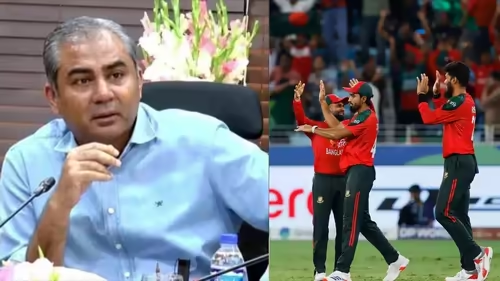
PCB Chief Mohsin Naqvi Sparks Global Cricket Controversy
In a statement that has sent shockwaves through the international cricket community, PCB chief Mohsin Naqvi suggested Pakistan could withdraw from the 2026 ICC Men’s T20 World Cup—a move he framed as a protest against the International Cricket Council’s (ICC) decision to replace Bangladesh with Scotland in the tournament. The fallout has been swift and severe, with former India cricketer Atul Wassan labeling the remarks as nothing short of “blackmail” and “foolish bravado.”
Table of Contents
- What Did PCB Chief Mohsin Naqvi Say?
- Why Was Bangladesh Replaced by Scotland?
- Atul Wassan’s Scathing Response
- The Politics Behind the Protest
- How ICC Rules Protect Tournament Integrity
- Conclusion: A Dangerous Precedent for Cricket
- Sources
What Did PCB Chief Mohsin Naqvi Say?
Speaking at a press conference in Lahore, PCB chief Mohsin Naqvi expressed strong disapproval of the ICC’s recent decision to remove Bangladesh from the 2026 T20 World Cup after the country refused to adhere to the tournament’s revised schedule. In a dramatic escalation, Naqvi declared, “If this is how the ICC treats its members, then we may have no choice but to reconsider our participation.” He went further, accusing the ICC of allowing “selective enforcement” and implying that Pakistan would not be part of a system it deemed unfair.
His comments were widely interpreted as a veiled threat to boycott the event—an unprecedented stance for a Full Member nation with a storied cricketing legacy.
Why Was Bangladesh Replaced by Scotland?
The ICC’s decision to replace Bangladesh with Scotland stems from a scheduling conflict. Bangladesh’s cricket board reportedly declined to adjust its domestic calendar to align with the ICC’s finalized window for the T20 World Cup, citing logistical and financial constraints .
Under ICC regulations, all participating nations must commit to the official tournament dates. Failure to do so can result in replacement by the next highest-ranked eligible team—which, in this case, was Scotland, currently ranked 9th in the ICC T20I rankings, just behind Bangladesh.
This isn’t the first time such a replacement has occurred. The ICC maintains that consistent scheduling is essential for broadcast deals, venue planning, and fan engagement—cornerstones of the modern global game.
Atul Wassan’s Scathing Response
Former Indian fast bowler and respected commentator Atul Wassan did not mince words in his critique of Naqvi’s remarks. Calling the threat to pull out of the World Cup “utterly foolish,” Wassan argued that such posturing harms the very athletes who dedicate their lives to the sport.
“This is not leadership—it’s emotional blackmail of the entire cricketing world,” Wassan said. “Players train for years for a chance to represent their country on the biggest stage. Administrators like Naqvi are playing political games while the careers of young cricketers hang in the balance.”
Wassan also pointed out the hypocrisy in Pakistan’s stance, noting that the country has historically benefited from ICC solidarity during its own periods of isolation due to security concerns. He questioned the timing and motive behind Naqvi’s comments, suggesting they were more about regional politics than genuine concern for fairness.
The Politics Behind the Protest
Observers note that Naqvi’s defense of Bangladesh may be less about cricket protocol and more about geopolitical alignment. Pakistan and Bangladesh share historical ties, and supporting Dhaka’s position could be seen as a strategic move to strengthen diplomatic bonds in South Asia.
However, critics argue that injecting regional politics into global sporting governance sets a dangerous precedent. If every nation begins pulling out over perceived slights or in solidarity with allies, the integrity and predictability of international tournaments would collapse.
Moreover, [INTERNAL_LINK:pakistan-cricket-board-controversies] past actions by the PCB—including frequent changes in leadership and public spats with other boards—have already strained its credibility within the ICC ecosystem.
How ICC Rules Protect Tournament Integrity
The ICC’s framework is designed to ensure fairness, consistency, and commercial viability across its events. Key provisions include:
- Mandatory scheduling compliance: All teams must confirm availability for the official tournament window.
- Transparent ranking-based replacements: If a team withdraws or is disqualified, the next eligible team in the ICC rankings is invited.
- Neutral oversight: Decisions are made by an independent committee, not by individual member boards.
These rules exist to prevent exactly the kind of unilateral threats now being floated by the PCB. As noted by ESPNcricinfo analysts, the ICC has consistently upheld these standards—even when it meant excluding high-profile teams in the past .
Conclusion: A Dangerous Precedent for Cricket
The remarks by PCB chief Mohsin Naqvi have done more than stir controversy—they’ve exposed a growing tension between national interests and global sporting governance. While boards have every right to voice concerns, threatening to boycott a World Cup over another nation’s scheduling issue crosses a line.
Cricket’s future depends on cooperation, not coercion. Players, fans, and the spirit of the game deserve better than political grandstanding disguised as principle. The ICC must now decide whether to engage diplomatically or stand firm on its protocols—because if one Full Member can dictate terms through intimidation, the entire structure of international cricket is at risk.
Sources
- Times of India: ‘Blackmail the whole cricketing world’: PCB chief under fire over pullout remarks
- ICC Official Regulations: ICC Announces Schedule for Men’s T20 World Cup 2026
- ESPNcricinfo: Analysis on ICC Governance and Team Participation