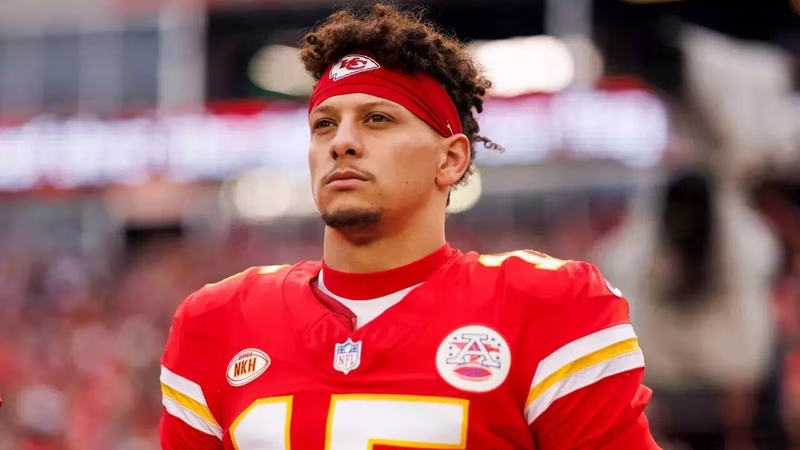
In the high-stakes world of professional football, where pain is often pushed aside and toughness is non-negotiable, a quiet moment of human connection has become the emotional cornerstone of Patrick Mahomes’ recovery journey. The Kansas City Chiefs quarterback, sidelined by a serious ACL injury, recently met 14-year-old Easton LaChappelle—a fellow Kansan bravely fighting Pompe disease, a rare and progressive neuromuscular disorder. Their encounter, arranged through the Make-A-Wish Foundation, didn’t just lift Mahomes’ spirits; it offered him a profound perspective on struggle, perseverance, and purpose beyond the game .
Table of Contents
- A Meeting Orchestrated by Make-A-Wish
- Patrick Mahomes ACL Recovery Gets a Human Dimension
- What Is Pompe Disease? Understanding Easton’s Battle
- Resilience Beyond the Field: How Illness Inspires Athletes
- The Psychology of Injury Recovery in Pro Sports
- Conclusion
- Sources
A Meeting Orchestrated by Make-A-Wish
Easton LaChappelle’s wish wasn’t for tickets or autographs—it was simply to meet his hero, Patrick Mahomes. Through Make-A-Wish, that wish came true in a private, heartfelt session where the roles unexpectedly reversed. Instead of just receiving encouragement, Mahomes became the one being inspired.
Easton, who has undergone countless hospital visits, physical therapy sessions, and experimental treatments since his Pompe diagnosis, shared candidly about his own rehabilitation journey. “He told me, ‘Every day I wake up and choose to fight,’” Mahomes later recounted. “And that hit me harder than any hit on the field ever could” .
Patrick Mahomes ACL recovery Gets a Human Dimension
For Mahomes, whose identity is so deeply tied to athletic excellence, the injury was more than physical—it was existential. ACL tears require months of grueling rehab, mental fortitude, and uncertainty about future performance. But hearing Easton describe facing daily mobility challenges with unwavering optimism reframed Mahomes’ own struggle.
“I’m working to run again,” Mahomes reflected. “Easton is working just to breathe, to walk, to live. If he can show up with that kind of courage every single day, then I have no excuse not to give everything I’ve got in my recovery” . This mindset shift is critical in long-term rehab, where motivation can wane and frustration builds.
What Is Pompe Disease? Understanding Easton’s Battle
Pompe disease is a rare genetic disorder caused by a deficiency of the enzyme acid alpha-glucosidase (GAA), which leads to dangerous glycogen buildup in muscles, including the heart and diaphragm . There are infantile and late-onset forms; Easton has the latter, which progressively weakens skeletal and respiratory muscles over time.
Key facts about Pompe disease:
- It affects approximately 1 in 40,000 people worldwide .
- Symptoms include muscle weakness, difficulty walking, and respiratory failure.
- Treatment involves enzyme replacement therapy (ERT), but it’s not a cure—just a way to slow progression .
- Patients like Easton must undergo regular infusions, physical therapy, and respiratory support.
Despite these challenges, many with Pompe disease, like Easton, maintain active lives through sheer determination—a reality that deeply moved Mahomes [INTERNAL_LINK:rare-diseases-in-america].
Resilience Beyond the Field: How Illness Inspires Athletes
This isn’t the first time an athlete has drawn strength from someone facing serious illness. From LeBron James visiting St. Jude Children’s Research Hospital to Simone Biles speaking about mental health after meeting young patients, these interactions often become turning points in an athlete’s personal narrative.
What makes Mahomes’ story unique is the reciprocity. In a culture that often idolizes athletes as invincible, this moment humanizes them—and elevates the quiet heroism of those living with chronic illness. It’s a reminder that resilience isn’t about physical strength alone; it’s about showing up, day after day, even when the odds are stacked against you.
The Psychology of Injury Recovery in Pro Sports
Sports psychologists emphasize that mental health is as crucial as physical therapy in injury recovery. A 2023 study published in the Journal of Athletic Training found that athletes who connected their rehab to a larger purpose—family, community, or personal values—reported higher adherence to treatment and faster emotional recovery .
Mahomes’ encounter with Easton provided exactly that: a “why” beyond statistics or contracts. It anchored his recovery in something deeply human. As Dr. Jim Afremow, a leading sports psychologist, notes: “When elite athletes find meaning in their struggle, they don’t just heal—they transform” .
Conclusion
The story of Patrick Mahomes ACL recovery has taken a powerful, deeply human turn—not through a new surgical technique or a celebrity trainer, but through the quiet courage of a 14-year-old boy fighting a rare disease. In a world obsessed with wins and losses, this moment reminds us that the greatest victories are often invisible, fought in hospitals, rehab centers, and living rooms across America. Mahomes may be the NFL star, but in this chapter, Easton is the true MVP of resilience.
Sources
- Times of India: Patrick Mahomes injury recovery takes powerful turn as teen fighting rare disease steps up to inspire him
- Muscular Dystrophy Association: Pompe Disease Overview
- Mayo Clinic: Pompe Disease – Symptoms and Causes
- Make-A-Wish Foundation Official Site
- Journal of Athletic Training: Psychosocial Factors in Injury Recovery