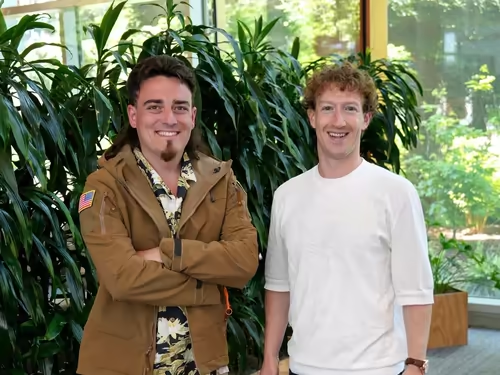
When news broke of Meta’s latest round of layoffs at Reality Labs—the division burning through billions to build the metaverse—most reactions ranged from concern to outrage. But not from **Palmer Luckey**, the original mind behind Oculus and the man who sold it to Facebook (now Meta) for $2 billion in 2014. In a candid, lengthy post on social media, Luckey delivered a contrarian verdict: *“This is not a disaster.”* In fact, he called it a “positive development” for the future of virtual reality.
Table of Contents
- The Backstory: Luckey vs. Zuckerberg
- Why Luckey Thinks Meta Reality Labs Layoffs Are Good
- The Problem with First-Party Content
- What This Means for Third-Party Developers
- Critics Push Back: Is Luckey Right?
- Conclusion: A Pivot Toward an Open VR Ecosystem?
- Sources
The Backstory: Luckey vs. Zuckerberg
Palmer Luckey’s relationship with Meta is famously complicated. After selling Oculus to Facebook in 2014, he was abruptly fired in 2017 following political controversies—a move widely seen as Mark Zuckerberg distancing the company from Luckey’s libertarian views. Since then, Luckey has founded Anduril Industries (a defense tech firm) but remained a vocal commentator on VR’s trajectory.
His latest comments aren’t just nostalgic—they’re strategic. Luckey has long believed that VR’s success depends on a vibrant, open ecosystem of independent creators, not corporate monopolies dictating content from Silicon Valley. The layoffs at Reality Labs, which heavily targeted first-party game and app studios, align with that vision—even if the human cost is real.
Why Luckey Thinks Meta Reality Labs Layoffs Are Good
In his post, Luckey acknowledged the pain felt by laid-off employees: *“I feel bad for the people impacted.”* But he quickly pivoted to the bigger picture. He argued that Meta’s massive investment in internal VR content—games like *Population: One*, *Blade & Sorcery: Nomad*, and studio acquisitions like Sanzaru and Ready at Dawn—created an unfair playing field.
“When Meta funds its own studios to make exclusive titles,” Luckey wrote, “it directly competes with small indie developers who can’t afford to give their games away for free or sell them at a loss.” This dynamic, he claims, stifled innovation and discouraged risk-taking in the broader VR community.
The Distortion of the Market
Luckey’s core argument hinges on market distortion. By bankrolling its own content, Meta could:
- Bundle games for free with Quest headsets
- Sell premium titles below cost to drive hardware adoption
- Prioritize its own apps in the Meta Store algorithm
For a solo developer or a 5-person studio, competing against a tech giant with near-infinite resources was nearly impossible. The result? A homogenized content library dominated by Meta’s aesthetic and business goals—not grassroots creativity.
The Problem with First-Party Content
While first-party titles often boast high production values, they tend to play it safe. They avoid experimental mechanics, niche genres, or politically charged narratives that might alienate Meta’s broad user base. In contrast, indie developers have historically driven VR’s most groundbreaking experiences—from *Job Simulator* to *Half-Life: Alyx* (developed by Valve, not Meta).
By scaling back its in-house ambitions, Meta may finally be acknowledging that it can’t—and shouldn’t—control every aspect of the VR experience. Instead, its role should be that of a platform enabler: providing tools, distribution, and hardware, while letting the community build the soul of the medium.
What This Means for Third-Party Developers
If Luckey is right, the next 12–18 months could see a renaissance in independent VR content. With less competition from subsidized Meta exclusives, indie studios may find:
- Better visibility in the Meta Quest Store
- Higher revenue shares as Meta seeks to incentivize external creators
- More creative freedom to explore unique concepts without corporate oversight
Already, developers on forums like Reddit and UploadVR are expressing cautious optimism. One studio head noted, “We were always afraid Meta would clone our idea and give it away. Now, maybe we have a real shot.” For more on how indie devs are adapting, see our [INTERNAL_LINK:indie-vr-developers-rise] feature.
Critics Push Back: Is Luckey Right?
Not everyone agrees. Critics argue that Meta’s pullback could lead to a “content drought,” especially as Apple’s Vision Pro targets enterprise users, not gamers. Without high-budget exclusives, they say, consumer interest in VR headsets may wane.
Moreover, some point out the irony: Luckey, now a billionaire defense contractor, is advocating for underfunded indie creators while his own company, Anduril, benefits from massive government contracts—a form of first-party advantage in its own right.
Still, even skeptics concede that a more balanced ecosystem is healthier long-term. As one analyst told The Verge, “VR needs diversity, not dominance.”
Conclusion: A Pivot Toward an Open VR Ecosystem?
Whether intentional or not, Meta’s Reality Labs layoffs may mark a turning point. By retreating from content creation, the company could be forced to double down on what it does best: hardware and platform infrastructure. And if Palmer Luckey’s vision holds true, this painful reset might just give the VR industry the breathing room it needs to evolve—not as a Meta-controlled metaverse, but as a truly open, creator-driven frontier.
Sources
- Times of India: ‘This is not a disaster’: Palmer Luckey writes a long note on Meta layoffs
- The Verge: Palmer Luckey defends Meta’s VR layoffs as good for the ecosystem
- UploadVR: Meta Layoffs: How Third-Party VR Developers Are Reacting
- Anduril Industries Official Blog: Luckey on the Future of Immersive Tech
- Stanford Virtual Human Interaction Lab: Ecosystem Diversity in VR: A Research Perspective