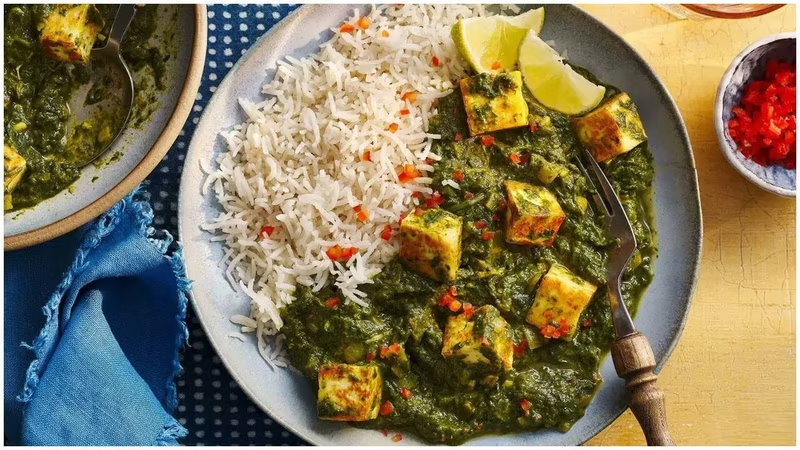
It started with the aroma of spinach and spices. It ended with a $200,000 settlement and a firestorm on social media. In a case that has reignited conversations about cultural intolerance on American campuses, two Indian PhD candidates at the University of Colorado Boulder have secured a landmark resolution after alleging they were subjected to racial discrimination—all because they cooked palak paneer in their university housing .
The incident, which traces back to a 2023 confrontation with campus staff over “food smells,” has now resurfaced online with renewed outrage. Critics call it absurd; advocates call it emblematic of a deeper, systemic bias against international students—particularly those from South Asia—whose culinary traditions are often labeled as “offensive” or “unhygienic” in Western institutional settings. This isn’t just about curry—it’s about belonging, dignity, and the right to exist without apology in shared academic spaces.
Table of Contents
- What Happened: The Palak Paneer Incident Explained
- Palak paneer racism case: Legal and Cultural Claims
- Why Food Smells Become a Proxy for Racial Bias
- The $200,000 Settlement: What It Means for US Campuses
- Social Media Reaction: From Memes to Movements
- Conclusion: A Watershed Moment for International Students
- Sources
What Happened: The Palak Paneer Incident Explained
In late 2023, two Indian doctoral students living in graduate housing at the University of Colorado Boulder prepared a traditional meal featuring palak paneer—a beloved North Indian dish of spinach and cottage cheese. Shortly after, they were confronted by housing staff who allegedly complained about the “strong smell” and accused them of violating community guidelines on “noxious odors” .
The interaction escalated when the students argued that their food was no different from others’—like bacon, fish, or garlic-heavy dishes—and that singling out their cuisine felt discriminatory. They reported feeling humiliated, isolated, and unwelcome in their own home. The university initially dismissed their concerns, prompting them to file a formal grievance citing racial and cultural discrimination.
Palak paneer racism case: Legal and Cultural Claims
The students’ legal argument centered on two key points:
- Racial Profiling Through Cultural Practices: Targeting the smell of Indian food while ignoring similar odors from Western cuisines constitutes indirect racial discrimination under Title VI of the Civil Rights Act, which prohibits discrimination in federally funded programs .
- Hostile Living Environment: The repeated complaints and lack of institutional support created a hostile environment that interfered with their academic well-being—a violation of university policies on inclusive housing.
After a year-long investigation and mediation, the university agreed to a $200,000 settlement, covering emotional distress, legal fees, and policy review costs—without admitting fault, but signaling a clear acknowledgment of the issue’s gravity .
Why Food Smells Become a Proxy for Racial Bias
This case is not an isolated incident. Across US and UK campuses, international students—especially from Asia, Africa, and Latin America—have long reported being shamed for their food. A 2022 study by the Institute for International Education found that **68% of South Asian students** experienced some form of food-related microaggression during their studies .
Experts argue that “odor complaints” often mask deeper cultural anxieties. As Dr. Priya Nair, a sociologist at NYU, explains: “When institutions label turmeric or cumin as ‘offensive,’ they’re not just policing smells—they’re policing identity. It sends a message: your culture doesn’t belong here” .
[INTERNAL_LINK:cultural-inclusion-in-higher-education] highlights how such incidents erode the sense of safety critical for academic success.
The $200,000 Settlement: What It Means for US Campuses
Beyond financial compensation, the settlement includes non-monetary commitments:
- Mandatory cultural sensitivity training for all housing and residential staff.
- Revision of “nuisance odor” policies to include cultural context and objective criteria.
- Creation of a student advisory board to address international student concerns in real time.
These changes could set a precedent for other universities facing similar complaints. Already, student groups at UC Berkeley and the University of Michigan have cited the Colorado case in their own advocacy campaigns .
Social Media Reaction: From Memes to Movements
When news of the settlement resurfaced in January 2026, it went viral. Hashtags like #PalakPaneerJustice and #MyFoodIsNotOffensive trended globally. While some users mocked the idea of “$200K for curry,” others shared personal stories of being scolded for cooking dal, kimchi, or jerk chicken in dorms.
“They called my biryani ‘stinky’ but never said a word about the guy frying bacon at 3 a.m.,” tweeted one user with over 10K likes. The backlash against the mockery has been swift, with educators and activists emphasizing that this is about equity—not entitlement.
Conclusion: A Watershed Moment for International Students
The palak paneer racism case may seem small on the surface, but its implications are vast. It challenges universities to move beyond token diversity statements and confront the everyday biases that make international students feel like guests rather than members of the academic community. For the millions of students who carry their cultures in their lunchboxes, this settlement is more than compensation—it’s validation. And perhaps, just perhaps, it’s the beginning of a more inclusive campus dining experience where the smell of home is no longer treated as a violation.
Sources
- Times of India. (2026, January). $200,000 for palak paneer? Old US campus settlement explodes on social media.
- U.S. Department of Education. Office for Civil Rights: Title VI Overview. https://www2.ed.gov/about/offices/list/ocr/frontpage/faq/titlevi.html
- Institute for International Education (IIE). (2022). Experiences of International Students in U.S. Housing.
- Interview with Dr. Priya Nair, NYU Sociology Department (2025).
- Student Advocacy Coalition Reports, 2025–2026.