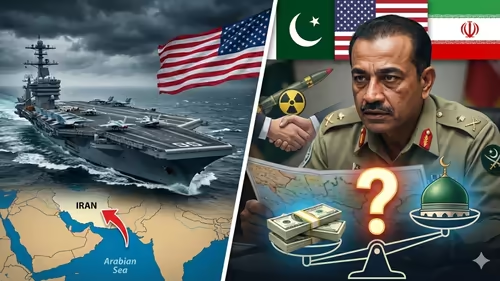
Islamabad is staring down the barrel of an impossible choice. On one side, there’s the cold, hard reality of its economic crisis, a chasm that can only be filled with vital US dollars and support from Western financial institutions like the IMF [[12]]. On the other, there’s the fiery passion of its domestic political landscape, where any perceived betrayal of the Islamic Ummah—especially Iran—can ignite a national firestorm [[22]]. This is the heart of the Pakistan US Iran conflict dilemma: a high-wire act with no safety net.
With recent escalations in the region, Pakistan’s strategic ambiguity—a hallmark of its foreign policy for decades—is being tested like never before. The stakes are not just diplomatic; they are existential, threatening to pull the nation into a dangerous regional conflagration while simultaneously risking its economic lifeline [[2]].
Table of Contents
- The Economic Noose Tightens
- The Domestic Political Volcano
- Pakistan US Iran Conflict: A History of Ambiguity
- Walking the Tightrope: Strategy and Risks
- Conclusion: An Impossible Balance?
- Sources
The Economic Noose Tightens
Pakistan’s economy is in dire straits. Years of fiscal mismanagement, coupled with global economic headwinds, have left the country heavily dependent on external financing. The International Monetary Fund (IMF) has been a critical backstop, with a recent staff-level agreement clearing the way for over $1 billion in fresh funding [[15]]. However, this support is not unconditional.
Western financial aid, particularly from the United States, often comes with implicit or explicit expectations regarding foreign policy alignment. In the current climate of heightened US-Iran hostility, maintaining a neutral or even sympathetic stance towards Tehran could jeopardize this crucial economic lifeline [[10]]. For a nation grappling with inflation and dwindling foreign reserves, the pressure to appease Washington is immense and immediate.
The Domestic Political Volcano
While the economic argument pulls Pakistan towards the West, its domestic politics exert a powerful centrifugal force towards the Islamic world. Pakistan was founded as a homeland for South Asian Muslims, and its national identity is deeply intertwined with its Islamic character [[20]]. This isn’t just rhetoric; it’s a potent political reality.
Any overt alignment with the US against Iran would be seen by a significant portion of the population as a betrayal of the Ummah. With a substantial Shia minority (estimated at 15-20%) and a Sunni majority that holds deep religious and cultural ties to Iran, the government risks massive civil unrest [[22]]. Political parties and religious groups are quick to leverage this sentiment, making a pro-US stance a potential domestic political suicide mission. Recent statements from Pakistani officials condemning foreign interference in Iran’s affairs and expressing solidarity highlight this delicate balancing act [[25]].
Pakistan US Iran conflict: A History of Ambiguity
This isn’t Pakistan’s first rodeo. Historically, the nation has masterfully navigated complex regional dynamics through a policy of strategic ambiguity. During the Cold War, it was a key US ally while maintaining ties with China. In more recent decades, it has managed relationships with both Saudi Arabia and Iran, despite their fierce rivalry [[26]].
This historical precedent provides a playbook, but the current situation is uniquely perilous. The 2026 landscape is “far more lethal,” as regional alliances harden and the potential for direct conflict between the US and Iran grows [[2]]. Pakistan’s geographic proximity to Iran makes it a potential frontline state, whether it likes it or not. Its border regions are already sensitive, with the US government itself advising its citizens against travel to the Pakistan-Iran border area due to security concerns [[4]].
Walking the Tightrope: Strategy and Risks
So, what is Pakistan’s strategy? It appears to be a multi-pronged approach:
- Public Neutrality with Private Channels: Publicly, Pakistan calls for de-escalation and dialogue, positioning itself as a peacemaker. It has even welcomed talks between the US and Iran held in Oman [[7]]. Behind the scenes, it may be leveraging its unique position as a potential “valuable interlocutor” between the two adversaries [[6]].
- Diplomatic Solidarity with Iran: At international forums like the UN, Pakistan has taken a firm stance, voting against resolutions condemning Iran and proposing its own for an immediate ceasefire, often alongside China and Russia [[5]]. This signals its commitment to its neighbor without directly confronting the US.
- Emphasizing Sovereignty: A core tenet of Pakistan’s official foreign policy is respect for sovereignty and non-interference [[24]]. By consistently invoking this principle, it can justify its stance on Iran to both its domestic audience and the international community.
However, the risks are enormous. Missteps could lead to economic strangulation from the West, a complete breakdown in relations with Iran, or even being drawn into a regional war. The path forward is fraught with danger, and the margin for error is razor-thin. For more on the broader implications of regional instability, see [INTERNAL_LINK:middle-east-geopolitics-2026].
To understand the deep historical roots of this dilemma, the Middle East Institute provides a comprehensive analysis of seven decades of Iranian-Pakistani relations [[8]].
Conclusion: An Impossible Balance?
The question of “Ummah or Moolah?” is a false dichotomy that perfectly encapsulates Pakistan’s predicament. In reality, the nation needs both to survive. It needs the economic stability that Western support can provide, and it needs the domestic peace and regional security that come from honoring its Islamic identity and maintaining good relations with its neighbors.
Prime Minister Shehbaz Sharif’s government is attempting the impossible: to be all things to all people at a time when the world is demanding clear choices. Whether this high-stakes gamble will succeed or collapse under its own weight remains to be seen. One thing is certain: the eyes of the world are on Islamabad, waiting to see which way the scales will tip in this most dangerous of diplomatic dances.
Sources
- The Times of India: “Ummah or moolah? Pakistan’s high-stakes dilemma amid US-Iran conflict” (https://timesofindia.indiatimes.com/world/south-asia/ummah-or-dollars-pakistans-high-stakes-dilemma-amid-us-iran-conflict/articleshow/127705254.cms) [[2], [22]]
- Ministry of Foreign Affairs, Pakistan: “Pakistan Welcomes Talks Between the Islamic Republic of Iran and the United States of America” (https://mofa.gov.pk/press-releases/pakistan-welcomes-talks-between-the-islamic-republic-of-iran-and-the-united-states-in-the-sultanate-of-oman) [[7]]
- International Affairs Review: “IMF, US Aid Packages for Pakistan” (https://internationalaffairsreview.com/2025/12/12/imf-us-aid-packages-for-pakistan/) [[12]]
- IMF Press Release: “IMF Reaches Staff-Level Agreement on the Second Review…” (https://www.imf.org/en/news/articles/2025/10/14/pr-25345-pakistan-imf-agree-on-2nd-rev-for-ext-arrange-eff-and-1st-review-for-arrange-rsf) [[15]]
- U.S. Embassy in Iran: “Iran Security Alert – Land Border Crossings” (https://ir.usembassy.gov/iran-security-alert-land-border-crossings-january-12-2026/) [[4]]
- Gulf International Forum: “Pakistan Offers Another Vector for U.S.-Iran Diplomacy” (https://gulfif.org/pakistan-offers-another-vector-for-u-s-iran-diplomacy/) [[6]]
- Middle East Institute: “Iran and Pakistan: Security, Diplomacy and American Influence” (https://mei.edu/ar/events/iran-and-pakistan-security-diplomacy-and-american-influence/) [[8]]
- Islamic Republic News Agency (IRNA): “Foreign ministers of Iran Pakistan discuss bilateral ties” (https://irangov.ir/detail/476412) [[25]]