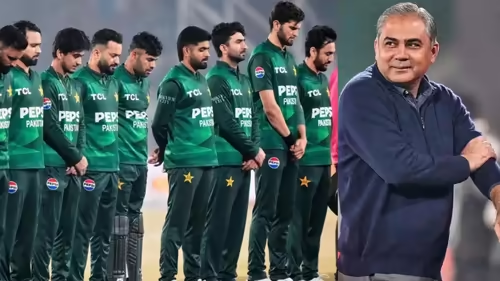
The cricketing world is watching Pakistan with bated breath. Amid rising political tensions over Bangladesh’s exclusion from certain bilateral arrangements, whispers of a potential Pakistan T20 World Cup boycott have begun circulating in Islamabad and Lahore. But now, a powerful chorus of former players and administrators is stepping in—not with support, but with urgent warnings.
Legends like Wasim Akram, Ramiz Raja, and former PCB officials are pleading with the current board leadership: Don’t do it. They argue that pulling out of the 2026 T20 World Cup—a tournament Pakistan desperately needs to compete in—would be “bad for our cricket” and could permanently damage relationships with the ICC and other member nations [[1]].
This isn’t just about sport. It’s about survival. And the stakes couldn’t be higher.
Table of Contents
- Why Is a Pakistan T20 World Cup Boycott Being Considered?
- Ex-Players Speak Out Against the Boycott
- The Real Cost of Withdrawing from the T20 World Cup
- How ICC Relations Could Be Permanently Damaged
- What Bangladesh Really Needs—and What Pakistan Can Do
- Conclusion: Play the Game, Not Politics
- Sources
Why Is a Pakistan T20 World Cup Boycott Being Considered?
The idea stems from growing frustration within certain Pakistani political and cricketing circles over Bangladesh’s recent diplomatic and sporting isolation. Some factions believe that by boycotting the T20 World Cup—co-hosted by the USA and West Indies—Pakistan can send a strong message of solidarity with Dhaka.
However, this rationale is deeply flawed. The T20 World Cup is an ICC event, not a bilateral series. Bangladesh’s issues (which reportedly involve visa restrictions and scheduling conflicts with other boards) are separate from the global tournament structure. Using the World Cup as a protest tool conflates unrelated matters and risks punishing Pakistan’s own players and fans.
Ex-Players Speak Out Against the Boycott
Former stars aren’t mincing words. In public statements and media appearances, they’ve laid out a clear case against withdrawal:
- Wasim Akram: “Boycotting will only isolate us further. Our players need exposure, not exile.”
- Ramiz Raja (ex-PCB Chairman): “This is emotional politics, not cricket strategy. We’ll pay the price for years.”
- Moin Khan (former captain): “Don’t spoil ties with ICC. We’re already on thin ice financially.” [[1]]
Their message is unified: Pakistan’s cricket is in a fragile state. With domestic instability, declining revenues, and player burnout, the last thing the team needs is self-inflicted exile from the sport’s biggest T20 stage.
The Real Cost of Withdrawing from the T20 World Cup
Pulling out wouldn’t just be symbolic—it would have concrete, devastating consequences:
- Financial Loss: The PCB receives millions in ICC funding tied to World Cup participation. Withdrawal could trigger immediate cuts, worsening its existing cash crunch.
- Player Development: Young talents like Mohammad Haris and Naseem Shah need high-pressure games to grow. Missing the World Cup stalls their progress.
- Rankings & Seeding: Non-participation affects ICC T20 rankings, potentially leading to tougher group draws in future tournaments.
- Sponsorship Fallout: Brands like Pepsi and Habib Bank may reconsider partnerships if Pakistan becomes “unreliable.”
[INTERNAL_LINK:pakistan-cricket-financial-crisis-explained] details how the PCB is already struggling to pay staff and host international matches—making a boycott financially suicidal.
How ICC Relations Could Be Permanently Damaged
The International Cricket Council has zero tolerance for political interference in its events. Remember Zimbabwe’s suspension in the 2000s or South Africa’s apartheid-era ban? While Pakistan wouldn’t face immediate expulsion, a unilateral withdrawal would be seen as a breach of the ICC’s “spirit of cricket” charter.
According to the ICC’s official regulations, member boards must “participate in good faith” in all global events unless under force majeure (e.g., war, natural disaster) [[2]]. Political solidarity doesn’t qualify.
Worse, other boards—especially India, Australia, and England—might view Pakistan as an unpredictable partner, making future tours and revenue-sharing deals harder to negotiate.
What Bangladesh Really Needs—and What Pakistan Can Do
If Pakistan truly wants to support Bangladesh, there are smarter, more effective paths:
- Host a bilateral series in Pakistan to boost Bangladesh’s morale and revenue.
- Lobby the ICC collectively for fairer scheduling and visa policies.
- Joint development programs for women’s and U-19 cricket.
As one former administrator put it: “Solidarity is shown through action, not absence.” Sitting out the World Cup helps no one—not Bangladesh, and certainly not Pakistan.
Conclusion: Play the Game, Not Politics
The Pakistan T20 World Cup participation isn’t just about winning matches—it’s about securing the future of the sport in the country. The warnings from ex-players aren’t nostalgic ramblings; they’re hard-earned lessons from decades of navigating cricket’s complex political landscape.
Boycotting might feel like a noble gesture today, but tomorrow, Pakistan’s players could be left on the sidelines—financially broke, diplomatically isolated, and competitively irrelevant. The right move is clear: pack the bags, play the games, and let cricket do what it does best—build bridges, not burn them.
Sources
- Times of India. “‘Bad for our cricket, don’t spoil ties’: Ex-Pakistan stars warn PCB against T20 WC boycott.” January 27, 2026. https://timesofindia.indiatimes.com/sports/cricket/icc-mens-t20-world-cup/bad-for-our-cricket-dont-spoil-ties-with-icc-former-pakistan-stars-warn-pcb-against-t20-world-cup-boycott-over-bangladesh/articleshow/127671480.cms
- International Cricket Council (ICC). “ICC Playing Conditions and Member Obligations.” https://www.icc-cricket.com
- ESPNcricinfo. “PCB’s Financial Woes Deepen Ahead of T20 World Cup.” January 2026. https://www.espncricinfo.com