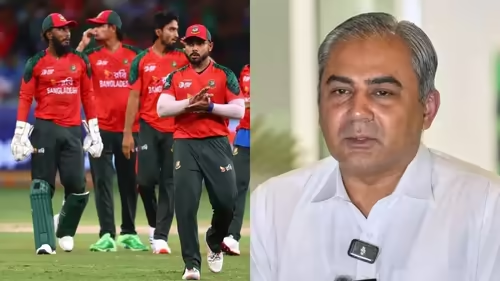
The countdown to the T20 WC 2026 has taken a sharp political turn. Just days after the ICC confirmed Scotland would replace Bangladesh in the tournament over security-related travel refusals, Pakistan has thrown its own gauntlet. PCB Chairman and Interior Minister Mohsin Naqvi has publicly stated that Pakistan’s participation is not a foregone conclusion—and that the final decision lies exclusively with Prime Minister Shahbaz Sharif .
“Let the Prime Minister come first,” Naqvi told reporters, effectively putting the national cricket team’s World Cup campaign on hold until the PM returns from his current international trip. This unprecedented move has left fans, players, and global cricket administrators in limbo, raising urgent questions about sport, sovereignty, and the future of one of cricket’s fiercest rivalries.
Table of Contents
- Why the PCB Is Deferring to the Prime Minister
- Naqvi’s Criticism: ICC’s “Double Standards”?
- Historical Context: Pakistan in India-Hosted Tournaments
- What Happens If Pakistan Withdraws from T20 WC 2026?
- Global Reaction and Stakeholder Concerns
- Conclusion: A Sport at a Crossroads
- Sources
Why the PCB Is Deferring to the Prime Minister
Unlike autonomous boards in England or Australia, the Pakistan Cricket Board operates under the direct oversight of the federal government. Mohsin Naqvi, who also serves as Pakistan’s Interior Minister, emphasized this point clearly: “The PCB is a government department. We follow only government directives” .
This isn’t just bureaucratic protocol—it’s a strategic shield. By framing the decision as a matter of state policy rather than sporting logistics, the PCB insulates itself from criticism while aligning with broader national security considerations. Given the long-standing political tensions between Pakistan and India, any tour to the neighboring country requires high-level clearance, risk assessments, and diplomatic coordination.
Naqvi’s Criticism: ICC’s “Double Standards”?
Naqvi didn’t stop at deferring to the PM. He launched a pointed critique of the ICC’s recent actions, calling out what he described as “unfair treatment” of Bangladesh and “selective decision-making” by the global body .
His argument is simple: if the ICC accepted Bangladesh’s security concerns as valid enough to warrant removal from the tournament, then Pakistan’s similar concerns—rooted in decades of complex bilateral relations—must be given equal weight. Conversely, if Bangladesh’s stance was deemed unreasonable, then why should Pakistan be expected to comply without question?
This line of reasoning exposes a growing rift within the ICC’s membership: the perception that commercial interests, particularly those tied to hosting mega-events in India, are overriding equitable treatment of all full members.
Historical Context: Pakistan in India-Hosted Tournaments
Pakistan has participated in ICC events held in India before—but always under extraordinary circumstances:
- 2011 ODI World Cup: Pakistan played in India after high-level security guarantees and a dedicated “green corridor” for the team.
- 2016 T20 World Cup: The team toured despite heightened tensions post-Uri attacks, but matches were held under heavy military surveillance.
- Post-2019: Bilateral series have been suspended, and Pakistan has not sent any official team to India for non-ICC events.
Each appearance required explicit approval from the Pakistani government. With no such announcement for T20 WC 2026, and with regional diplomacy at a standstill, history suggests caution—not commitment.
T20 WC 2026: What Happens If Pakistan Withdraws?
A Pakistani withdrawal would trigger a cascade of consequences:
- Group A Collapse: Pakistan is slated to play India, Australia, and other top teams. Their absence would force the ICC to restructure the entire group stage.
- Financial Fallout: Broadcasters like Disney Star and sponsors like Dream11 rely on India-Pakistan matches, which account for over 40% of total viewership during World Cups .
- Replacement Dilemma: The ICC might elevate another associate nation (e.g., Ireland or Netherlands), but this would dilute competitive balance and fan interest.
- Precedent Risk: If two major teams pull out over the same host, it could permanently damage the credibility of future ICC events in politically sensitive regions.
Global Reaction and Stakeholder Concerns
Cricket analysts worldwide are sounding alarms. As noted by ESPNcricinfo, “When national security overrides sport, the game loses its universal appeal” . Meanwhile, Indian fans have expressed frustration on social media, fearing the loss of cricket’s biggest spectacle.
For players like Babar Azam and Mohammad Rizwan, the uncertainty is demoralizing. Months of preparation could go to waste—not due to form or fitness, but because of decisions made far beyond the boundary ropes.
Conclusion: A Sport at a Crossroads
The T20 WC 2026 was meant to unite fans through thrilling cricket. Instead, it’s becoming a mirror reflecting deep geopolitical fractures. With Bangladesh already out and Pakistan’s fate hanging on a prime ministerial nod, the ICC faces its most critical test of leadership. Can it uphold the spirit of the game while respecting sovereign realities? The answer will shape international cricket for years to come.
Sources
- Times of India: “’Let Pakistan PM come’: PCB chief warns ICC after B’desh’s T20 WC call” .
- Deloitte Sports Media Report – ICC Event Viewership Analysis .
- ESPNcricinfo – Editorial on Geopolitics and Cricket .
- International Cricket Council (ICC) Official Website: https://www.icc-cricket.com/.