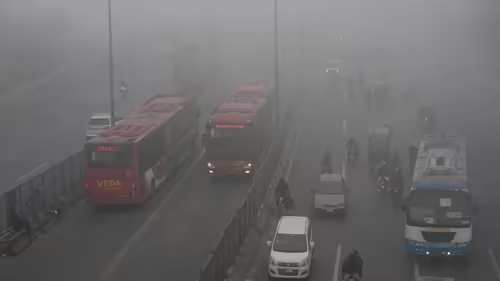
Saturday, January 17, 2026, began with tragedy on Pakistan’s roads. In just hours, two catastrophic crashes—one in Punjab, another in Balochistan—took 23 lives, shattering families and exposing once again the deadly consequences of inadequate road safety measures in the country.
These incidents, occurring amid thick winter fog, are not isolated. They are part of a grim pattern: Pakistan road accidents claim thousands of lives every year, making its highways among the most dangerous in the world. But this weekend’s toll—especially the loss of six young children—has struck a raw nerve nationwide.
Table of Contents
- The Sargodha Tragedy: Truck Plunges into Canal
- The Gwadar Bus Overturn Near Coastal Highway
- Why Pakistan Road Accidents Are So Deadly
- The Hidden Crisis: Child Fatalities on Pakistani Roads
- What Needs to Change: Policy and Infrastructure Reforms
- Conclusion: A Call for Urgent Action
- Sources
The Sargodha Tragedy: Truck Plunges into Canal
In the central Punjab district of Sargodha, a passenger truck veered off the road and plunged into a dry canal in the early morning hours. The vehicle was carrying laborers and their families, many of whom were asleep.
Local rescue services reported that 14 people died at the scene, including four children. Survivors described near-zero visibility due to dense fog—a common winter hazard in the region. Preliminary investigations suggest the driver was speeding, unable to react in time to a sharp turn obscured by mist .
Emergency teams from Edhi Foundation and local police worked for hours to recover bodies. Many victims were identified only through personal belongings, as the impact left few recognizable features.
The Gwadar Bus Overturn Near Coastal Highway
Over 1,000 kilometers southwest, near the port city of Gwadar in Balochistan, another horror unfolded. A passenger coach traveling from Karachi to Gwadar lost control on the Makran Coastal Highway and overturned.
Nine people were killed instantly, including two children. Dozens more were injured, some critically. Witnesses told reporters that the bus was attempting to overtake another vehicle when it skidded on the wet, fog-covered road .
The remote location delayed medical response, with ambulances taking over an hour to reach the site. Local villagers used tractors and private vehicles to ferry the wounded to the nearest hospital—a stark reminder of the region’s underdeveloped emergency infrastructure.
Why Pakistan Road Accidents Are So Deadly
Pakistan records over 12,000 road fatalities annually, according to the World Health Organization (WHO)—a rate nearly double the global average . Several systemic issues contribute to this crisis:
- Poor Road Design: Many highways lack proper signage, guardrails, or lighting, especially in rural areas.
- Vehicle Safety Standards: Aging fleets, poorly maintained brakes, and overloaded vehicles are common.
- Enforcement Gaps: Speeding, drunk driving, and mobile phone use while driving are rarely penalized.
- <Weather Vulnerability: Winter fog in Punjab and Sindh, and monsoon rains in other regions, turn roads into death traps without adequate warnings or speed advisories.
As noted by the World Health Organization, low- and middle-income countries like Pakistan account for 93% of global road deaths despite having only 60% of the world’s vehicles .
The Hidden Crisis: Child Fatalities on Pakistani Roads
The fact that six children died in these two accidents is particularly devastating—and indicative of a larger problem. Children in Pakistan often travel in unsecured vehicles, sit on laps, or ride in open cargo areas. There are no mandatory child seat laws, and school transport regulations are weakly enforced.
According to a 2025 study by the Pakistan Institute of Development Economics, children under 15 account for nearly 18% of all road crash fatalities in the country—a figure far higher than in neighboring India or Bangladesh .
Advocates argue that protecting children on the road must become a national priority, not an afterthought.
What Needs to Change: Policy and Infrastructure Reforms
Experts and civil society groups are calling for immediate action:
- Implement Fog Warning Systems: Install real-time weather sensors and variable message signs on high-risk corridors like the M-2 and N-5 highways.
- Enforce Speed Limits in Poor Visibility: Mandate automatic speed governors during fog or rain.
- Modernize Emergency Response: Expand the National Highways & Motorway Police’s rescue capabilities and integrate them with provincial ambulance networks.
- Launch Public Awareness Campaigns: Educate drivers on safe speeds in fog—“slow down, stay alive” should be more than a slogan.
For deeper insights into regional transportation safety, see our coverage on [INTERNAL_LINK:south-asia-road-safety-challenges].
Conclusion: A Call for Urgent Action
The Pakistan road accidents that claimed 23 lives this weekend are not just “unfortunate events”—they are preventable tragedies rooted in decades of policy neglect. While fog provided the immediate trigger, the real culprits are outdated infrastructure, lax enforcement, and a culture that normalizes risk on the road.
As Pakistan mourns the loss of innocent lives—including six children whose futures were cut short—the nation must move beyond condolences and commit to concrete, life-saving reforms. Because without systemic change, the next foggy morning could bring another headline just like this one.
Sources
- Times of India: Pakistan: At least 23 killed in separate road accidents amid dense fog; 6 children among dead
- World Health Organization (WHO): Road Traffic Injuries Fact Sheet
- Pakistan Institute of Development Economics (PIDE): Road Safety and Child Mortality in Pakistan (2025 Report)