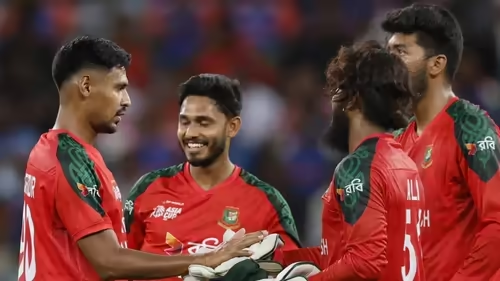
Introduction: A Cricket Crisis Unfolds
The world of cricket is facing a seismic political and sporting crisis just months before the T20 World Cup 2026. At the heart of it is a bitter standoff between Bangladesh and India, which has now drawn in Pakistan in a surprising and potentially game-changing move. The situation, fueled by diplomatic tensions and player safety concerns, threatens to upend the entire tournament schedule.
In a bold show of solidarity, the Pakistan Cricket Board (PCB) has officially offered to host Bangladesh’s matches if they cannot be played in India. This unprecedented offer comes as the International Cricket Council (ICC) grapples with a final decision that could see one of its founding members excluded from the sport’s biggest global event.
Table of Contents
- The Standoff: Bangladesh Refuses to Play in India
- Pakistan’s Surprise Move: A Bold Offer
- The ICC at a Crossroads
- The Mustafizur Rahman Incident: The Spark
- What Happens Next? Potential Scenarios
- Conclusion: A Tournament on the Brink
- Sources
The Standoff: Bangladesh Refuses to Play in India
The core of this crisis is Bangladesh’s firm and unwavering stance against playing its scheduled T20 World Cup matches on Indian soil. The Bangladesh Cricket Board (BCB) has cited serious “safety and security concerns” for its players and officials as the primary reason for this refusal .
This position isn’t just a simple request; it’s a hardline demand for a venue change. The BCB has formally asked the ICC to relocate their group-stage fixtures to the other co-host, Sri Lanka . The tension between the two neighboring nations has been escalating, creating an environment that Dhaka deems unsafe for its national team.
Pakistan’s Surprise Move: A Bold Offer
In a significant development that has added another layer to this complex situation, Pakistan has thrown its hat into the ring. The Pakistan Cricket Board (PCB) has formally written to the ICC, not only backing Bangladesh’s security concerns but also offering a concrete solution: to host Bangladesh’s matches in Pakistan itself .
This offer is multifaceted. Reports suggest the PCB is willing to step in if Sri Lanka’s venues are unavailable, effectively positioning Pakistan as a viable, neutral(ish) ground for the contested fixtures . This move is seen as a strategic gesture of regional solidarity from Pakistan, aligning itself with Bangladesh’s position against the ICC’s preferred plan to keep the tournament in India .
The ICC at a Crossroads
The International Cricket Council is now under immense pressure to make a swift and decisive ruling. On one hand, it has a duty to ensure the safety of all participating teams. On the other, it must uphold the integrity of the pre-published tournament schedule and its commercial agreements with the host nation, India.
Recent reports indicate that the ICC has already held a virtual board meeting to address the BCB’s request. The outcome appears to be a firm rejection of any venue change. According to multiple sources, the ICC has voted to uphold the original schedule and has given Bangladesh a final ultimatum: confirm participation in India or face replacement [[21], [24]].
The potential replacement team, should Bangladesh hold its ground, is reportedly Scotland, who finished as the top non-qualified team in the T20 World Cup rankings . This would be a historic and controversial move, sidelining a full-member nation for geopolitical reasons.
The Mustafizur Rahman Incident: The Spark
While security concerns are the official reason, the current crisis can be traced back to a specific incident involving star pacer Mustafizur Rahman. Ahead of the IPL 2026, Rahman was forced to withdraw from his franchise, the Chennai Super Kings, following what many described as “Hindutva pressure” in India .
This high-profile snub ignited a wave of public anger in Bangladesh. In response, the interim government in Dhaka took the extraordinary step of banning the broadcast of the IPL across the entire nation . The exclusion of one of Bangladesh’s most beloved athletes from a major Indian league became the catalyst for the deep-seated mistrust that now underpins their refusal to participate in the T20 World Cup in India. The BCB’s decision is widely seen as a direct consequence of this diplomatic and sporting rift .
What Happens Next? Potential Scenarios
With the ICC’s apparent decision to reject the venue change, the ball is now firmly in Bangladesh’s court. Several scenarios could unfold in the coming days:
- Bangladesh Backs Down: The BCB reverses its decision, citing assurances from the ICC and Indian authorities on security, and agrees to play in India. This would defuse the crisis but likely cause domestic political backlash in Bangladesh.
- Bangladesh Stands Firm: Dhaka refuses to send its team, leading to their forfeiture of all matches. Scotland would be invited to take their place, a move that would cast a long shadow over the tournament’s legitimacy.
- Last-Minute Compromise: Despite the reported rejection, intense behind-the-scenes negotiations could lead to a compromise, perhaps involving a single neutral venue for all of Bangladesh’s matches, possibly even in Pakistan if the ICC were to reconsider its stance.
Conclusion: A Tournament on the Brink
The T20 World Cup 2026 is at a critical juncture. What was meant to be a celebration of global cricket is now mired in a complex web of geopolitics, player safety, and institutional authority. Pakistan’s unexpected offer has provided a potential lifeline, but the ICC’s apparent hardline stance suggests a difficult path forward. The next few days will be crucial in determining whether cricket can rise above the fray or if the beautiful game will become another casualty of international discord. For fans worldwide, the hope is that a solution can be found that prioritizes both safety and the spirit of the sport.
Sources
- Times of India: Pakistan offers to host Bangladesh’s T20 WC matches amid standoff with India
- ESPNCricinfo: Reports on PCB’s offer to ICC
- NDTV Sports: ICC rejects Bangladesh’s request to shift T20 World Cup matches
- The Hindu: Coverage of the Mustafizur Rahman IPL controversy