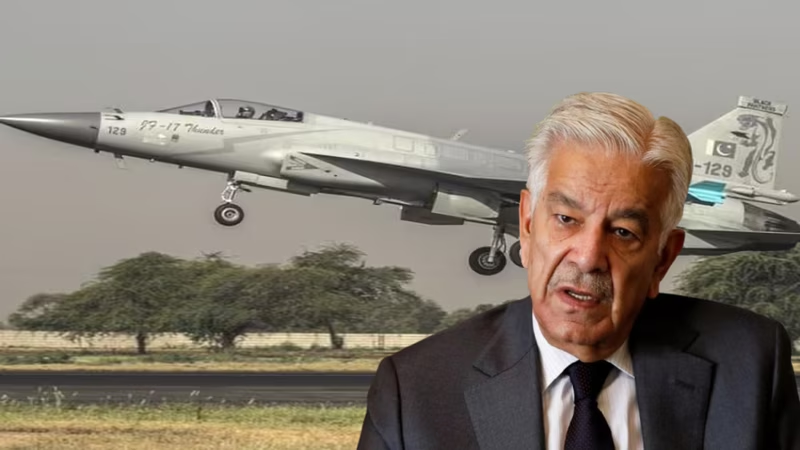
For a nation that has approached the International Monetary Fund (IMF) for financial bailouts a staggering 23 times since 1958, the idea of breaking free seems like a dream. Yet, that’s exactly what Pakistan’s Defence Minister Khawaja Asif boldly proclaimed this week: Pakistan may no longer need IMF loans “in the next six months.”
What’s behind this extraordinary confidence? According to Asif, it’s not oil, remittances, or agriculture—it’s fighter jets. Specifically, the Chinese-Pakistani co-developed JF-17 Thunder, which he claims is on the verge of massive export breakthroughs with Bangladesh and Saudi Arabia. If these deals materialize, they could inject billions into Pakistan’s struggling economy and reduce its chronic balance-of-payments crisis.
But experts urge caution. Can defence exports—historically a minor contributor to Pakistan’s GDP—really replace the lifeline of IMF loans in just half a year?
Table of Contents
- Khawaja Asif’s Bold Promise: No More IMF Loans?
- The JF-17 Thunder: Pakistan’s Economic Hope?
- Bangladesh and Saudi Arabia: Are Deal Signings Imminent?
- Pakistan Economic Reality: Why IMF Loans Have Been Essential
- Can Defence Exports Replace IMF Bailouts? An Expert Analysis
- Geopolitical Implications of Pakistan’s Defence Diplomacy
- Conclusion: Hope vs. Hype in Pakistan’s Economic Narrative
- Sources
Khawaja Asif’s Bold Promise: No More IMF Loans?
Speaking to reporters on January 7, 2026, Defence Minister Khawaja Asif declared, “We are very close to finalizing big aircraft orders… There is a strong possibility that Pakistan will not need IMF loans within the next six months” .
The statement comes amid tense regional dynamics—just weeks after a military standoff with India along the Line of Control—and as Pakistan navigates the final phase of its current $3 billion IMF Stand-By Arrangement, set to expire in April 2026 .
Asif’s optimism hinges entirely on the successful export of the JF-17 Thunder, a lightweight multirole fighter co-produced by Pakistan Aeronautical Complex (PAC) and China’s Chengdu Aircraft Corporation.
The JF-17 Thunder: Pakistan’s Economic Hope?
Launched in 2007, the JF-17 was meant to modernize Pakistan’s air force and create a platform for export revenue. To date, only Myanmar and Nigeria have officially purchased the jet—around 60 units total—generating an estimated $1–1.5 billion over 15 years .
But Asif is betting on a quantum leap. He claims Bangladesh is “very close” to ordering 16–20 jets, while Saudi Arabia—the Gulf’s biggest defence spender—is “seriously considering” a much larger batch, possibly up to 50 aircraft .
At an estimated $40–50 million per unit, even a modest deal with Bangladesh could bring in $800 million–$1 billion. A Saudi order, however, could net $2–2.5 billion—enough to cover nearly half of Pakistan’s current monthly import bill.
Bangladesh and Saudi Arabia: Are Deal Signings Imminent?
While Asif expressed “strong confidence,” neither Bangladesh nor Saudi Arabia has confirmed any deal.
Bangladesh: The country is indeed evaluating new fighter jets to replace its aging MiG-29s. But it’s also in talks with Russia (for MiG-35s), Sweden (Gripen), and China (J-10C). The JF-17 faces stiff competition on both performance and price .
Saudi Arabia: Despite close ties with Pakistan, Riyadh has never bought Pakistani weapons. Its air force relies on U.S. (F-15s), European (Typhoons), and increasingly Chinese (Wing Loong drones) systems. A JF-17 purchase would be a major policy shift—and likely require U.S. approval due to embedded American tech in Saudi defence networks .
Pakistan Economic Reality: Why IMF Loans Have Been Essential
Pakistan’s economy remains fragile:
- Foreign exchange reserves: ~$8.2 billion (barely enough for 2 months of imports)
- Current account deficit: Projected at 2.5% of GDP in FY2026
- Public debt: Over 70% of GDP
- Annual IMF dependency: Averaged $1–2 billion per year since 2019
Even a $2 billion jet deal would provide temporary relief—but not structural reform. As the World Bank notes, “Sustainable economic stability requires revenue mobilization, energy sector reform, and export diversification—not one-off deals” .
Can Defence Exports Replace IMF Bailouts? An Expert Analysis
Most economists are skeptical. “Defence deals are lumpy, unpredictable, and often delayed by geopolitical vetoes,” says Dr. Hafsa Kanwal, an economist at the Lahore School of Economics. “Relying on them to replace IMF support is risky and unsustainable.”
Moreover, JF-17 production is limited. PAC can build only 16–20 jets per year. Fulfilling a 50-jet Saudi order would take 2–3 years—meaning revenue inflows would be staggered, not immediate.
For more on Pakistan’s economic challenges, see our analysis on [INTERNAL_LINK:pakistan-imf-bailout-history-and-future-outlook].
Geopolitical Implications of Pakistan’s Defence Diplomacy
Beyond economics, these deals serve Pakistan’s strategic goals:
- Strengthening ties with Muslim nations: Arms sales deepen military-diplomatic bonds with Saudi Arabia and Bangladesh.
- Countering India: A robust defence industry bolsters deterrence narrative post-standoff.
- Reducing reliance on China: While co-developed with China, JF-17 exports could give Pakistan more leverage in its own defence ecosystem.
However, success depends on navigating complex U.S. export controls and regional rivalries—no small feat.
Conclusion: Hope vs. Hype in Pakistan’s Economic Narrative
Khawaja Asif’s claim that IMF loans may soon be obsolete is a powerful political message—one designed to boost national morale and signal economic sovereignty. And if even half the reported deals go through, Pakistan will see a meaningful, if temporary, financial boost.
But replacing systemic IMF support with defence exports? That’s a leap of faith the data doesn’t yet support. For now, the world watches—not just to see if jets fly, but whether Pakistan’s economy can finally take off on its own.
Sources
- Times of India: Khawaja Asif says Pakistan may not need IMF loans soon
- International Monetary Fund (IMF) – Pakistan Country Page
- Stockholm International Peace Research Institute (SIPRI) – Arms Transfers Database
- Reuters – Asia-Pacific Defence News
- World Bank – Pakistan Economic Overview
- Ministry of Foreign Affairs, Pakistan