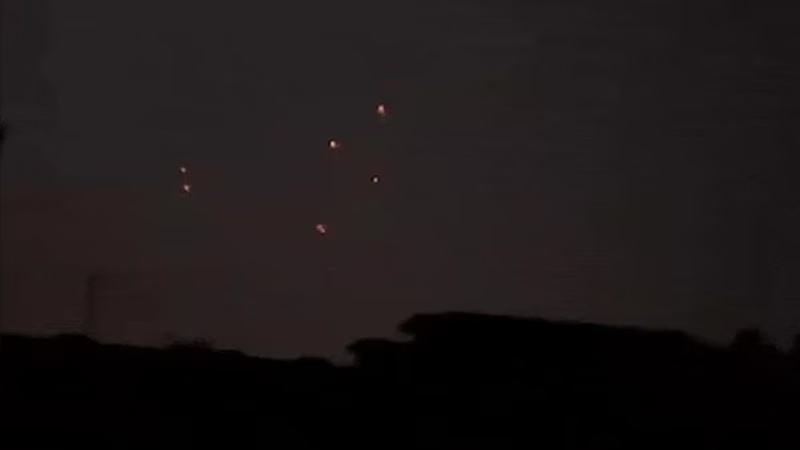
Pakistan Drones Along LoC: A Disturbing Pattern Emerges in J&K
The serene but heavily militarized landscape of Jammu and Kashmir has been jolted by a new and persistent threat from across the border. In a significant security development, Indian Army sources have confirmed that Pakistan drones along LoC were sighted on two separate occasions within a mere 48-hour window . This isn’t an isolated incident; it’s a pattern that points to a deliberate and evolving strategy by Pakistan to exploit unmanned aerial vehicles for its objectives in the region. For a nation already on high alert along its volatile western frontier, this repeated drone activity represents a complex challenge that demands a robust and multi-layered response.
Table of Contents
- The Latest Incident: What We Know
- Why Drones Are a Growing Threat Along the LoC
- India’s Counter-Drone Strategy: From Detection to Destruction
- Historical Context: The Rise of Drone Incursions
- Geopolitical Implications and the Path Forward
- Conclusion: Vigilance in the Age of Unmanned Warfare
- Sources
The Latest Incident: What We Know
According to official reports from the Indian Army, the first drone was spotted in the general area of the Line of Control in Jammu and Kashmir. Security forces immediately initiated standard operating procedures, which include tracking the drone’s flight path and attempting to neutralize it. Within two days, a second drone was detected in a similar sector, confirming a troubling trend rather than a one-off event .
While the specific payloads of these drones remain under investigation, their primary purposes are generally understood to be either surveillance or the smuggling of contraband like weapons, narcotics, or communication equipment to support militant activities on the Indian side. The fact that they were able to penetrate Indian airspace, even briefly, highlights a critical vulnerability that the armed forces are racing to close.
Why Drones Are a Growing Threat Along the LoC
The use of drones by state and non-state actors has transformed modern asymmetric warfare, and the LoC is no exception. Their appeal lies in several key factors:
- Cost-Effectiveness: Commercially available drones are relatively cheap and easy to acquire, making them a low-cost tool for high-impact operations.
- Stealth and Accessibility: Small, low-flying drones can be difficult to detect with traditional radar systems, especially in the mountainous terrain of J&K.
- Deniability: A state actor like Pakistan can often claim that such incursions are the work of non-state groups, providing a layer of plausible deniability while still achieving strategic goals.
This makes drones an ideal instrument for probing defenses, gathering intelligence, and sustaining proxy warfare without engaging in direct, conventional military conflict.
India’s Counter-Drone Strategy: From Detection to Destruction
In response to this growing menace, the Indian military has been rapidly developing and deploying a comprehensive counter-drone ecosystem. This multi-pronged approach includes:
- Detection Systems: Deploying RF (Radio Frequency) detectors, radar systems specifically tuned for micro-drones, and even acoustic sensors to pick up the unique sound signatures of drone motors.
- Neutralization Technologies: Utilizing both soft-kill methods (like GPS jamming and spoofing to take control of the drone) and hard-kill options (such as laser-based directed energy weapons and anti-drone guns that can physically destroy the intruder).
- Policy Framework: The Ministry of Home Affairs has also issued a national counter-drone strategy to coordinate efforts across various security agencies .
However, the challenge remains immense. The sheer length of the border and the constant evolution of drone technology mean that India’s defenses must be equally dynamic and innovative.
Historical Context: The Rise of Drone Incursions
This recent double-sighting is part of a much larger and escalating trend. Over the past few years, there has been a sharp increase in drone sightings along both the India-Pakistan International Border (IB) and the LoC. The Indian Army has recovered numerous drones, many of which were found to be of Chinese origin, carrying payloads of drugs and pistols .
This shift from traditional infiltration methods to drone-based logistics and surveillance marks a significant evolution in cross-border tactics. It underscores the need for India to not only defend its physical borders but also its increasingly contested aerial domain. For a deeper dive into the history of India-Pakistan tensions, see our analysis on [INTERNAL_LINK:history-of-india-pakistan-conflict].
Geopolitical Implications and the Path Forward
The repeated appearance of Pakistan drones along LoC is more than just a local security issue; it has broader geopolitical ramifications. It reflects Pakistan’s continued use of hybrid warfare tactics and its willingness to test India’s defensive capabilities. It also highlights the global proliferation of drone technology and its accessibility to actors who wish to destabilize a region.
Moving forward, India’s response must be both tactical and strategic. This includes strengthening its technological edge, enhancing intelligence sharing, and potentially engaging in diplomatic channels to establish norms against the malicious use of drones in conflict zones. The stability of Jammu and Kashmir, and indeed the entire subcontinent, may well depend on how effectively this new aerial frontier is secured.
Conclusion: Vigilance in the Age of Unmanned Warfare
The sighting of Pakistani drones along the LoC twice in 48 hours is a stark reminder that the nature of border security is changing. The threat is no longer confined to the ground; it now extends into the skies. While the Indian Army has shown resolve and is building sophisticated counter-measures, the cat-and-mouse game with these unmanned intruders will likely continue. Constant vigilance, technological innovation, and strategic foresight are the only ways to ensure that the skies over Jammu and Kashmir remain a domain of peace, not a new battlefield.
Sources
- Times of India: J&K: Pakistan drones sighted along LoC; second time in 48 hours
- Ministry of Home Affairs, Government of India: Counter-Drone Strategy Framework
- International Institute for Strategic Studies (IISS): Military Balance and Regional Security Analysis