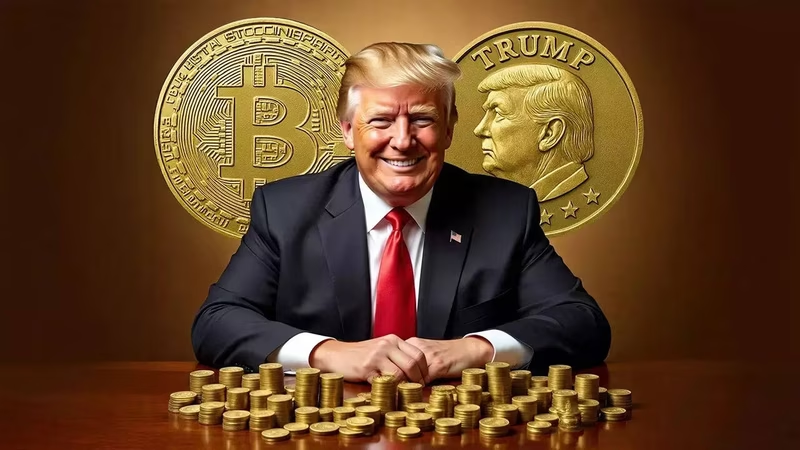
In a move that blends high-stakes geopolitics with cutting-edge fintech, Pakistan has quietly inked a strategic agreement with a company linked to World Liberty Financial—a cryptocurrency venture associated with former U.S. President Donald Trump’s family. The deal, confirmed by multiple sources this week, aims to explore the use of the firm’s proprietary stablecoin for cross-border payments, potentially reshaping how Pakistan handles remittances, trade settlements, and foreign reserves . This unexpected Pakistan crypto partnership marks a bold step for a nation long grappling with economic instability and foreign exchange shortages.
Table of Contents
- The Deal Explained: What’s on the Table?
- Who Is World Liberty Financial? The Trump Connection
- Why Pakistan Is Betting on Stablecoins
- Risks and Controversies: Geopolitical and Regulatory Red Flags
- Global Precedents: How Other Nations Are Using Stablecoins
- What This Means for Pakistan’s Economy
- Conclusion: A High-Reward Gamble in a Volatile Landscape
- Sources
The Deal Explained: What’s on the Table?
According to reports from the Times of India and Pakistani financial insiders, the State Bank of Pakistan (SBP) and relevant ministries have initiated exploratory talks with a subsidiary or affiliate of World Liberty Financial to test the feasibility of using its U.S. dollar-pegged stablecoin for international transactions . The primary focus is on facilitating faster, cheaper, and more transparent cross-border payments—especially for the $30+ billion in annual remittances sent home by overseas Pakistani workers . Unlike traditional banking corridors that can take days and charge high fees, blockchain-based stablecoins promise near-instant settlement at a fraction of the cost.
Who Is World Liberty Financial? The Trump Connection
World Liberty Financial (WLF) emerged in late 2024 as a fintech brand under the Trump Organization umbrella, though it operates independently with its own management team. While Donald Trump himself maintains no direct operational role, the venture is widely seen as part of his family’s broader push into digital assets—a space he once criticized but now embraces as a tool for “financial freedom” . WLF has launched a suite of financial products, including a payment app and a stablecoin reportedly backed 1:1 by U.S. Treasury securities. However, the firm has yet to receive formal regulatory approval from U.S. agencies like the SEC or CFTC, raising questions about its compliance framework .
Why Pakistan Is Betting on Stablecoins
Pakistan’s interest in stablecoins isn’t born out of trend-chasing—it’s a survival tactic. The country faces chronic challenges:
- Foreign Exchange Crisis: With reserves often dipping below $8 billion, Pakistan struggles to pay for essential imports like oil and medicine .
- Costly Remittance Channels: Traditional money transfer operators (MTOs) charge average fees of 6–8%, siphoning billions from low-income families .
- Slow Transaction Speeds: SWIFT-based transfers can take 2–5 business days, creating liquidity bottlenecks for businesses.
A well-regulated stablecoin system could address all three issues simultaneously—offering speed, low cost, and dollar-denominated stability without relying on volatile local currency conversion.
Risks and Controversies: Geopolitical and Regulatory Red Flags
Despite its potential, the Pakistan crypto partnership is fraught with risks:
- Regulatory Uncertainty: Neither Pakistan nor the U.S. has clear laws governing private stablecoins. The SBP has previously expressed caution about crypto, calling it a “speculative asset” .
- Geopolitical Backlash: Aligning with a Trump-affiliated entity could strain relations with the current Biden administration or international financial institutions like the IMF.
- Counterparty Risk: If WLF’s stablecoin isn’t fully reserved or audited, Pakistan could expose its financial system to collapse or fraud—a scenario seen in the TerraUSD crash of 2022 .
Global Precedents: How Other Nations Are Using Stablecoins
Pakistan wouldn’t be the first nation to experiment with private stablecoins. Nigeria’s eNaira (though a CBDC, not a private coin) and El Salvador’s Bitcoin adoption show both promise and pitfalls. More relevantly, countries like the UAE and Singapore have created regulatory sandboxes where firms like Circle (issuer of USDC) can pilot institutional stablecoin use for trade finance . These models emphasize transparency, auditability, and central bank oversight—key lessons Pakistan must heed. For a deeper dive into global crypto regulations, see our guide on [INTERNAL_LINK:how-different-countries-regulate-cryptocurrency].
What This Means for Pakistan’s Economy
If successfully implemented, this initiative could be transformative. Faster remittance inflows would boost household consumption and forex reserves. Businesses could import raw materials more efficiently, reducing production delays. Over time, it might even position Pakistan as a regional hub for blockchain-based trade in South Asia. However, success hinges entirely on robust safeguards, independent audits, and phased implementation—not political symbolism.
Conclusion: A High-Reward Gamble in a Volatile Landscape
The Pakistan crypto partnership with a Trump-linked firm is undeniably audacious. It reflects a government desperate for innovative solutions amid economic turmoil—but also one walking a tightrope between opportunity and exposure. The world will be watching closely: if Pakistan can navigate the regulatory, technical, and geopolitical minefields, it may pioneer a new model for emerging economies. If it stumbles, the fallout could set back its digital finance ambitions for years.
Sources
- Times of India: Pakistan ties up with crypto business of Donald Trump’s family
- State Bank of Pakistan: Official Website
- World Bank: Pakistan Economic Overview
- International Monetary Fund (IMF): Pakistan Country Page
- U.S. Securities and Exchange Commission (SEC): Crypto Asset Regulation Updates