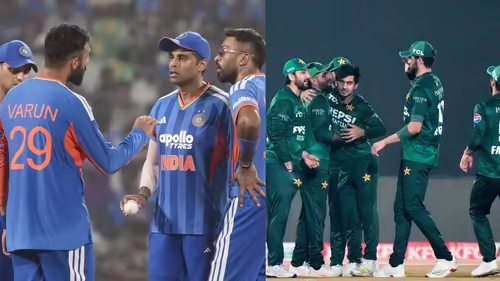
Pakistan Boycotts India T20 World Cup 2026 Match: A Historic Standoff
The most anticipated fixture in international cricket has just been thrown into chaos. The Government of Pakistan has officially confirmed that the national cricket team will boycott the India T20 World Cup 2026 match scheduled for February 15th in Colombo, Sri Lanka. This unprecedented decision, announced without a specific public reason, has ignited a global debate about the intersection of sports, politics, and diplomacy [[1]].
While the Pakistani team has been granted permission to participate in the rest of the tournament, the explicit statement—“the Pakistan Cricket Team shall not take the field in the match scheduled on 15th February 2026 against India”—leaves no room for ambiguity [[3]].
Table of Contents
- The Official Announcement and Its Implications
- What Does This Mean for the ICC and the Tournament?
- The History of the India-Pakistan Cricket Rivalry
- Why Would Pakistan Boycott the Match? Political Context
- Conclusion: A Sad Day for Cricket Fans Worldwide
- Sources
The Official Announcement and Its Implications
The announcement came as a bombshell on a quiet Sunday. The Pakistani government’s statement was clear and direct, confirming a full-scale boycott of the single fixture while allowing the team to compete in all other matches of the 2026 ICC Men’s T20 World Cup [[2]]. This creates a unique and complex scenario for the International Cricket Council (ICC).
The match is officially scheduled for February 15, 2026, at the R. Premadasa Stadium in Colombo, with a start time of 7:00 PM IST [[11]]. With this boycott, the ICC now faces a logistical and disciplinary nightmare. Historically, such a refusal to play has resulted in severe consequences, including forfeiture of the match, hefty financial penalties, and even potential suspension from future tournaments [[9]].
What Does This Mean for the ICC and the Tournament?
The ICC, which has always strived to keep politics out of sport, is now in an impossible position. Their official playing conditions are unambiguous: any team that refuses to play a scheduled match forfeits the game and is subject to sanctions.
For fans who have already booked travel and accommodations for this marquee event, the disappointment is immense. The India-Pakistan clash is consistently the highest-rated and most-watched cricket match globally, often breaking viewership records [[INTERNAL_LINK:most-watched-sporting-events]].
Here’s a quick look at the potential outcomes:
- Match Forfeiture: India would be awarded a win by default, impacting the group stage standings.
- Financial Penalties: Pakistan Cricket Board (PCB) could face multi-million dollar fines from the ICC.
- Reputational Damage: Both the PCB and the ICC’s credibility in managing a global event could be severely damaged.
The History of the India-Pakistan Cricket Rivalry
To understand the magnitude of this decision, one must appreciate the deep history of this rivalry. Since their first meeting in a World Cup in 1992, India and Pakistan have faced off 16 times in ICC tournaments, with India winning a staggering 15 of those encounters [[22]].
This isn’t just a game; it’s a cultural event that transcends sport. From the inaugural T20 World Cup final in 2007, where India triumphed over Pakistan, to the nerve-wracking encounters in the Champions Trophy and ODI World Cups, these matches are etched in the memories of millions [[26]]. The intense passion and national pride on display make every ball bowled a matter of high stakes.
Why Would Pakistan Boycott the Match? Political Context
While the official statement provided no explicit reason, experts point to the broader geopolitical climate. Recent reports suggest the decision may be linked to a separate issue involving Bangladesh’s participation in the tournament, which was scheduled to host some matches in India [[9]]. This move appears to be a form of political protest, using the global platform of cricket to send a message.
This is not the first time politics has seeped into this fixture. Over the decades, bilateral series between the two nations have been frequently canceled or moved to neutral venues due to diplomatic tensions. However, a boycott of an ICC-organized global event is a significant escalation, setting a dangerous precedent for the future of international sports.
Conclusion: A Sad Day for Cricket Fans Worldwide
The decision for Pakistan to boycott the India T20 World Cup 2026 match is a profound loss for the sport. It replaces the thrilling uncertainty of a live contest with the cold certainty of a political statement. While nations have the right to their foreign policy, using a beloved sporting event as a pawn diminishes the spirit of competition that fans cherish. As the ICC scrambles to respond, one thing is certain: February 15th, 2026, will be remembered not for a great game of cricket, but for the game that never was.
Sources
- Times of India: Pakistan to boycott February 15 T20 World Cup match against India
- ESPNCricinfo: Pakistan to boycott T20 World Cup group match against India
- ICC: Official Match Schedule for India vs Pakistan, 2026
- Wikipedia: India–Pakistan cricket rivalry
- NDTV Sports: Pakistan To Face Financial Penalties For Boycotting T20 World Cup Game