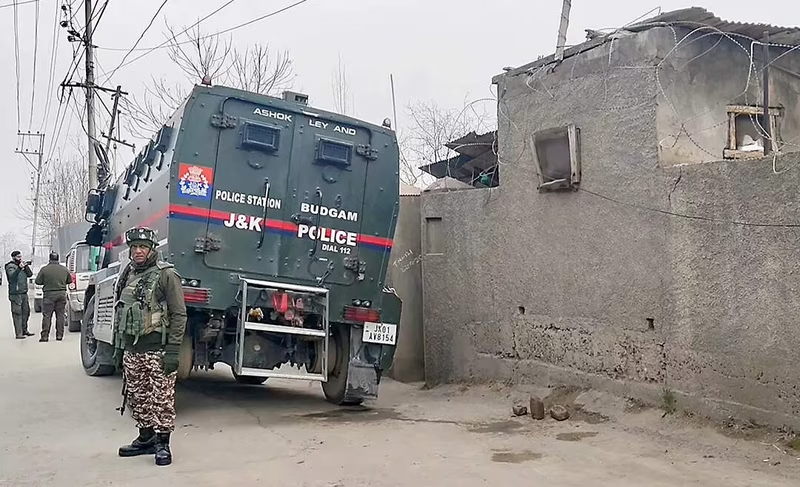
The serene fields of Poonch have become the latest battleground in India’s war against terror financing. In a move that sends a powerful message across the border, the Jammu and Kashmir Police have attached a piece of agricultural land worth Rs 10 lakh belonging to Pakistan-based terror handler Rafiq Nai, also known as Sultan . This isn’t just a routine administrative action; it’s a calculated, strategic strike aimed at the very heart of cross-border terror operations.
Table of Contents
- Who is Rafiq Nai? The Pakistani Handler Behind the Land
- The Strategy Behind the Pakistan-Based Terror Handler Property Attachment
- How J&K Police Are Dismantling Terror Support Networks
- A Growing Trend of Financial Disruption in Jammu and Kashmir
- The Legal Hammer: Unlawful Activities (Prevention) Act (UAPA)
- Conclusion: Choking the Lifelines of Terror
- Sources
Who is Rafiq Nai? The Pakistani Handler Behind the Land
Rafiq Nai is no ordinary name on a land deed. He is identified as a launch commander for two of the most notorious and banned terrorist outfits operating in the region: Tehreek-ul-Mujahideen (TuM) and the Jammu Kashmir Ghaznavi Force . These groups, which draw their cadres from other major terrorist organizations like Lashkar-e-Taiba and Jaish-e-Mohammed, have a singular, dangerous agenda: the secession of Jammu and Kashmir from India [[1], [7]].
From his base in Pakistan, Nai is accused of orchestrating a complex web of illicit activities. His portfolio includes the supervision of narcotics and weapons smuggling operations and the facilitation of terrorist infiltration across the Line of Control (LoC) . His land in Poonch is a stark symbol of his deep-rooted connections to the region he seeks to destabilize from afar.
The Strategy Behind the Pakistan-Based Terror Handler Property Attachment
The attachment of this property is a textbook example of a modern counter-terrorism strategy: targeting the financial ecosystem that sustains violence. For too long, the focus was solely on neutralizing active terrorists on the ground. While crucial, this approach often failed to address the root cause—the money and logistical support flowing from across the border .
By seizing the assets of a Pakistan-based terror handler, the authorities are sending a clear, three-pronged message:
- Deterrence: To other handlers and their local sympathizers that their assets in India are not safe and can be legally confiscated.
- Disruption: To cut off a potential source of funding that could be used to purchase weapons, pay operatives, or finance logistics for future attacks.
- Accountability: To demonstrate that even those who operate from the safety of a foreign nation will face consequences for their actions on Indian soil .
How J&K Police Are Dismantling Terror Support Networks
This action in Poonch is not an isolated incident. It is part of a wider, intensified crackdown across Jammu and Kashmir. The police have been systematically identifying and attaching properties linked to terror funding.
For instance, in a similar operation, Srinagar police attached a property worth a staggering ₹1.5 crore under the UAPA, alleging its direct links to the proceeds of terrorist activities . In another case, Kishtwar police attached the properties of seven absconding terrorists, reaffirming their commitment to dismantling the entire terror ecosystem . This strategy of “choking the purse strings” is proving to be a highly effective complementary tactic to traditional ground operations .
A Growing Trend of Financial Disruption in Jammu and Kashmir
The trend of property seizures is accelerating. Authorities have already seized over 200 properties across Kashmir, worth crores of rupees, all classified as “proceeds of terrorism” . The National Investigation Agency (NIA) and the Enforcement Directorate (ED) have also identified around 30 more properties linked to terror financing, indicating a coordinated, multi-agency effort .
This comprehensive approach targets every node of the terror network, from the handlers in Pakistan to their local financiers and sympathizers. It’s a recognition that to win the war on terror, you must also win the war on its financing.
The Legal Hammer: Unlawful Activities (Prevention) Act (UAPA)
The legal backbone of these property attachments is the stringent Unlawful Activities (Prevention) Act (UAPA). This law empowers authorities to designate individuals and organizations as “terrorists” or “terrorist organizations” and to seize their properties if they are found to be proceeds of, or used for, terrorist activities .
The Ministry of Home Affairs recently designated the Jammu and Kashmir Ghaznavi Force as a terrorist organization under this very act, providing the necessary legal framework for actions like the one taken in Poonch . This legal clarity is essential for ensuring that these actions are not just symbolic but are enforceable and sustainable in a court of law.
For a deeper understanding of how legal frameworks are used in national security, check out our analysis on [INTERNAL_LINK:uapa-impact-on-national-security].
Conclusion: Choking the Lifelines of Terror
The attachment of the land belonging to Pakistan-based terror handler Rafiq Nai in Poonch is a small but significant victory. It represents a shift from a purely reactive security posture to a proactive, multi-dimensional strategy that targets the economic and logistical infrastructure of terrorism. By relentlessly pursuing these financial trails and legally dismantling the support networks, the J&K Police are not just seizing land—they are reclaiming a future of peace and stability for the region.
Sources
- Times of India: Pak-based terror handler’s property in Poonch attached
- Ministry of Home Affairs: Designation of Jammu and Kashmir Ghaznavi Force as a Terrorist Organisation
- Institute for Defence Studies and Analyses: Terror Financing and Support Structures in Jammu & Kashmir
- Hindustan Times: J&K Police attach property of Pak-based terror handler in Poonch