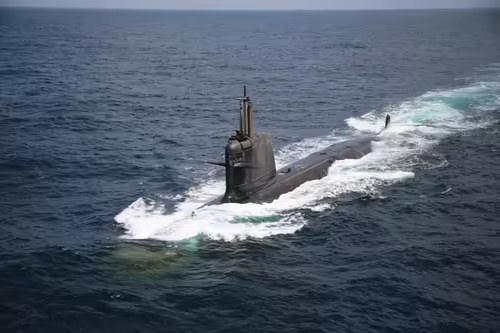
For over a decade, Project P75I has been the holy grail of India’s naval modernization efforts—a quest to build a new fleet of six state-of-the-art, conventionally-powered attack submarines. Now, it appears the long wait is finally over. India and Germany are in the final stages of negotiations for an $8 billion deal that could be signed by the end of March 2026, marking a pivotal moment for the Indian Navy and the nation’s strategic autonomy [[1]].
This isn’t just another defense contract. The P75I submarine deal represents a massive leap in India’s indigenous defense manufacturing ambitions under the ‘Make in India’ initiative and a significant shift in its geopolitical alignment. With China’s growing naval presence in the Indian Ocean, the urgency for a potent, stealthy, and lethal underwater force has never been greater.
Table of Contents
- What is the P75I Project?
- Why Germany Won the Race
- The Strategic Impact on the Indian Navy
- Make in India and Technology Transfer
- Geopolitical Implications
- Conclusion: A New Era for India’s Underwater Warfare
- Sources
What is the P75I Project?
Project P75I is the Indian Navy’s ambitious program to acquire six diesel-electric attack submarines equipped with Air-Independent Propulsion (AIP) systems. This technology allows them to stay submerged for weeks without surfacing, making them far more stealthy and dangerous than conventional subs [[2]].
The project is the logical successor to the P75 program, which delivered the first batch of six Scorpène-class submarines (including the INS Kalvari and INS Vela) built by Mazagon Dock Shipbuilders Limited (MDL) in collaboration with France’s Naval Group. However, P75I was designed to be a much more complex and capable platform, demanding a higher level of indigenous content and cutting-edge technology.
Initially, five global contenders were in the running: France (Naval Group), Germany (ThyssenKrupp Marine Systems), Russia (Rubin Design Bureau), Spain (Navantia), and South Korea (Daewoo). After a rigorous technical evaluation, the field was narrowed down to two finalists: Germany’s Type 214 and France’s upgraded Scorpène design [[3]].
Why Germany Won the Race
While France had the advantage of an existing partnership through the P75 project, Germany’s ThyssenKrupp Marine Systems (TKMS) appears to have clinched the deal with its proven Type 214 submarine. Several key factors likely tipped the scales in Germany’s favor:
- Proven AIP System: The Type 214 uses a highly reliable and efficient fuel-cell-based AIP system, which has been successfully deployed by navies in South Korea, Greece, and Portugal. This offered a lower-risk, off-the-shelf solution compared to developing a new AIP system from scratch.
- Strong Make in India Commitment: TKMS reportedly offered an unprecedented level of technology transfer and a robust plan for local manufacturing, aligning perfectly with the Indian government’s strategic goals [[4]].
- Geopolitical Neutrality: In an era of complex global alliances, partnering with Germany—a strong European ally but not a primary player in the US-China rivalry—offers India a degree of strategic flexibility.
The Strategic Impact on the Indian Navy
The induction of six new P75I submarines will be a transformative event for the Indian Navy. Currently, its submarine fleet is aging and numerically insufficient to effectively patrol the vast expanse of the Indian Ocean Region (IOR). The new boats will provide a massive boost in several critical areas:
- Deterrence: A modern, stealthy submarine fleet is the ultimate deterrent against any adversary contemplating hostile action in India’s maritime backyard.
- Anti-Access/Area Denial (A2/AD): These submarines can effectively deny freedom of movement to enemy fleets, particularly in crucial chokepoints like the Malacca Strait.
- Intelligence, Surveillance, and Reconnaissance (ISR): Their ability to operate covertly for extended periods makes them invaluable for gathering intelligence on naval movements.
Make in India and Technology Transfer
Perhaps the most significant aspect of the P75I submarine deal is its alignment with the ‘Make in India’ vision. The project mandates a high level of indigenous content, estimated to be around 60% or more. This means the submarines will be built in India, at either MDL in Mumbai or Garden Reach Shipbuilders & Engineers (GRSE) in Kolkata, creating thousands of high-skilled jobs and building a domestic ecosystem for advanced submarine construction [[5]].
The promised technology transfer from TKMS is equally crucial. It will not only enable the construction of these six boats but also lay the foundation for India to design and build its own future submarine classes, moving from a buyer to a builder in the elite club of submarine nations.
Geopolitical Implications
This deal is more than a commercial transaction; it’s a strategic statement. By choosing Germany, India is diversifying its defense partnerships beyond its traditional suppliers, Russia and France. It signals a deepening of the Indo-German strategic relationship and strengthens the broader framework of cooperation among democratic nations in the Indo-Pacific, often referred to as the ‘Quad Plus’ concept [[6]].
For China, this development is a clear signal that India is serious about countering its influence in the IOR. A potent German-designed submarine fleet operating from Indian bases will significantly complicate Beijing’s naval calculations in the region.
Conclusion: A New Era for India’s Underwater Warfare
The impending $8 billion P75I submarine deal with Germany is a watershed moment for India’s defense preparedness. It promises to deliver a world-class, stealthy, and lethal underwater force that will serve as the backbone of the Indian Navy’s deterrence strategy for decades to come. More importantly, by embedding advanced manufacturing and technology within India, the project is a giant leap toward true self-reliance in defense. If the deal is finalized as expected by March-end, it will mark the beginning of a new, more assertive chapter in India’s maritime history.
Sources
[INTERNAL_LINK:indian-navy-modernization-plan-2026]
[INTERNAL_LINK:make-in-india-defense-success-stories]
Times of India: India, Germany close to signing $8 bn P75I submarine deal [[1]]
Janes Defence: India P75I submarine programme [[2]]
thyssenkrupp Marine Systems: Type 214 Submarine [[4]]
Mint: India, Germany in final stage of $8 billion submarine deal [[5]]