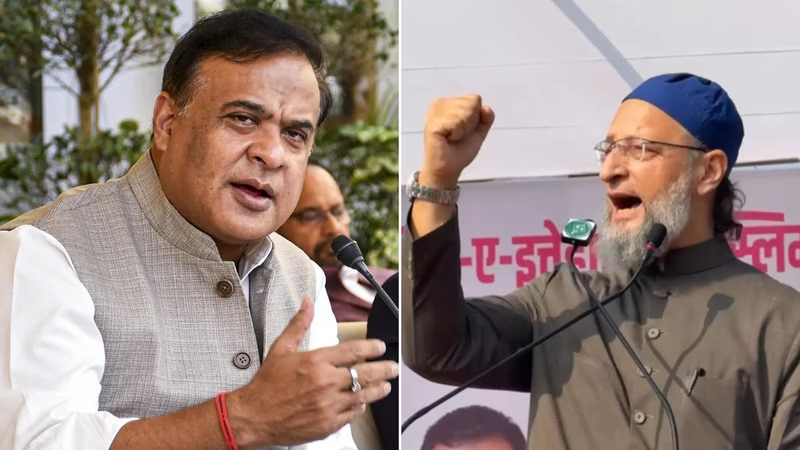
The political temperature in India has soared following a sharp exchange between All India Majlis-e-Ittehadul Muslimeen (AIMIM) chief Asaduddin Owaisi and Assam Chief Minister Himanta Biswa Sarma. At the heart of this storm is a provocative yet constitutionally grounded statement by Owaisi: his dream of a day when a hijab-clad PM will lead the nation. This remark, and Himanta’s subsequent response that “only a Hindu” can be India’s Prime Minister, have laid bare deep fissures in the country’s political discourse on secularism and identity.
Table of Contents
- The Spark: Owaisi’s Dream and Himanta’s Rebuttal
- Constitutional Truth: Can Any Indian Become PM?
- The Political Backlash: Accusations of Appeasement
- Beyond the Rhetoric: What This Debate Reveals
- Conclusion: A Nation at a Crossroads
- Sources
The Spark: Owaisi’s Dream and Himanta’s Rebuttal
The controversy began when Asaduddin Owaisi, speaking at an event in Nagpur, articulated a powerful vision for India’s future. “It is my dream that a day will come when a hijab-clad daughter will become the Prime Minister of this country,” he declared . This statement was a direct assertion of the inclusive promise of the Indian Constitution, positioning India in stark contrast to its neighbor, Pakistan.
In response, Assam CM Himanta Biswa Sarma offered a counter-view that many found exclusionary. He stated, “India’s PM will always be a Hindu,” framing it as a reflection of the country’s demographic reality . Owaisi, known for his sharp tongue, didn’t hold back. He retorted that Himanta must have “a tubelight in his mind” and accused him of harbouring a “Pakistan-like mindset”—a potent charge given the historical context .
Constitutional Truth: Can Any Indian Become PM?
While the political barbs fly, the bedrock of this debate lies in the text of the Indian Constitution itself. Contrary to popular belief, the Constitution does not specify any religious qualification for the office of the Prime Minister.
The Prime Minister, as the head of the Council of Ministers, must be a member of either house of Parliament. The qualifications to become a Member of Parliament are outlined in the Constitution and are based solely on citizenship, age, and voter registration in any parliamentary constituency. There is no mention of religion, caste, or gender.
For context, the qualifications for the highest constitutional post, the President of India, are detailed in Article 58. It states a candidate must be a citizen of India and at least 35 years old . Notably, even for this ceremonial head of state, faith is not a criterion. This constitutional silence on religion is a deliberate and powerful affirmation of India’s secular character, a principle enshrined in the Preamble.
Owaisi’s argument hinges on this very point: that the Indian state, by design, is open to all its citizens, regardless of their personal faith. His vision of a hijab-clad PM is not just a political statement but a test of whether India’s foundational secular promise holds true in practice.
The Political Backlash: Accusations of Appeasement
Owaisi’s comments predictably triggered a fierce backlash from across the political spectrum, particularly from the ruling BJP. The party framed his remarks as “irresponsible” and an attempt to create fear and division among communities .
Several BJP leaders launched scathing attacks:
- Nitesh Rane dismissed Owaisi’s statement, saying, “Barking dogs never bite,” and accused him of trying to polarize society .
- Anil Bonde criticized Owaisi for offering ‘half-truths,’ claiming that women do not desire subjugation, attempting to link the hijab to oppression .
- Former MP Sanjay Nirupam offered a more nuanced but equally dismissive take, stating, “A hijab-wearing woman may certainly become a Prime Minister, but not of India. She could become the PM of some other country” .
This wave of criticism underscores a recurring theme in Indian politics: any assertion of Muslim identity in the public sphere is often met with accusations of minority appeasement or separatism. The debate quickly shifted from a discussion on constitutional rights to a defensive posture about national identity.
Beyond the Rhetoric: What This Debate Reveals
This entire episode is far more than a war of words between two politicians. It serves as a critical litmus test for contemporary India.
On one side, we have a vision of India as a pluralistic democracy where a citizen’s potential is not limited by their faith—a nation where a woman in a hijab can aspire to the highest office, just as a Sikh, a Christian, or a Parsi can. This is the India promised by its founding fathers and codified in its Constitution.
On the other side, we see a narrative that defines national leadership through a majoritarian lens, where the identity of the leader is seen as synonymous with the identity of the majority population. Himanta’s remark, while perhaps reflecting a political reality, stands in tension with the constitutional ideal.
The intensity of the backlash against Owaisi’s simple statement reveals the deep anxieties and contested nature of secularism in modern India. It forces us to ask: Is India a nation for all its citizens, or is it a nation primarily for its Hindu majority? The answer to this question will shape the country’s future for generations to come.
Conclusion: A Nation at a Crossroads
The row between Owaisi and Himanta over the possibility of a hijab-clad PM is a microcosm of a much larger national conversation. It’s a battle between constitutional morality and political expediency, between an inclusive civic nationalism and an exclusive cultural nationalism. While the immediate political noise will fade, the fundamental questions it raises about equality, representation, and the soul of the Indian republic will persist. For a nation that prides itself on its diversity, the ability to imagine a leader from any community is not just a dream; it’s a necessity for its democratic health.
Sources
- Times of India: ‘A tubelight in his mind’: Owaisi hits back at Himanta over ‘only Hindu PM’ remark
- Government of India: The Constitution of India – Part V: The Executive
- Various news reports from PTI, ANI, and other outlets as cited in the web search results [[1]-.