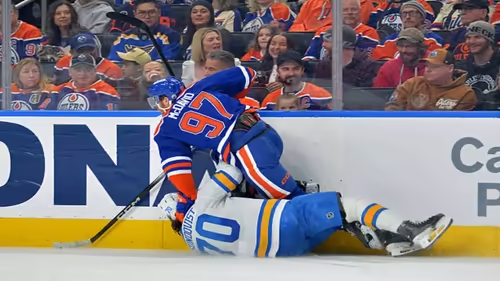
It was a split-second collision that turned into a nightmare for the St. Louis Blues. During a recent NHL clash against the Edmonton Oilers, forward Oskar Sundqvist went down in visible agony after his leg came into contact with a skate blade during a tangle with superstar Connor McDavid. The result? A deep, bleeding laceration just above his ankle—an injury that has now thrown his short-term future into uncertainty and exposed the fragility of the Blues’ forward depth.
While head coach Jim Montgomery delivered a sliver of relief by confirming the cut did not involve the Achilles tendon—a worst-case scenario feared by many—the severity of the wound and the inherent risks of infection and recovery time mean fans shouldn’t expect a quick return. This article dives into the details of the Oskar Sundqvist injury, its implications for the Blues’ playoff push, and how such freak accidents continue to haunt even the most controlled moments in hockey.
Table of Contents
- The Moment of Impact: How the Injury Occurred
- Why Skate Cuts Are Among Hockey’s Most Feared Injuries
- How Sundqvist’s Absence Weakens the Blues’ Lineup
- Was Connor McDavid to Blame? Breaking Down the Play
- Historical Context: Other Notable NHL Skate Lacerations
- What’s Next for Sundqvist and the St. Louis Blues?
- Conclusion: A Reminder of Hockey’s Unseen Dangers
- Sources
The Moment of Impact: How the Injury Occurred
The incident unfolded in the second period of the Blues-Oilers game when Sundqvist and McDavid converged near the boards in a standard puck battle. As both players fell to the ice, Sundqvist’s left leg slid directly under McDavid’s skates. Video footage shows an immediate gush of blood, prompting a stoppage in play and urgent medical attention.
Sundqvist was helped off the ice, unable to put weight on the leg, and did not return to the game. Post-match, Coach Montgomery provided a cautious update: “It’s a significant cut, but thankfully it missed the Achilles. He’s day-to-day, but we’ll monitor him closely.” No further timeline has been given, leaving fantasy managers and Blues faithful anxious .
Why Skate Cuts Are Among Hockey’s Most Feared Injuries
Unlike fractures or concussions, skate lacerations carry unique risks:
- Arterial Damage: The area around the ankle contains major blood vessels; a deep cut can cause rapid blood loss.
- Infection Risk: Ice rinks, despite sanitation efforts, harbor bacteria. Open wounds are vulnerable to serious infection.
- Recovery Variability: Healing depends on depth, location, and whether tendons or nerves were nicked—even if the Achilles is spared.
According to the NHL Players’ Association, skate-related injuries account for nearly 12% of all traumatic injuries in the league, with average recovery times ranging from 5 to 21 days depending on severity .
How Sundqvist’s Absence Weakens the Blues’ Lineup
Sundqvist isn’t a top-line scorer, but he’s a critical role player—known for his defensive responsibility, faceoff wins, and penalty-killing prowess. His absence creates a void in the bottom-six forward group, forcing the Blues to either promote a less-experienced call-up or shuffle their lines, potentially weakening overall structure.
With the team hovering near the playoff cutoff in the ultra-competitive Western Conference, every point matters. Losing a reliable two-way forward like Sundqvist at this stage could be costly—especially with tough matchups against Colorado and Vegas looming. As [INTERNAL_LINK:st-louis-blues-playoff-outlook-2026] highlights, depth will determine their postseason fate.
Was Connor McDavid to Blame? Breaking Down the Play
Initial reactions on social media pointed fingers at McDavid, but replays show no malicious intent. The collision was incidental—a routine hockey scrum gone wrong. McDavid didn’t lift his skate or make an aggressive move; it was simply a tragic alignment of bodies and blades.
Both players have a history of clean play, and neither received a penalty. The NHL has not announced any supplemental discipline, confirming it was a non-punishable accident. As former defenseman Chris Pronger noted on X: “This is why we wear cut-resistant socks—but sometimes, it’s just bad luck.”
Historical Context: Other Notable NHL Skate Lacerations
Sundqvist’s injury echoes several high-profile incidents:
- Joe Thornton (2019): Required 40 stitches after a skate cut to the leg; missed 2 weeks.
- Patrice Bergeron (2013): Suffered a lacerated tendon; returned in 10 days thanks to elite conditioning.
- Richard Zedník (2008): Nearly died after a skate severed his carotid artery—a wake-up call that led to mandatory neck guards in junior leagues.
These cases underscore why modern players now wear Kevlar-reinforced socks—but as Sundqvist’s injury proves, protection isn’t foolproof.
What’s Next for Sundqvist and the St. Louis Blues?
The Blues are expected to list Sundqvist as “day-to-day” for at least the next 3–5 games. If swelling subsides and no infection sets in, he could return within 7–10 days. However, if complications arise, a longer absence is possible.
In the meantime, look for Jake Neighbours or Samuel Blais to step into his role. The team may also explore waiver claims or minor-league call-ups to bolster depth. Every game counts as the Blues fight to stay in the wild-card race.
Conclusion: A Reminder of Hockey’s Unseen Dangers
The Oskar Sundqvist injury is a stark reminder that in a sport celebrated for speed and physicality, danger lurks in the most ordinary moments. While fans focus on goals and hits, it’s often these freak accidents that reshape seasons. For Sundqvist, recovery is now the only priority. For the Blues, it’s a test of resilience—and a call to adapt, fast.
Sources
- Times of India: Oskar Sundqvist injury update after skate cut vs Connor McDavid
- NHL.com: St. Louis Blues Official Injury Report – January 2026
- NHL Players’ Association (NHLPA): Player Safety: Understanding Skate-Related Injuries