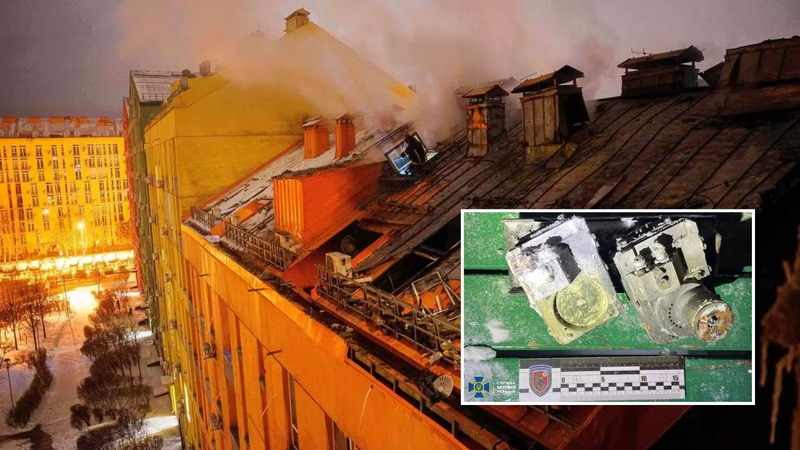
The fog of war just got a little clearer—and far more terrifying. In a move that signals a major escalation in its campaign against Ukraine, Russia has unleashed its most advanced weapon yet: the Oreshnik missile strike. Now, for the first time, the world can see the physical evidence of this fearsome new threat, as Ukrainian authorities have released stark, undeniable photos of the missile’s wreckage.
This isn’t just another barrage of rockets. The Oreshnik represents a quantum leap in Russian military technology, and its deployment marks a dangerous new chapter in the ongoing conflict. But what exactly is this weapon, and why has its use sent shockwaves through global security circles?
Table of Contents
- What is the Oreshnik Missile?
- The January 2026 Strike: A Major Escalation
- Ukraine Releases Debris: Evidence of a New Threat
- Why Does the Oreshnik Matter for the Future of the War?
- Conclusion: A Dangerous New Chapter
- Sources
What is the Oreshnik Missile?
Often described as an intermediate-range ballistic missile (IRBM), the Oreshnik is Russia’s latest addition to its strategic arsenal. Its name, which translates to “Hazel Tree,” belies its destructive potential. According to Ukrainian military intelligence, this weapon is capable of speeds exceeding Mach 10, placing it firmly in the hypersonic category .
But speed is only part of the story. The Oreshnik’s most alarming feature is its reported ability to carry multiple independently targetable reentry vehicles (MIRVs). This means a single missile can deploy up to six separate warheads, each capable of striking a different target simultaneously . This capability effectively overwhelms existing air defense systems, which are designed to track and intercept a limited number of incoming threats at once .
Furthermore, the Oreshnik is believed to be a dual-stage system with nuclear capabilities, although the recent strikes appear to have used conventional or possibly even non-explosive payloads . Its development and deployment are widely seen as a direct response to the West’s military support for Ukraine, showcasing Russia’s intent to escalate with weapons that are difficult, if not impossible, to defend against with current technology.
The January 2026 Strike: A Major Escalation
In the early hours of January 9, 2026, a series of powerful explosions rocked the western Ukrainian region of Lviv . Preliminary reports quickly pointed to a long-range ballistic missile strike, a tactic Russia has employed before, but the scale and nature of this attack were different .
It was soon confirmed: Russia had launched its new Oreshnik missile. The strike caused significant damage, including to residential buildings in Kyiv, and tragically resulted in at least four deaths and over twenty injuries . The choice of target—Lviv, a city far from the front lines and a crucial logistical hub for Western aid—was a deliberate message. It demonstrated Russia’s ability to project power deep into Ukrainian territory, threatening the very lifeline of international support that keeps Ukraine’s defenses operational .
This event wasn’t an isolated incident but a calculated act of escalation. By using its most advanced, publicly untested weapon in combat, Russia signaled its willingness to raise the stakes dramatically in its war effort .
Ukraine Releases Debris: Evidence of a New Threat
In a powerful counter-move to Russia’s show of force, Ukraine’s Security Service (SBU) has taken the extraordinary step of releasing official photographs of the Oreshnik missile’s wreckage recovered from the Lviv region . These images, showing twisted metal, guidance units, and other critical components, serve multiple strategic purposes .
First, they provide irrefutable, tangible proof of the weapon’s use, countering any potential Russian disinformation. Second, by sharing this debris with its Western allies, Ukraine is facilitating a rapid technical analysis of the missile’s design, capabilities, and potential vulnerabilities. This intelligence is invaluable for developing future defensive countermeasures .
The SBU has gone a step further, officially classifying the use of such a weapon against civilian infrastructure as a war crime . This move is a clear attempt to build a legal and diplomatic case against the Russian leadership on the international stage. The release of this evidence transforms the Oreshnik from a mere rumor into a documented, physical reality of the war .
Why Does the Oreshnik Matter for the Future of the War?
The deployment of the Oreshnik missile is a watershed moment with profound implications:
- Defense Dilemma: Current air defense systems like Patriot and S-300 are largely ineffective against hypersonic threats traveling at Mach 10+. This creates a massive gap in Ukraine’s ability to protect its cities and critical infrastructure [INTERNAL_LINK:ukraine-air-defense-systems].
- Strategic Shift: Russia can now credibly threaten targets anywhere in Ukraine with near impunity, potentially disrupting supply chains, demoralizing the population, and forcing a reallocation of scarce defensive resources.
- Global Arms Race: The successful (or even attempted) use of the Oreshnik will accelerate the global race for hypersonic weapons and defenses, as nations scramble to keep pace with this new technological frontier.
The Oreshnik strike is less about immediate tactical gains on the battlefield and more about a long-term strategic objective: to demonstrate overwhelming technological superiority and break the West’s resolve to continue supporting Ukraine.
Conclusion: A Dangerous New Chapter
The release of the Oreshnik missile debris by Ukraine is more than just a photo op; it’s a stark warning to the world. The Oreshnik missile strike represents a significant and dangerous evolution in the Russia-Ukraine war, introducing a weapon system that could fundamentally alter the balance of power. As Ukraine and its allies analyze the wreckage, the race is on to find a way to counter this new hypersonic threat before it’s used again. The conflict has entered a new, more perilous phase, and the world is watching closely.
Sources
- Institute for the Study of War. (2026, January 8). Russian Offensive Campaign Assessment, January 8, 2026.
- Associated Press. (2026, January 9). A residential building is seen damaged after a Russian strike in Kyiv.
- Security Service of Ukraine (SBU). (2026, January 9). SBU shows wreckage of Oreshnik, which Russia used to strike Lviv region – photos.
- Reuters. (2026, January 9). Factbox-What is the Oreshnik missile that Russia has fired at Ukraine?.
- BBC News. (2026, January 9). Four killed in Kyiv, as Russia uses nuclear-capable missile.